Credit: breitbart.com
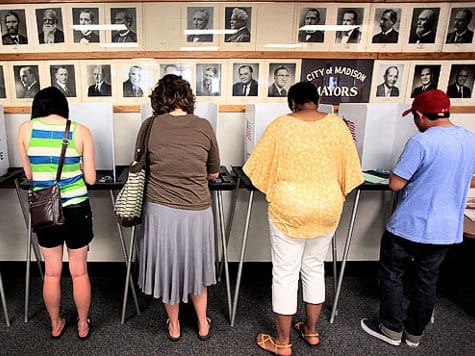
If history is any guide, this year there will be more eligible voters who refuse to cast a ballot in the presidential election than there will be who vote for the eventual winner. In the 2008 presidential election, voter turnout was as high as it had been in a generation, yet still only about 60% of eligible voters cast a ballot. In that election, just under 70 million individuals voted for Barack Obama and nearly 60 million cast a ballot for John McCain, but roughly 80 million eligible voters opted not to vote at all. Given the relative lack of enthusiasm for the Democratic and Republican party candidates, observers predict that voter turnout will once again sink into the mid-50% range in this year's elections.
Though they constitute a large subsection of the electorate, there are few regular studies of the American non-voter. The major parties often seem more likely to engage in efforts to suppress voter turnout than significantly increase it, while many polling and media organizations focus almost exclusively on registered and likely voters in their surveys of public opinion. However, a new survey by Suffolk University and USA Today may help to shed some light on the thinking of the tens of millions of Americans who opt not to vote.
“There is a huge block of Americans who are never asked their opinions because they are immediately screened out once they’ve indicated that they are not registered or unlikely to vote,” says David Paleologos, director of the Suffolk University Political Research Center, who refers to this bloc of the electorate as the “Other America”.
The nationwide survey of 800 eligible voters was conducted earlier this month. Of those polled, 44% stated that they were not likely to vote, while 52% stated that whether they would vote was basically a 50/50 toss up. Of these unlikely voters, 31% are not registered to vote, while 30% said they were registered Democrats, 17% said they were Independents and 14% said they were Republicans.
Participants offered many different reasons as to why they are not registered to vote and why they are unlikely to vote at all even if they are registered. Among those who are not registered to vote, 26% said it was because they have no time or are too busy to register, while 12% said it was because their vote won't matter, and 10% said they “just don't want to.” Those who are registered but unlikely to vote offered a similar array of reasons for their decision: 14% said they may in fact end up casting a ballot, 13% said it was their right not to vote, 12% said it was because their vote doesn't count or matter, and another 12% said it was because they don't like either major party candidate.
Interestingly, though not surprisingly, there are significant levels of support for third party alternatives to the Republicans and Democrats among unlikely voters. Just 32% of these individuals stated that the major parties do a good job of representing the American public, while 26% said that a third party is necessary and 27% said that multiple parties are necessary. Extrapolating to the population of unlikely voters, that comes out to roughly 42 million people who believe that a third party or a multiparty system is necessary in the United States. Furthermore, unlikely voters are much more likely to say they would support a third party candidate for president than likely voters. Among those not registered to vote, 23% said they would support a third party candidate over Obama or Romney, while among registered unlikely voters 18% said they would support a third party candidate over Obama or Romney.
The low opinion of the Republican and Democratic parties appears to play a major roll in turning off would-be voters from the political process: 54% said they do not pay very close attention to politics because the system is so corrupt, while 59% said that they do not pay very close attention to politics because “nothing ever gets done” and the system is based on “a bunch of empty promises.”
Given this distaste for the Democrats and Republicans combined with an openness to third party alternatives, it is no wonder that the major parties do not put much effort into increasing the rates of voter turnout. What do you think it would take to significantly increase voter participation in the United States?