STEM (Science, Technology, Engineering, Math) has been a growing movement in education. It’s part of the public debate regarding school curriculum and reform. The related fields are also a growing economic force, as STEM job opportunities continue to increase and result in higher salaries. STEM education may be the key to closing achievement gaps for low-income students.
A state-by-state analysis of future STEM demands done by Georgetown University’s Center on Education and the Workforce revealed the following:
“19 states will be at or above the national average of 92 percent in terms of the share of their STEM jobs that will require post-secondary education or training.”
Along with the educational demands of STEM jobs, more openings are to be created in the near future. This isn't a problem for graduates with a STEM field degree, but the US economy may face a limited workforce pool:
“The national report projects 2.4 million job openings in STEM through 2018; 1.1 million of these will be net new job openings, while 1.3 million will be replacement openings.”
Georgetown University mapped the percentage of jobs within each state that are in the STEM field: Credit: Georgetown University
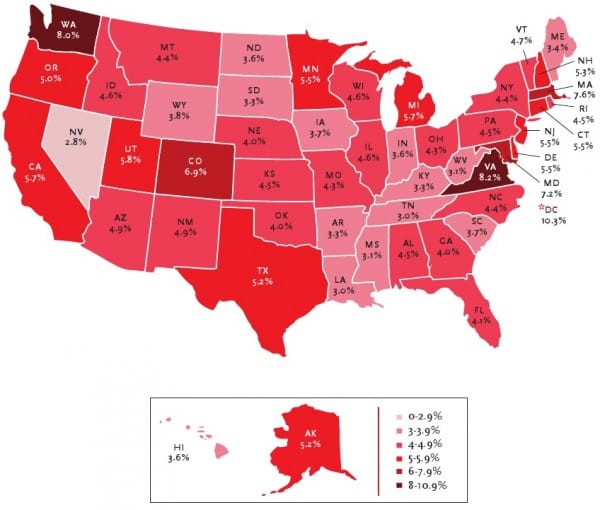
The analysis found the following information for the state of California, the world's 9th largest economy:
- California will demand a total of 1.1 million STEM jobs by 2018, up from 894,860 in 2008.
- 93 percent of these jobs will require postsecondary education and training by 2018.
- STEM jobs will be 6 percent of all jobs in California in 2018.
- This represents a 19 percent increase in STEM jobs, 2 percent points above the national average.
PBS Newshour documented the success of one STEM-focused school in the Washington D.C. area. McKinley Technology High is a public 9-12 magnet school and enrolls many low-income students. McKinley is federally funded through Title I, funds for schools who have 40-percent or more low-income students.
Change the Equation is non-profit STEM education movement and found that there are two openings for every one qualified person in the United States. PBS spoke to CEO of Change the Equation Linda Rosen and she stated:
"Students from impoverished areas generally have not met STEM professionals, do not know about STEM careers. It's generally out of the realm of their experience."
Exposure to STEM education and the possible careers in the field can serve as a motivating factor for low-income students to strive in school. STEM jobs can be a means for these students to rise from low-income status while fulfilling an economic short-coming in the US.
It appears difficult to get students on a STEM education track if one was not exposed to the field early in school. However, the concentration of STEM education can both impact achievement rates of all students and supply the economy with a substantial pool of potential employees. A challenge for closing the achievement gap through STEM is there may not be enough funds to establish schools similar to McKinley High.