Image source: The First Amendment Center.
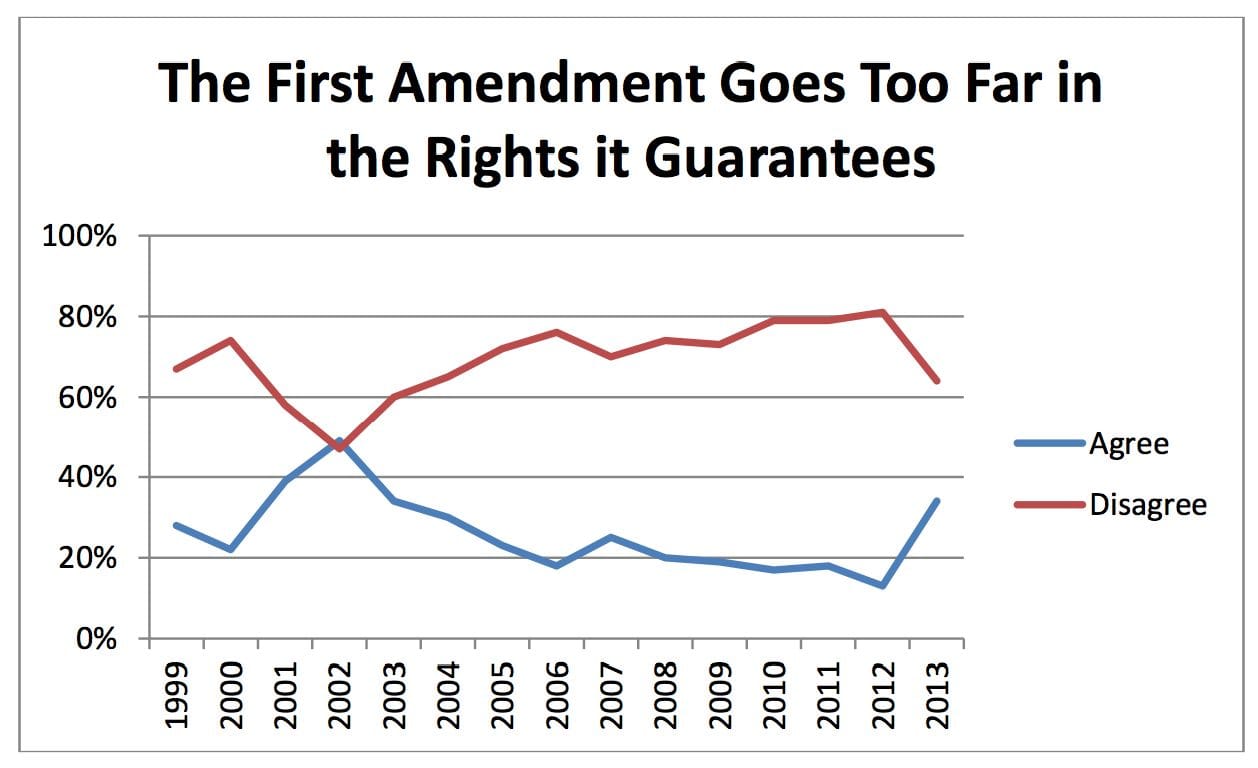
Since 1997, the First Amendment Center, a research and education foundation, has sponsored an annual survey of American public opinion on First Amendment issues. This year’s results are in. Here are some of the key takeaways, paraphrased from the report:
- The First Amendment got a lot less popular this year. The percentage of Americans who say the First Amendment goes too far in protecting rights shot up to 34%, in the largest single-year increase since the question has been asked. See the chart above.
- Young people aren’t big on free speech. Forty-seven percent of Americans ages 18-30 believe the First Amendment goes too far, compared with “44% of 31-45-year-olds, 24% of 46-60-year-olds and 23% of people over 60.”
- Whites are more supportive of the First Amendment than other racial groups. Twenty-nine percent of whites, compared with about half of African Americans and Hispanics, said the First Amendment goes too far.
- Support for religious freedom is wavering when it comes to extreme religious groups. 31% of Americans say that freedom to worship does not apply to fringe groups. This is the highest percentage recorded in the survey’s 17 year history.
- Religious freedom is on a collision course with gay rights. A strong majority of Americans agree that the government should be able to compel religious groups receiving public funds to provide health care to gay partners of employees. A slimmer majority also believes that businesses that provide wedding services should be required to serve same-sex couples, even if the owner has religious objections to same-sex marriages.
What do all these numbers mean? I don’t think there’s a single, overarching message from the survey results. So I’ll offer some tentative (and wide-ranging) interpretations.
On liberty and security: The consensus among the people who conducted the survey is that the 21 point increase in the perception that First Amendment liberties go “too far” is mostly attributable to “Americans’ increased willingness to give up their freedoms in return for greater security when they feel threatened.” The survey was conducted in May, the month after the Boston bombings.
This is a reminder that the real source of terrorism’s brutal potency is not the property it destroys or the lives it takes, but the injury we inflict on ourselves in the wake of terrorist attacks as we retreat from our own freedoms. The Bill of Rights always needs vigilant defenders, but especially so after events like the Boston bombing.
On the other hand, the predictable collapse in support for personal liberty that follows acts of terror illustrates a dilemma for civil libertarians. Thomas Friedman has argued “that if there is one more 9/11 … it could lead to the end of the open society as we know it.” An absolutist stand on civil liberties might be self-defeating if it raises the possibility of an attack taking place — though robust First Amendment liberties rarely, if ever, put our security at risk.
On demographics: A few months ago, I made the case that the American right, in a departure from historical precedent, is becoming the principal champion of the First Amendment. I based my argument on recent left-wing policy initiatives, like a new sexual speech code recently imposed by the Obama administration on all U.S. colleges and universities.
The survey provides demographic support for this observation. (See the second and third bullet points above). The groups that were most likely to think the First Amendment goes too far were two key Democratic constituencies: Young people and racial minorities. Meanwhile, older white people — essentially, the Republican base — are least likely to say that First Amendment liberties are too broad, according to the survey.
It’s been a long time since the 1960s, when Mario Savio and his liberal compatriots at UC Berkeley launched a nationwide student free speech movement. First Amendment lawyer Greg Lukianoff argued in his book, “Unlearning Liberty,” that young people have retreated from free speech because of increased instances of campus censorship, which teach students “the wrong lessons about living in a free society.”
On gay rights: As Andrew Sullivan has pointed out, Republicans are “in full-on rage in their cultural defeat” over equality for gays and lesbians. They are going down kicking and screaming. Religious institutions, especially in the South, are likely to cling to the traditionalist definition of marriage long after the rest of the country has extended marriage rights to same-sex couples. Bitter conflagrations over religious freedom are sure to ensue.
The survey results (see bullet points four and five) suggest that Americans have surprisingly little patience for churches or businesses with religious objections to gay marriage. The remaining reservoirs of tolerance are likely to evaporate as the American consensus in favor of marriage equality solidifies.
Issues of religious liberty where it collides with gay rights raise thorny questions for First Amendment supporters, who, like me, also care about equal rights for gays and lesbians. In the long run, a compromise will have to be reached. It will need to offer much more to traditionalist religious groups than the sentiment, expressed by New York Times commenter Adam Rothstein that “opponents of same-sex marriage will always retain the liberty to not enter into a same-sex marriage, which is the only religious liberty in this area they should be entitled to.” But it will also need to demand that religious employers not run roughshod over the rights of their gay and lesbian employees.
I don’t know what the eventual outcome will be in this area. It looks like the public is pretty sympathetic to Rothstein's view, suggesting that a standoff between civil rights advocates and conservative churches is on its way. And it won’t be pretty.
I invite you to follow me on Twitter or email me at jawillick at gmail dot com.