 Shawn Griffiths
The 2028 Democratic presidential primary is still years away, but the early polling is already revealing a familiar problem: A crowded field can make voter preferences look flatter, narrower, and more divided than they actually are.
A new national poll from Lake Research Partners, released by FairVote on May 20, tested a hypothetical 2028 Democratic presidential primary using ranked choice voting.
While no one has officially entered the race yet, the survey included 13 candidates who are on everyone’s radar. Lake Research Partners surveyed 800 likely Democratic primary voters.
The topline results look like the kind of horse-race numbers the media loves: Kamala Harris leads Gavin Newsom 52% to 48% in the final ranked choice simulation, which falls in the poll’s margin of error.
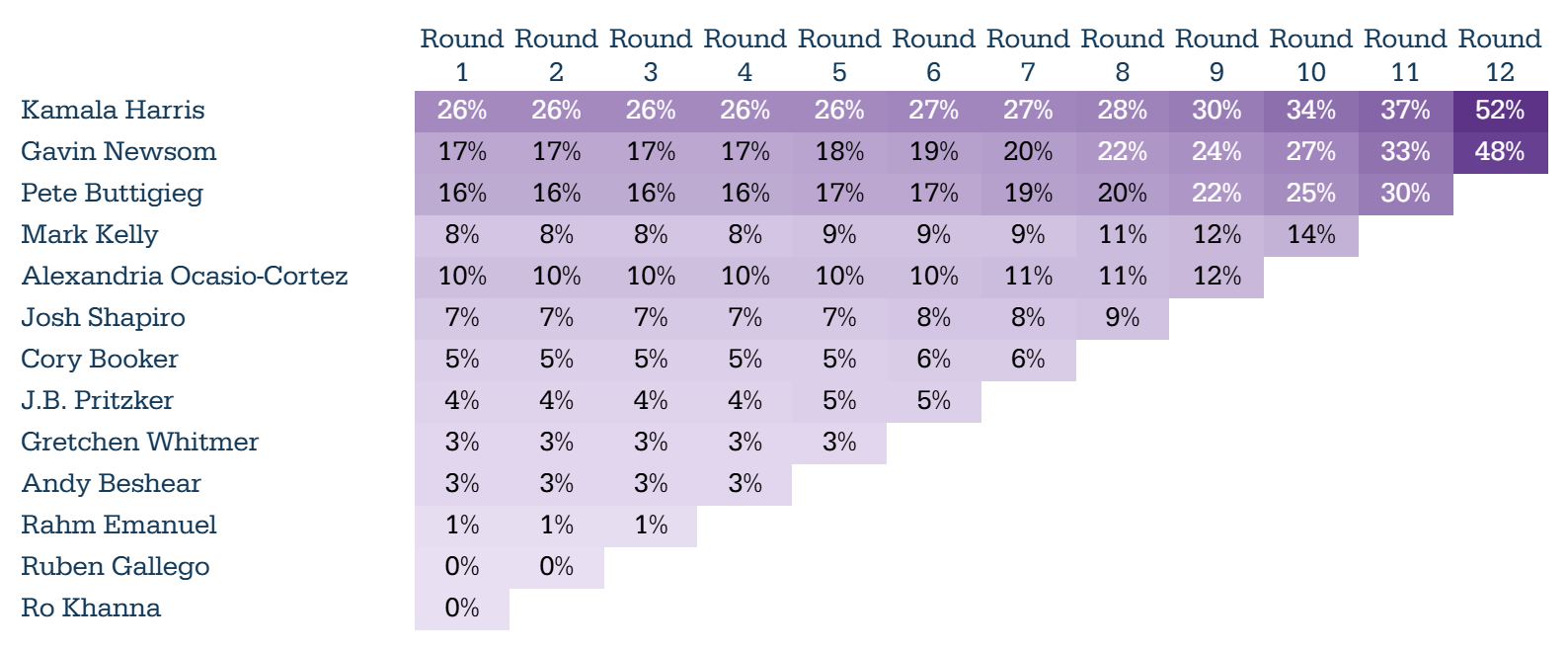
But the more important finding may be what happened before the final round.
Only 26% of respondents ranked Harris first. Newsom was the first choice of 17%. Combined, just 43% of Democratic primary voters ranked either of the top two finishers first. Yet 80% ranked Harris and/or Newsom somewhere in their top five.
This means their preferences still helped shape the final outcome.
In a traditional single-choice poll, support for lower-polling candidates is often treated like wasted or symbolic support. Voters are pressured to guess who is viable, abandon their favorite early, or vote strategically to block someone else.
Advocates of ranked choice voting assert that the reform changes that dynamic by letting voters support their first choice while still having a say if that candidate falls short. This can shape whether a nominee emerges with broad support or simply survives a fractured vote.
Simple, Fair, and Easy: Voters Used Their Rankings
The poll found that Democratic primary voters did not skip their opportunity to rank the candidates. FairVote reports that 89% of respondents ranked at least two candidates, and 69% used all five rankings available to them.
Further, support for ranked choice voting in presidential primaries started at 63%, then rose to 70% after voters had the chance to rank candidates. Just 16% opposed using RCV, while 21% were unsure.
“The poll shows that ranked choice voting is popular among Democratic voters, and a perfect tool for a crowded 2028 primary," said Celinda Lake, president of Lake Research Partners.
"It can bring unity in a divided field. It fosters competition and choice. It’s a more inclusive system, giving more voters a voice in who the party nominates. Most importantly, voters like ranked choice voting and find it easy."
The poll also found that 84% of respondents said ranking candidates was easy.
It’s an important figure to consider because one of the most common arguments against ranked choice voting is that it is too complex for voters. Yet, in poll after poll when voters can use it (from NYC to Alaska), none ever show mass confusion.
Portland’s 2024 city council elections found that RCV produced “simple and transparent dynamics” in practice and that ballot exhaustion changed outcomes in only 3 of 110 elections studied.
To clarify, an “exhausted ballot” happens when a voter’s ranked candidates have all been eliminated, leaving no next choice to count in the remaining rounds.
In this poll, Democratic primary voters were presented with a long list of potential presidential candidates, asked to rank them, and overwhelmingly reported that the process was not difficult.
The Backup Choices Matter Under RCV
FairVote’s poll also shows why ranked choice polling can reveal more than a standard first-choice survey.
Harris and Newsom were not just first-choice leaders. They were also widely acceptable backup choices. FairVote reported that 57% of respondents ranked Harris somewhere on their ballot, while 56% ranked Newsom.
The overlap between their voters was substantial but uneven: 54% of Newsom supporters also ranked Harris, while 44% of Harris supporters also ranked Newsom.
There were also distinct lanes of backup support.
Voters who ranked AOC first, for example, were more likely to rank Harris as a backup choice. Voters who ranked Pete Buttigieg, Mark Kelly, Josh Shapiro, and Corey Booker were more likely to rank Newsom as a backup.
Newsom and Buttigieg, in particular, shared a clear overlapping voter base. Each served as the most common second or third choice among voters who supported the other. Harris supporters, by contrast, were more divided – splitting among Newsom, Buttigieg, and AOC.
Imagine what this kind of information would mean for a presidential nomination process that uses ranked choice voting. Campaigns would be incentivized to compete for more than first-choice votes. They’d have to compete to be the most broadly preferred candidate.
Poll Highlights How Ranked Choice Voting Changes the Incentives
There are many names being thrown out for the 2028 presidential election cycle in both major parties. It will be the first open contest in 12 years. Most candidates won’t even announce their exploratory committees until after November.
This isn’t about Harris or Newsom having an edge. Plenty can change over the next two years, and the results of the poll were within the margin of error.
FairVote asserts that the bigger implication is that ranked choice voting changes what voters, candidates, and parties are incentivized to do.
Under a single-choice system, candidates often benefit by defining opponents as unacceptable and pressuring voters to consolidate early. Under ranked choice voting, candidates have an incentive to seek second- and third-choice support from voters who may prefer someone else.
That does not eliminate hard campaigning. It does not remove ideological differences. It does not guarantee unity. But it does reward candidates who can build broader coalitions in a fragmented field.
For independent voters and reform-minded observers, that is the part worth watching. Presidential primaries are publicly administered elections, but they are still shaped by party rules, media narratives, donor pressure, and strategic voting fears.
The more crowded the field, the more those pressures can distort voter choice.
The 2028 Democratic primary is nowhere near settled. It is not even formed. But this poll shows why the way voters are asked to choose is just as important as which candidates eventually run.