The Supreme Court Could Look Differently in Four Years

 Alex Gauthier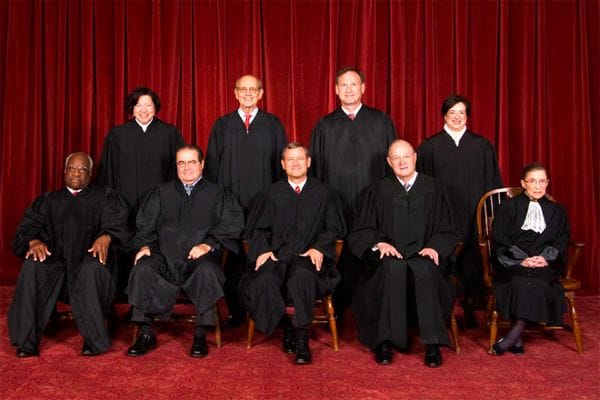
Now that Barack Obama has secured another four years in the White House, the nation's eyes are turning to the Judicial branch. The president is allowed to appoint justices to the Supreme Court in the event of a vacancy through retirement, or otherwise. The 9-member court interprets and establishes law as a federal body by judging whether or not laws or policies are constitutional.
An average term for a Supreme Court Justice is 16 years, although since 1970 average tenure is closer to 25 years. Justice Antonin Scalia has served the longest, at 26 years, and was appointed by President Ronald Reagan on September 26, 1986. Justice Ruth Bader Ginsburg is the oldest, at 79 years. Since 1970 the average retirement age for a Supreme Court Justices has been 79 years old. With almost 600 years amongst them, the average age of the court is 66. This fact makes it increasingly likely that the next four years will see one, if not two, new Supreme Court appointments. These appointments could result in dramatically different Supreme Court decisions, depending on who retires and when.
The prevailing schism that has developed in the court is between the more conservative justices, appointed by Republican presidents, and the more liberal justices, appointed by Democratic presidents.
Many previous Supreme Court decisions, including the controversial 'Citizens United' case, were decided 5 to 4 in favor of the more conservative, strict constructionist side. However, Justice Roberts, one of the more conservative justices, cast the deciding vote to uphold the constitutionality of the 'Affordable Care Act' as a tax.
As the court stands now, if either Ginsburg or Breyer were to step down, another Obama appointment would likely be for another precedent-oriented justice, similar in approach and ideology to Obama's previous two appointments, Sotomayor and Kagan. However, if Scalia or Kennedy were to step down, Supreme Court decisions could begin to look much different, with 5 to 4 decisions flipping the other way.
AgeJustice's NameAppointed By
57John G. ROBERTS, JR.George W. Bush
76Antonin SCALIARonald Reagan
76Anthony M. KENNEDYRonald Reagan
64Clarence THOMASGeorge HW Bush
79Ruth Bader GINSBURGBill Clinton
74Stephen G. BREYERBill Clinton
62Samuel A. ALITO, JR.George W. Bush
58Sonia SOTOMAYORBarack Obama
52Elena KAGANBarack Obama
You Might Also Like