
 Shawn Griffiths
The 2026 primary elections in Texas had their fair share of excitement and controversy Tuesday night. But one thing that stood out more than anything else was the turnout.
Specifically, in the Democratic primaries, which soared above the Republicans.
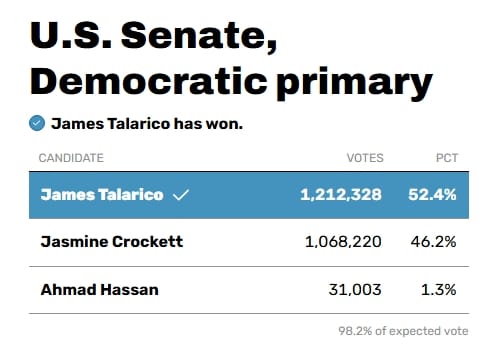
The race for US Senate received a lot of media attention – especially after Democratic candidate James Talarico was featured on Stephen Colbert’s late night show. So, naturally it attracted voters.
With 98% of precincts reporting, the turnout was over 2.31 million in the Democratic US Senate primary. To put this in perspective, the 2024 Senate primary (in which Colin Allreed became the Democratic nominee) drew in a total of 967,503 voters.
Talerico and US Rep. Jasmine Crockett each exceeded that total in votes.
On the Republican side, over 2.12 million voters cast a ballot in the US Senate race, which came down to a contest between incumbent US Sen. John Cornyn and Texas Attorney General Ken Paxton. Both will advance to a May 26 runoff election.
Turnout in the runoff is expected to be half or less of the primary election turnout.
The Democratic primary also had higher turnout for governor, lieutenant governor, and attorney general. This has not happened in a non-presidential statewide primary in Texas since the 1990s.
Democrats slightly beat out the GOP in the 2020 presidential primary, but Trump still won the state.
So, what does this mean?
- Is it an indication that there are more Democrats in Texas than the common narrative would have people believe?
- Is it a preview of what may happen in November?
- Did independent voters drive up the numbers for Democrats this time around?
- Were there Republicans who crossed over to vote in the Democratic primaries?
All of these are possibilities, though to call it a preview of what will happen in November would be premature. However, data suggests it may be a combination of the other options.
Texas conducts open partisan primaries. It does not register voters by party. Instead, they can choose between a Republican ballot and Democratic ballot each primary election cycle.
The Republican Party of Texas has sued Secretary of State Jane Nelson, a Republican, to close the state’s primary elections. Still, the current open system is the law of the land.
 Shawn Griffiths
Although the state does not officially track party membership, L2 Data – the nation’s leading independent voter data and technology firm – has used tested methodology to create voter files for every state, including Texas.
L2 draws from several datapoints to construct an analytical model of how voter registration breaks down, including races in major cities and urban areas that have a heavy concentration of eligible voters compared to rural areas.
When the Independent Voter Project (co-publisher of IVN) updated its state-by-state primary map using data from L2, the organization received a lot of feedback when the numbers showed more Democrats in Texas than Republicans.
Some people couldn’t believe it. Especially in a state controlled at every level of government by the GOP. And so, I wrote a piece explaining the source of the numbers.
The current voter file shows:
Total Registered Voters: 16,630,174
Democrats: 7,901,734 (47.51%)
Republicans: 6,217,550 (37.39%)
Unaffiliated: 2,510,890 (15.10%)
These numbers aren’t official. Again, Texas does not track party membership among registered voters. However, they are based on trusted data modeling. So, it may not be a surprise to see a shift in primary turnout going forward.
L2’s data also raises an important question: What if Texas has actually been purple this entire time? Neither major party has a majority of registered voters. There are nearly 3 million independent voters in the state.
And this is the most consequential voting bloc.
Statewide election trends show increasingly tighter statewide contests between Republicans and Democrats. US Sen Ted Cruz won re-election in 2024 with just 53% of the vote. Cornyn won re-election with the same percentage in 2020.
What if winners are not being determined by Republicans or Democrats – but independents? And what will happen when independents in Texas get excited about a candidate that doesn’t have an "R" next to their name?
In the Senate race, Talarico didn’t just campaign for Democrats. He reached out to independent voters as well. And it paid off. The last public survey on the Democratic contest showed he had a clear advantage with independents over Crockett, 62% to 35%.
Independent voters made the difference for his campaign, which could extend to the general election depending on who wins the Republican runoff between Cornyn and Paxton.
And if these voters still feel incentivized to vote for either party’s nominee.