Voter turnout in the United States: How low can you go?

 Rob Weber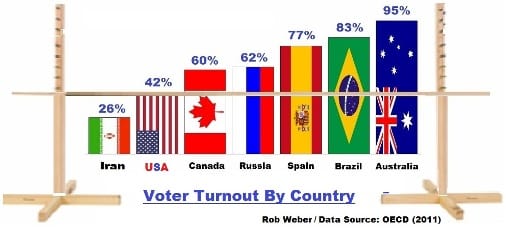
Voter turnout in America is like a limbo contest - How low can you go? We can raise the bar with Online Voting.
A consistently sad truth about U.S. elections is that most eligible voters don't vote. A few weeks ago, a Los Angeles mayoral race yielded a whopping 20% voter turnout. In my town last week, the school budget vote brought 11% of the taxpaying voters to the polls. How about your town?
The issue of low turnout should be an important one for the independent voter. When a majority of voters don't show up at the polls, there is a lack of diversity among those who do. Like young voters, independents often don't vote in midterm and local elections. The result is two different electorates: one for Presidential elections and another for all the rest. One is diverse and represented by a broad spectrum of race, class, party affiliation, and especially age. The other is not.
A common conclusion regarding turnout is to simply criticize those who don't vote, and place the blame on the individual who "doesn't care enough" to show up at the polls. This attitude is as uniquely American as low turnout itself. In the United States, registering and voting is considered to be the citizen's responsibility. The voter must jump through many hoops, including often having to wait in long lines on election day. Absentee voting can be an extremely confusing and inconvenient process for many voters, particularly those who are overseas or in the military.
A "voter's burden" system of access is not the norm in many other countries, where it is the state's responsibility to foster voter participation. In Australia, the state automatically registers all voters. In Belgium, voters can usually vote at one of many locations. They are not confined to a predefined polling place. In some countries election days are holidays.
Numerous countries are also thinking outside the ballot box and have begun to vote online. In today's digital world, it isn't necessary to turn the voter out to the polls - we can bring the polling place to the voter. France, Australia, Estonia, Sweden, Austria, Latvia, Norway, Belgium, Mexico and others have all used online voting for elections.
Canada is the most recent country to embrace online voting. After pilot programs like one in Markham, Ontario were extremely successful, the entire country has moved forward with implementation.
Online voting eliminates many of the issues that plague us, from long lines to the faulty results that paper ballots produce. Online voting can increase voter participation dramatically, especially among younger voters who do everything else online (from banking to ecommerce to filing their taxes) and should rightfully expect the same easy access to the vote. All of these benefits also come at a lower cost to the taxpayer.
Why don't we try using online voting to boost turnout here in the United States? Why indeed. The answer is that our election administration culture refuses to embrace modern voting technology. Their willingness to consider this kind of reform is as low as our turnout. Unfortunately, the people who manage and observe our elections seem to care much less about voter access than they do about maintaining the status quo of paper ballot voting.

Despite our low turnout and the failings of our paper-based election system (Remember Bush v. Gore, butterfly ballots, and hanging chads?) it is online voting that is vilified as "unsafe" and almost evil by the "election integrity" folks. I find their arguments to be lacking even common sense much less scientific validity. It is clear that what these people fear is the automation of our election process. Instead of fighting for voter access, they fight for paper ballots and hand recounts, which serve them but do not serve the voter.
It is very sad and troubling that rational public discourse about online voting barely exists in America. With the notable exception of Dr. William Kelleher, author of "Internet Voting Now", who has been fighting for voting access for years, there are few advocates. I decided to become one and started my blog in 2010.
Online voting isn't just a "cool idea for the future". It is here today and in use around the world with great success. Online voting is also more than just a tool. It represents the cause of voter participation and access. It is a cause that needs more support.
If we want to raise the turnout bar in America we must think outside the ballot box as well. We must Cyber The Vote.
You Might Also Like