

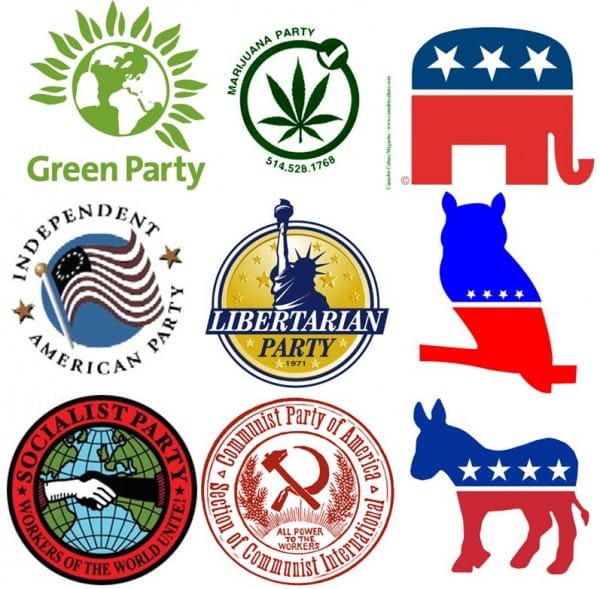
What is party affiliation? For many Americans, party affiliation undoubtedly plays a significant role in how they understand themselves with respect to our political system and contextualize their place in our political economy. For others, it functions as a core aspect of their individual self-identity, on a par with basic demographic indicators, such as ethnic background, profession, age or place of residence. And, of course, there are some for whom the notion of party affiliation or political identification plays no role whatsoever in how they make sense of their relation to the wider world.
For this reason, among many others of course, party affiliation is dynamic. Changes in a given person's party affiliation or political identification may result from the evolution of their own individual views and attitudes over time, or as a result of changes in the views and attitudes of others. An individual may cease to affiliate with a given party because he or she no longer subscribes to certain political propositions or attitudes represented by that party, or individuals may find that the party with which they have long identified no longer stands for the positions they still hold dear.
Earlier this month, the Pew Research Center published an interesting article elaborating upon how party affiliation figures in its survey methodology. Consider the high degree of volatility in short term party affiliation that Pew measured immediately before and after the 2008 presidential election, i.e. in October and November of that year. Pew reports:
“Among Republicans interviewed in October, 17% did not identify as Republicans in November. Among Democrats interviewed in October, 10% no longer identified as Democrats. Of those who declined to identify with a party in October, 18% told us they were either Democrats or Republicans when we interviewed them in November. Overall, 15% of voters gave a different answer in November than they did in October.”
Over the longer term, the most striking trend in party affiliation and political identification is the increasing number of Americans who refuse to identify with either the Republican or Democratic parties. According to Pew's annual party affiliation totals for all registered voters surveyed by the organization this year, 35% affiliate with the Democratic party, 28% affiliate with the Republican party and 33% identify themselves as Independents. Just ten years ago, Democrats and Republicans were at near parity in the mid 30% range, while Independents accounted for just 25% of those surveyed.
The trend is even more apparent when one considers the Pew's aggregate survey files. On that score, the percentages of Democrats, Republicans and Independents were in relative parity in 2002: 31% Democrat, 30% Republican and 30% Independent. The numbers are quite different today. According to Pew's aggregate totals for 2012, 38% identify themselves as Independents, while 32% affiliate with the Democratic party and 24% affiliate with the Republican party.
If current trends continue, it is only a matter of time before Independents outnumber Democrats and Republicans combined. But the question remains: as fewer and fewer Americans are willing to admit that they affiliate with either of the major parties, how much longer will it be before they are willing, as it were, to put their votes where their mouths are and cease supporting the representatives of these parties in the only poll that truly counts, on Election Day?