 Cara Brown McCormick

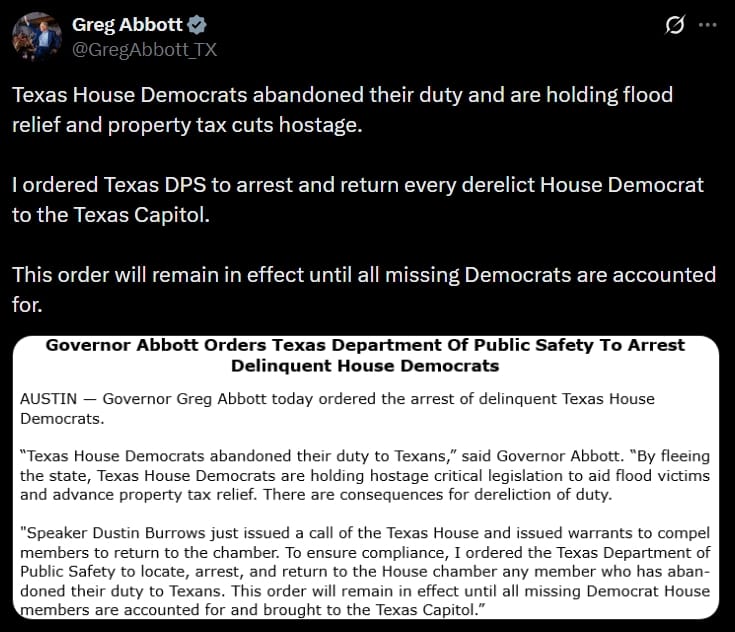
Update 8/4/2025: It was reported over the weekend that Texas House Democrats fled the state in order to break quorum. On Monday, Governor Greg Abbott issued an official statement, calling on the Texas Department of Public Safety to arrest delinquent Democrats and compel them back to the state capitol building.
AUSTIN, TEXAS - As Texas Republicans push forward with a controversial plan to redraw the state’s congressional districts, Democrats are weighing whether to deploy one of their most extreme forms of resistance: a quorum break.
The dramatic standoff in Texas bears an unmistakable resemblance to a plotline from the political drama House of Cards, where Frank Underwood orchestrates the arrest and retrieval of opposition senators to forcibly reestablish quorum in the U.S. Senate.
In the real world, Texas Attorney General Ken Paxton has openly offered to do the same, pledging to assist in “hunting down and compelling the attendance of anyone who abandons their office.”
The image of law enforcement dragging legislators back into chambers may sound fictional, but in Texas, it is a live possibility.
Privately, the Democrats’ quorum-breaking idea is gaining momentum, and so is the financial backing to make it viable.
Democrats who flee the state to block a vote would face $500 a day in fines and the threat of arrest. But according to individuals involved in current discussions, wealthy Democratic donors are already offering to cover those costs.
This financial safety net could tip the scales for lawmakers who might otherwise hesitate.
The last time Texas Democrats broke quorum was in 2021, in an attempt to stall a GOP-backed overhaul of election laws. The effort ultimately failed. Since then, Republican leaders in the Texas House passed rules banning lawmakers from using campaign funds to pay fines related to quorum breaks, a legal wrinkle Democrats now say they are prepared to work around.
A Legal and Political Test
Two sources familiar with the fundraising conversations said legal teams working with Democrats believe they have found a workaround, though they declined to offer details. One potential path, according to Rep. Jasmine Crockett of Dallas, who joined the 2021 walkout and now serves in Congress, would be for lawmakers to treat the funds as personal income, since Texas imposes few restrictions on outside earnings.
Crockett, who holds a $3.7 million campaign war chest, has indicated she would use her donor base to help pay any resulting penalties. Other House Democrats, including Rep. Greg Casar of Austin, have been actively pitching the strategy to major contributors on private calls, sources said.
Those briefed on the calls said donors appear willing to bankroll the effort. One estimate placed the cost of sustaining the protest at $1 million per month, a target that insiders say is within reach.
But Crockett suggested fines may not be enforceable at all. “I think that the first step would be to make sure that there are attorneys on deck to actually challenge the legality of these rules,” she told The Texas Tribune.
Austin-based ethics attorney Andrew Cates echoed that skepticism, saying he would be “very surprised if there were any real monetary penalties that were enforceable.”
A High-Stakes Messaging War
Democratic lawmakers say halting the Legislature, even temporarily, would buy time to educate voters and challenge the legality of the maps in court. Litigation over Texas’s 2021 maps is already underway, and Democrats argue that Republicans are using a Justice Department letter as a pretext for racially motivated gerrymandering.
The letter says four current districts are racially gerrymandered, but in court, GOP mapmakers have claimed they did not consider race. “All of a sudden, all these years later, they’re like, ‘never mind,’” Crockett said. “They really were considering race. They weren’t race neutral.”
If Democrats walk out, both sides are expected to launch major public campaigns to frame the move. Republicans are likely to accuse Democrats of dereliction, particularly with pending flood relief legislation following deadly storms in Central Texas. Democrats, for their part, argue that the move would be a legitimate effort to represent constituents who oppose the GOP’s redistricting plans.
National Money Pours In
Even without a formal decision on a quorum break, national Democratic groups are mobilizing in Texas.
The Democratic National Committee says it has activated 30,000 volunteers to pressure persuadable Republicans and independents to weigh in on redistricting. According to the DNC, the effort includes 250,000 text messages urging voters to attend field hearings and contact their state legislators.
Meanwhile, the National Democratic Redistricting Committee is planning an August fundraiser on Martha’s Vineyard featuring President Barack Obama, former House Speaker Nancy Pelosi, and the group’s chair, former Attorney General Eric Holder. Proceeds will go toward supporting Texas Democrats and funding broader NDRC operations.
While the NDRC is not directly involved in the quorum break effort, its campaign arm, the National Redistricting Action Fund, has pledged digital advertising dollars to influence public opinion in Texas.
The Democratic Congressional Campaign Committee has also committed six figures to a public opinion campaign, with plans to target vulnerable Republicans under the proposed map. And on Monday, a fund backed by the House Majority PAC announced $20 million to flip congressional seats in Texas.
Spokespeople for the DNC, DCCC, and NDRC say they have not yet formally joined the quorum break strategy, but the cash and coordination are already flowing.