 Shawn Griffiths
People Not Politicians (PNP) submitted over 305,000 signatures last week to freeze a congressional gerrymander passed by the Missouri Legislature in September. However, state officials are doing everything they can to pretend this citizen revolt isn’t happening.
“The citizens of Missouri have spoken loudly and clearly: they deserve fair maps, not partisan manipulation,” said PNP Executive Director Richard von Glahn.
Yet the partisan manipulations continue. Not only have state officials sued to block the referendum, but they are defying their own precedent to ignore citizens entirely and move forward with the gerrymandered map.
Here Is What Voters Need to Know
Article III, Section 52(a) of the Missouri Constitution states that voters have the right to challenge actions taken by the General Assembly through a veto referendum if they collect enough signatures to put it on the ballot.
Petitioners are required to get signatures from 5% of legal voters in two-thirds of the state’s congressional districts, which in 2025 means about 110,000 Missourians.
PNP started to collect petitions in mid-September after the Republican-controlled Missouri Legislature passed HB 1, a new congressional map that carves up Kansas City in an attempt to give the GOP one additional seat (which would give them 7 of the state’s 8 seats).
Republican Gov. Mike Kehoe signed HB 1 into law on September 28. After Texas and California, it fueled further escalation in a bipartisan race to the bottom that IVN News has covered extensively.
Secretary of State Denny Hoskins, also a Republican, approved PNP’s referendum petition to overturn the gerrymander on October 16, but said any signatures collected prior to October 14 would not count. By then, PNP says it had collected 100,000 signatures.
“Under Missouri law, no signatures gathered before this approval date are valid, and doing so constitutes a misdemeanor election offense,” Hoskins said.
Von Glahn asserts that this position not only deliberately deceives voters, but violates court precedent:
Secretary Hoskins is deliberately spreading misinformation for political purposes. Our campaign has gathered signatures at a historic pace — I’ve never seen Missourians unite and mobilize this quickly,” he said in October.
He also cites No Bans on Choice et al. v. Ashcroft (2022). In its decision, the state Supreme Court found that the law Hoskins claims still exists was struck down for violating citizens’ constitutional rights.
PNP’s referendum was then taken to court – not only on the subject of signatures, but Hoskins and State Attorney General Catherine L. Hanaway also sued PNP. They claimed that the anti-gerrymandering referendum violated the U.S. Constitution.
On December 8, a federal judge dismissed the case over a lack of jurisdiction.
At the same time, Cole County Circuit Judge Christopher Limbaugh heard arguments on the signature issue. On Monday, December 15, Limbaugh delayed ruling on the case until after election officials are done verifying the 305,000 signatures submitted by PNP.
PNP delivered more than 600 boxes of signatures to Hoskins. However, the secretary says HB 1 will not be suspended until he certifies the referendum for the ballot, which Von Glahn notes is another departure from established precedent.
"It is very clear in law and in practice in Missouri that upon the submission of signatures, until the Secretary of State makes a decision to either certify the initiative as sufficient or to certify the petition is insufficient, the map is frozen,” he said.
PNP points to 2017 when then-Secretary of State Jay Ashcroft suspended a “right to work” law the moment veto referendum signatures were submitted – not when Ashcroft certified the referendum for the ballot.
But Hoskins has made it clear that protecting the new map is his priority: "I’m going to do everything I can to protect Gov. (Mike) Kehoe’s Missouri First Map – the map the General Assembly passed,” he said.
The signature verification process generally takes 8-10 weeks, but state law allows election officials to drag this out until July 2026. The state could then argue it is too late to suspend HB 1 because candidates have filed and primaries have been held.
PNP has vowed additional legal action if Hoskins does not suspend HB 1.
“If the secretary of state refuses to certify the referendum or attempts to put HB1 into effect prematurely, People Not Politicians is prepared to take immediate action in state court,” the campaign states.
The organization expects the state and allied intervenors to attempt procedural delays, but remains confident that Missouri’s courts will uphold voters’ constitutional rights.”
For Reformers in Maine, This Situation Is All Too Familiar
Missouri is one of 23 states that have some form of veto referendum process. Another state that allows it is Maine, where reformers are familiar with the procedural stalling tactics lawmakers and state officials on both sides of the aisle use to circumvent the will of voters.
In 2016, Maine became the first state in the nation to adopt ranked choice voting after a majority of voters approved Question 5. Then, after a rollercoaster of a legislative process on the issue in 2017, state lawmakers passed LD 1646, which delayed RCV and set it up for repeal.
Lawmakers did this even after voters packed committee rooms, thousands of calls were made to legislative offices, and voters made it clear that they wanted their vote on RCV respected.
The Committee for Ranked Choice Voting, the same group that spearheaded the 2016 RCV campaign, launched a People’s Veto to overturn LD 1646, which was approved by voters on June 12, 2018, with a higher percentage of the vote than 2016.
Reformers, however, faced the same type of stalling tactics seen in Missouri. Not only did the legislature set RCV up for repeal, then-Secretary of State Matt Dunlap, a Democrat, tried to keep LD 1646 in place even when the People’s Veto was certified for the ballot.
In Maine, an action by the legislature being challenged by voters has to be suspended until a vote is held on the veto referendum. It took a court order to force Dunlap to implement RCV for the June 12 primary elections.
It looks like it will take a court order in Missouri to get state officials to comply with their own laws. Expect another lawsuit to be filed by People Not Politicians.
Rand Paul Says Gerrymandering Fight Could Lead to More Violence and Maryland Voters Say ‘Stay Out of It’
On NBC’s Meet the Press Sunday, U.S. Sen. Rand Paul (Kentucky) said the mid-cycle gerrymandering fight between the two major parties is going to “lead to more civil tension and possibly more violence."
“When it becomes so extreme – like if California has no Republican representatives after this is done or has one left, I think that makes people so dissatisfied, they think the electoral process isn’t working anymore. 'Maybe we have to resort to something else,'” he said.
Paul didn’t just call out Democrats in California, but both sides for escalating the situation.
These comments come at the end of a year that saw a surge of politically motivated violence and threats of violence, from the assassinations of Charlie Kirk and Democratic state legislators in Minnesota, to Indiana senators receiving death threats over refusing to gerrymander.
Paul believes mid-cycle gerrymandering adds more chaos and exacerbates a system in which people think their vote doesn’t matter – and that is a recipe for disaster.
Multiple polls show voters do not approve or like the gerrymandering that has occurred in 2025. The most recent poll this week came out of Maryland from the Institute of Politics at the University of Maryland, Baltimore County.
According to the results, 81% of Maryland respondents said redrawing electoral districts to benefit a single party is “a major” problem for American democracy. Further, only 12% of respondents supported a redistricting process in which state legislators redraw districts.
The poll comes as an advisory commission commissioned by Gov. Wes Moore voted behind closed doors to move forward with the redistricting process mid-cycle. Currently, all but one of the state’s congressional districts are held by Democrats.
Democrats in the Maryland legislature previously decided not to hold a special session to redraw its maps.
In Other Reform News…
Time Is Running Out for CA Voter ID Initiative to Hit 1 Million Signatures
With Christmas week coming up and New Years the following week, many of the reform campaigns IVN News is following are going to slow down their operations or take a break completely for the holidays.
However, Reform California’s Voter ID initiative is an exception as the group faces a self-imposed December 31 deadline to gather one million petition signatures – a tall and expensive order for any statewide initiative campaign in California.
To qualify for the ballot, close to 875,000 signatures will need to be verified. Ballot initiative campaigns always give themselves extra cushion just in case signatures cannot be verified or are disqualified, which is why Reform California is shooting for a million going into the new year.
The group’s voter ID initiative requires every voter to present a government-issued ID when voting in person or provide the last 4 digits of their ID when voting by mail – which is now most voters in the state.
“This is going to be a popular reform measure,” said California Assemblymember Carl DeMaio, who is also the chair of Reform California. “Even a majority of Democrats support it, and 72% of Latinos support it.”
Reform California announced on December 4 that it had reached 750,000 signatures, meaning it had less than a month to collect the remaining 250,000 it needed. However, the campaign also tweeted 5 days later that it needed 300,000 signatures.
No updated numbers have been provided since then.
“Californians are speaking loud and clear: they want election integrity – and they’re ready to make history to get it,” DeMaio said.
A January 2025 poll conducted by Public Opinion Strategies found that 52% of Democrats, 70% of independents, and 93% of Republicans in California support a state requirement that voters show government-issued photo ID when voting in person.
The most outspoken opponents to voter ID are Democratic leaders who say it leads to voter suppression. Republican leaders say voter ID protects elections from fraud. But research shows both parties are wrong.
Election fraud in general is considered so rare in the U.S. that statistically it doesn’t exist (and this is using data compiled by the conservative-leaning Heritage Foundation), including the type of fraud voter ID is supposed to prevent: voter impersonation.
Other research, including from Harvard, has found that not only does voter ID have no impact on election security, but there is also no evidence that it has a negative effect on voter turnout. This has led to some calling the whole debate on the issue a waste of time.
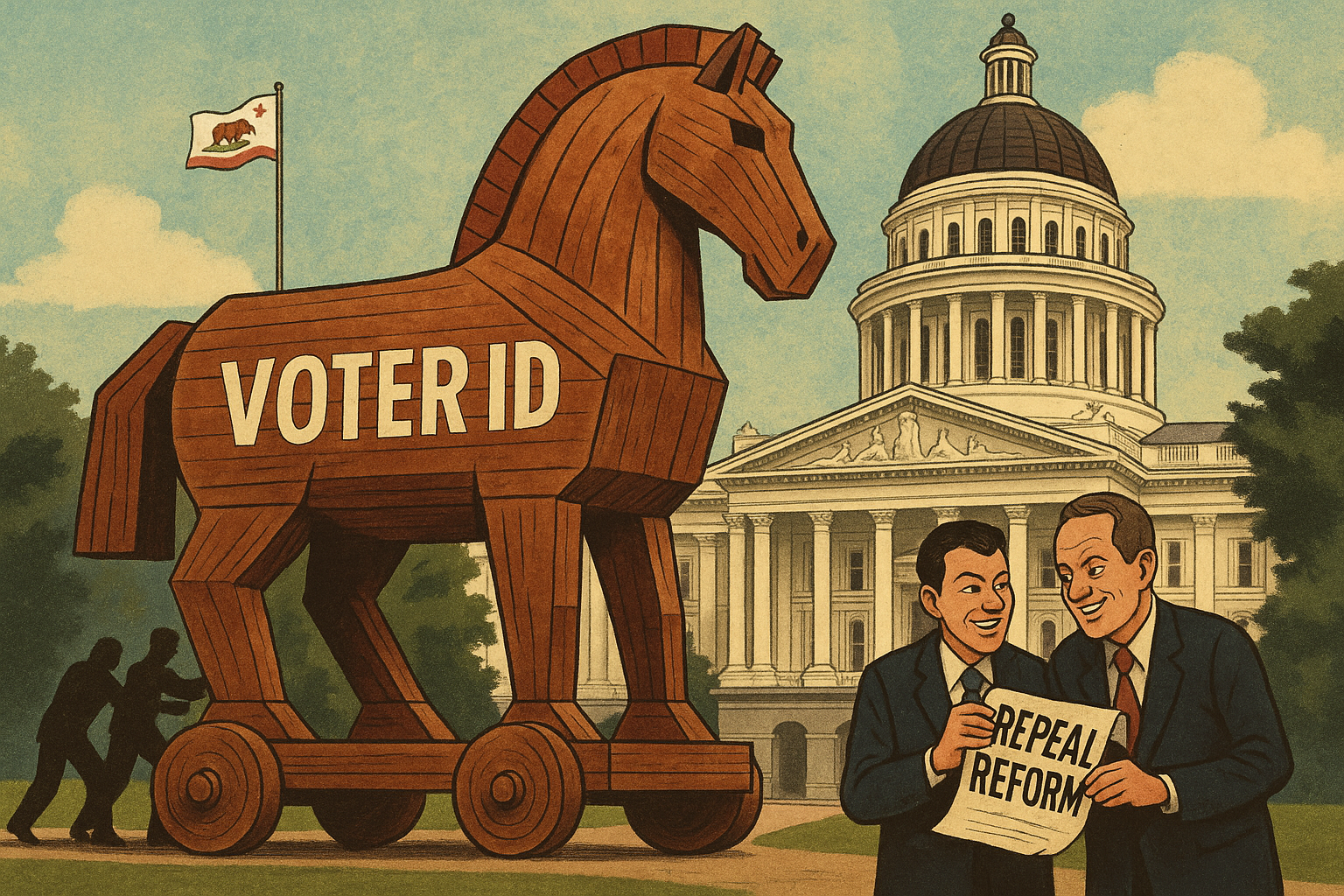
Still, as previously reported on IVN News, this is a nonpartisan issue Republicans can take the lead on in a deep blue state, particularly after a year in which they may have lost half of their congressional seats going into the 2026 midterms under Prop 50.
Oklahoma Independents: We Deserve the Right to a Meaningful Vote
The campaign for State Question (SQ) 836 in Oklahoma released a new video featuring interviews with Republicans, Democrats, and independents at the Tulsa State Fair who all agree that the state’s taxpayer-funded elections should be open to all voters.
The Yes on 836 campaign is currently gathering signatures for its ballot initiative that, if approved by voters, implements a nonpartisan top-two open primary that allows all voters and candidates to participate on a single primary ballot, regardless of party.
Oklahoma uses a semi-closed primary election system, which means the parties eligible to hold primaries can decide whether or not to allow independent voters to participate in the most critical stage of the public elections process.
For the 2026-2027 cycle, the Republican, Democratic, and Libertarian Parties will use closed primaries. State Democrats say they voted to keep their primary open to independents, but the Oklahoma Election Board claims they did not file the right notice in time.
The party is reportedly considering its legal options.
“Roughly one in five registered voters — almost 500,000 independents — will be barred from participating in taxpayer-funded primaries that effectively decide the vast majority of elected offices in the state,” the Yes on 836 campaign states.
It is noted in the video that “Oklahoma has a 68% uncontested rate. It’s the highest in the country. Politicians are not being held accountable term after term after term. They don’t have to run because no one is running against them.”
Even more seats are safe for one party, which means the most consequential vote is in the primaries, which limit choice for party members and bar independent and third-party voters entirely.
“Of the 445 county, state, and federal races up for election last cycle, only seven (about 2%) were decided in November general elections by fewer than 10 points,” Yes on 836 notes.
The remaining 98% of November races were blowouts, determined instead in June primaries or August runoffs, or ended on filing day when candidates ran unopposed.”
The campaign began gathering signatures in November. Margaret Kobos, the CEO and founder of Unite Oklahoma (which spearheaded SQ 836), expressed her optimism with IVN News about the initiative’s chances going into the new year.
“Oklahomans are ready for an open primary system where every voter matters and has a voice," she said. "We have been working hard, visiting communities across the state to ensure every voter has a chance to sign our petition and put this initiative to a vote of the people.”
Quick Takeaways
- The Department of Justice accused Democrats in court Monday of obstructing discovery in a lawsuit against Prop 50 in California. The DOJ and the California GOP allege the gerrymandered map approved by voters constitutes a racial gerrymander.
- The better elections group Open Primaries launched a litigation portal so that people can track the progress of legal challenges to closed primaries across the country, including Florida’s historic case considered by SCOTUS, Pennsylvania, Maryland, Wyoming, and Oregon.
- In New Jersey, Morris County Democrats used ranked choice voting to decide their endorsement of former Rep. Tom Malinowski in a special primary election for the state’s 11th Congressional District. The state still uses closed primaries that will shut out 36% of the state’s electorate in the special primary election.
- The Utah Forward Party used a first-of-its-kind preference poll to select a replacement for retiring state Sen. Dan Thatcher – a process opened to all district voters that used approval voting, which allows voters to select as many candidates as they want.
- The better elections group FairVote released a new in-depth report on ranked choice voting in NYC in 2025, finding that the reform continues to deliver everything advocates promised.