 Shawn Griffiths
California Assemblymember Carl DeMaio’s Reform California, which has proposed amending the California Constitution with a voter ID ballot measure, says it has crossed a major threshold going into 2026 – and it is not slowing down.
The campaign announced on January 3 that it had collected more than 1 million signatures in 90 days, which it says puts the measure well ahead of pace to qualify for the November 2026 statewide ballot.
State law requires 874,641 valid signatures for a constitutional amendment to qualify for the ballot. Organizers say they plan to submit at least 1.2 million signatures to ensure the initiative survives the state’s verification process.
“We are absolutely thrilled with the overwhelming and broad-based support,” said DeMaio. “By submitting 1.2 million signatures, we are confident this initiative will qualify for the November 2026 midterm ballot.”
Reform California reports that more than 18,000 volunteers continue to gather signatures statewide. They have been instructed to return all petitions by February 6, which would allow the campaign to submit them a full month before the March deadline.
DeMaio framed the rapid signature haul as a direct challenge to California’s political power structure, calling it “a shock to California’s corrupt political establishment.” He believes state officials will try procedural and legal tactics to block the initiative.
What the Initiative Would Do
The California Voter ID Initiative is a state constitutional amendment that would:
- Require government-issued voter identification to cast a ballot in all elections
- Require voters who submit their ballot by mail to include the last 4 digits of their
- Mandate that state election officials verify the citizenship of registered voters
- Require regular maintenance of voter rolls
Currently county election officials are responsible for maintaining their voter rolls and submitting updates to the secretary of state’s office.
Voter ID: A Nonpartisan Issue That Both Parties Get Wrong
Republican leaders argue that the voter ID requirement is critical in securing elections, though research shows that election fraud in the U.S. (including voter impersonation) is so rare that statistically it might as well not exist.
For example, the Heritage Foundation found just 34 cases of voter impersonation across the U.S. in the last 30 years.
Democratic leaders claim voter ID will lead to voter suppression, denying people who cannot easily acquire or update a government-issued ID their right to vote. However, the same research that found zero impact on election security also found little to no impact on voter turnout.
Both sides have turned this into a polarizing issue, suggesting that the other side is either trying to rig elections or deny eligible voters their constitutionally-protected rights. But it turns out, both sides are wrong.
Still, supporters of the California voter ID initiative say this about bolstering voters’ floundering trust in the elections process.
“You’ve got an interesting issue that fully unites people. And for the last several decades, most political initiatives have either intentionally or unintentionally divided the electorate,” said Republican strategist Ryan Erwin.
This one unites it. I think that’s a big part of the eagerness to sign and participate.”
Erwin is not wrong about public support for voter ID. A Gallup poll from October 2024 found that 84% of voters favor a requirement that people show photo ID in order to vote, including two-thirds of Democrats surveyed.
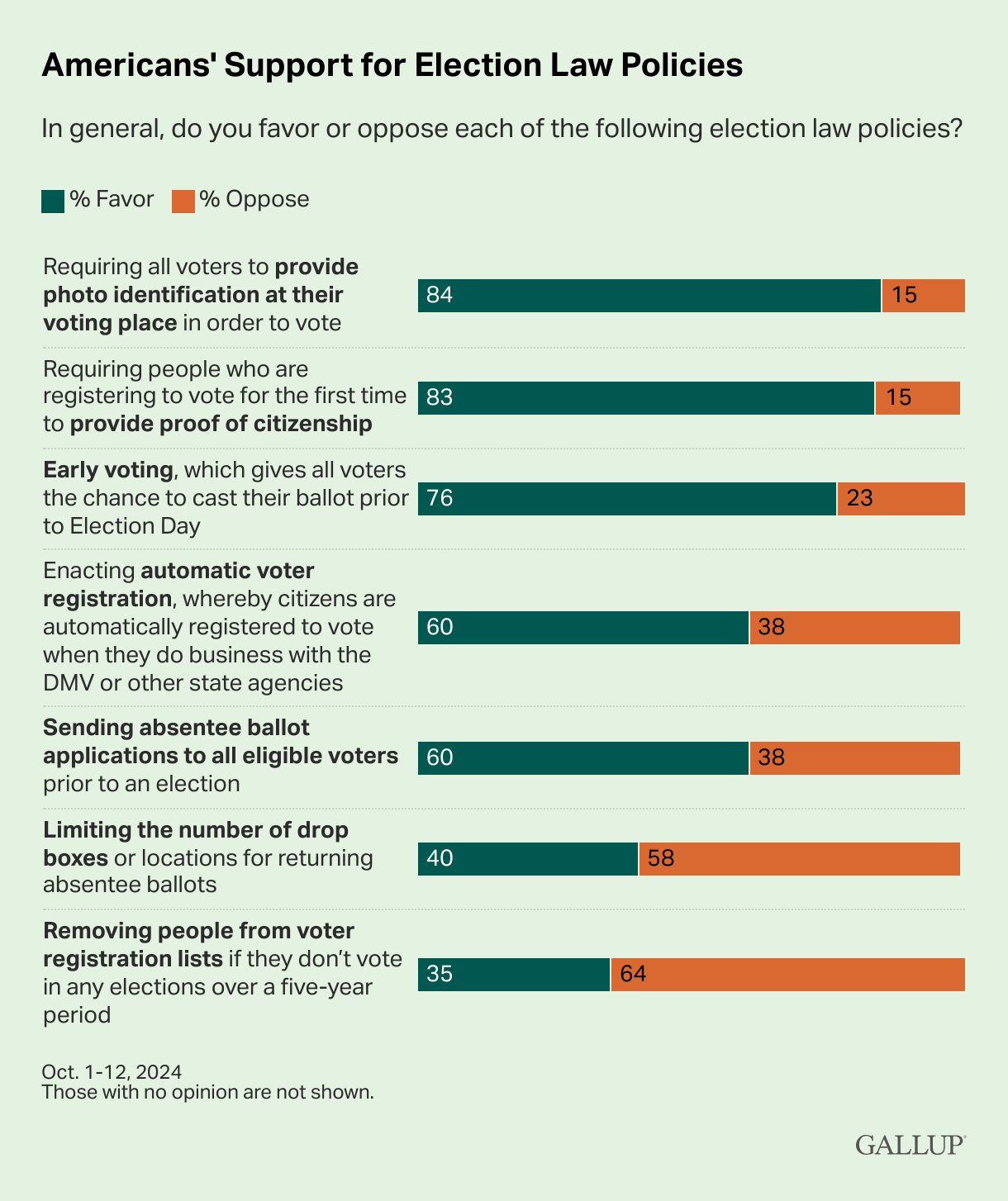
A January 2025 poll from Public Opinion Strategies found that 52% of Democrats, 70% of independents, and 93% of Republicans in California support voter ID.
If Reform California clears the signature verification process, it could be a rare instance where Republicans can lead on a nonpartisan, 80-20 issue in the state. But will they focus on how voter ID unites voters or divides the parties?