Should the Presidential Debates Include Third Parties?
 Taylor Tyler
Credit: debates.org
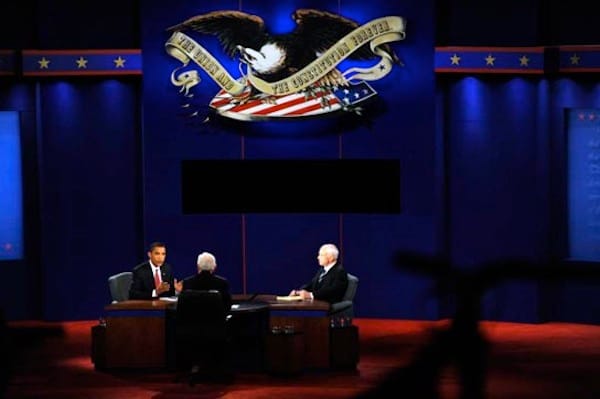
The Commission on Presidential Debates (CPD) was started in 1987 by the Democratic and Republican parties to organize and host presidential election debates in the United States.
Reportedly nonpartisan, CPD is a non-profit 501(c)(3) corporation headed by former RNC chairman Frank J. Fahrenkopf, Jr. and former Clinton press secretary Michael D. McCurry. The organization hosts debates that are sponsored by contributions from corporations and foundations.
Prior to 1987, the League of Women Voters moderated the debates, but withdrew their participation, refusing to become "an accessory to the hoodwinking of the American public."
The CPD's mission statement is as follows:
198819921996200020042008
For the CPD to successfully complete their mission of providing the best possible information to viewers and listeners, they must invite every candidate who has a mathematical chance of winning the presidential election. That is to say, a candidate must be listed on the ballot in enough states to be able to win 270 electoral votes.
There are currently four candidates who meet this requirement: Barack Obama, Gary Johnson, Mitt Romney, and Jill Stein. These four candidate also each receive matching FEC funds, which are paid for through the one dollar check off on individual income tax returns.
Since each of these candidates have varying opinions on the issues being debated, and each have different information to provide, they must be invited to participate in the debates. Failing to invite Gary Johnson and Jill Stein is failing to provide a large portion of information to the viewers and listeners.
Some have considered the failure of the Commission to consistently invite eligible third parties a violation of section 501(c)(3) of the Internal Revenue Code, and others have filed complaints with the Federal Elections Commission.

With a record high percentage of U.S. voters identifying as independent from the Democratic and Republican parties, one would think that the Commission would feel obligated to invite candidates from outside the two-party system.
A poll released by Gallup on Sept. 12 asked, "Do the Republican and Democratic parties do an adequate job of representing the American people, or do they do such a poor job that a major third party is needed?" The results showed that 46 percent of Americans believe a third party is needed.
Ross Perot has been the only third party candidate invited to participate by the Commission when he was invited in 1992.
The Commission requires candidates meet a set of "nonpartisan selection criteria" to receive invitations to the debates. The first and second criteria are that a candidate must have evidence of constitutional eligibility and evidence of ballot access.
The third and most controversial rule has been highly contested:
"The CPD's third criterion requires that the candidate have a level of support of at least 15% (fifteen percent) of the national electorate as determined by five selected national public opinion polling organizations, using the average of those organizations' most recent publicly-reported results at the time of the determination."
Libertarian Party candidate Gary Johnson referred to the 15 percent rule in a letter he sent to the Commission stating, "this polling performance criterion is entirely arbitrary and based, frankly, on nothing other than an apparent attempt to limit participation to the Democrat and the Republican."
"In all due respect, it is not the proper role of an non-elected, private, and tax-exempt organization to narrow the voters’ choices to only the two major party candidates," said Johnson.
Jill Stein, Green Party candidate, answered questions in a Reddit AMA Sept. 12 where she said, "We haven't thrown in the towel on this. In fact we haven't begun to fight. Fight we will because the American people deserve a real debate. The idea that a private corporation - the Commission on Presidential Debates (CPD) - controlled by the Democratic and Republican Parties is being allowed to silence opposition voices is anti-democratic and unacceptable."

The Commission has not yet sent debate invitations and Executive Director Janet Brown said in July, "those lobbying to get Johnson in the debates are making assumptions about something that has not happened."
You Might Also Like