
Overwhelming Majority of Voters Remain Disenfranchised in the United States

 Shawn M Griffiths
During every midterm and presidential election year, traditional media outlets pull out their electoral maps that paint every congressional district in a deep shade of red or blue, depending on who is currently the incumbent and who is expected to win in that election. Most of the time, if a district is a toss-up, it will not be colored in at all.
While traditional models for electoral maps do not accurately represent changes in voter preferences, there is one map that shows the tragic reality of politics in the United States:
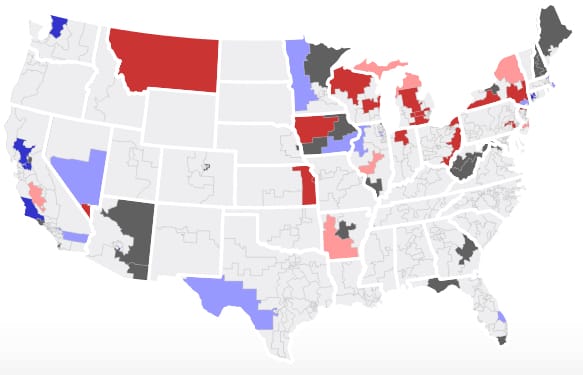
This is the map Real Clear Politics (RCP) has for the 435 congressional districts in the United States. RCP assigns a district a color based on its level of competitiveness. Dark gray indicates a toss-up race. Light red or blue indicates that the race leans either Republican or Democratic. A deep shade of blue or red means the district will likely go one way or the other.
However, as one may notice, there are many districts void of color. In fact, much of the United States is blank. This is because all of these districts are considered truly "safe" for an incumbent or a party. There is not even a remote chance that these districts will turn, no matter what party is in control of the seat.
This is the result of two centuries of partisan gerrymandering and election laws that are designed or manipulated to favor the two dominant parties.
In total, there are 366 districts RCP says are not even worth following -- leaving 84 percent of the map blank. This does not even include the districts RCP says are likely to go to one party or the other.Unfortunately, RCP uses a traditional "red-versus-blue" model for states that have adopted nonpartisan election reform, like California and Washington state.
Though the map indicates that even under this model, competitive elections in California have increased, it doesn't take into account the fact that while some districts may be relatively safe districts for a party based on voter preferences, party label isn't enough to get candidates elected in California anymore (take, for instance, the hotly contested race in CA-17).
Voters outside the majority party will actually have a say on which of the two candidates in the general election will represent them as opposed to having no voice at all, which is what happens under a traditional partisan system. In traditional partisan systems, individual voting power is diminished and typically only voters in the majority party actually decide who will represent the entire district.
This is not how a democratic system should work.

Millions of voters are under-represented or completely disenfranchised by the electoral process in the United States, which has given the dominant parties even more power to manipulate and control elections. The more individual voting power is diminished, the less the political system in the U.S. resembles that of a representative democracy.
As a result, the hyper-partisan environment in Washington only gets worse and nothing gets done. Further, very few people realize how powerful money in politics becomes when there are few competitive elections.
Competitive races draw in a higher voter turnout, which diminishes the influence a single dollar will have on each vote. Plus, a special interest group has a much easier time influencing a small handful of races than they would influencing hundreds of races.
American voters deserve better. Americans deserve a system that puts power in the hands of the electorate, not the hands of private organizations and special interests.
Photo Source: Northeast Ohio Media Group
You Might Also Like


