

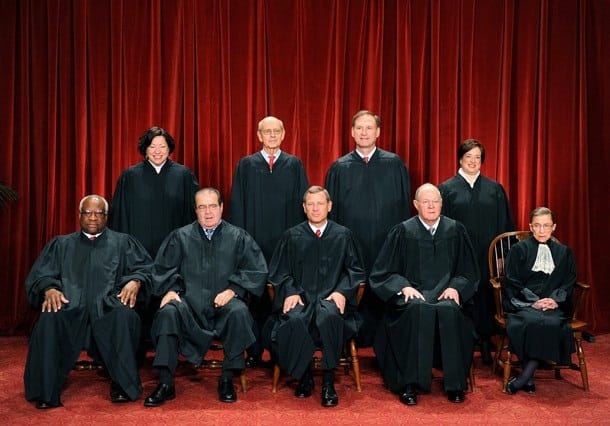
Today at 10am Eastern time, the Supreme Court is expected to release their ruling on health care reform. In what has been a closely watched and debated legal battle, the Court will answer a handful of questions that has nearly every political observer holding their breath:
1) Can the Supreme Court rule on the question of the mandate in the health care law, at all? SCOTUSBlog goes into more detail on the Anti-Injunction Act, which may prevent a ruling on the constitutionality of contested portions of the Affordable Care Act given the "tax" has not come into effect yet.
2) Is the "minimum coverage" portion of the bill, widely referred to as the individual mandate, constitutional? More specifically, does Congress have the power to regulate commerce between the states and force people to buy health insurance?
3) If parts of the bill are found unconstitutional, does the rest of the bill still stand? This is known as the "severability" question.
4) Is the Medicaid expansion also constitutional, given that the opposition argue the Affordable Care Act puts an "undue burden" on states?
The Patient Protection and Affordable Care Act (PPACA), often referred to as “Obamacare", is the major health care reform law passed in 2010. The case before the Supreme Court specifically examined whether the individual mandate portion of the legislation was, in fact, constitutional.
The individual mandate is one of the most contentious provisions of the bill. It requires all individuals not covered by employer or government sponsored insurance plans to maintain minimal, essential health insurance coverage or else, pay a penalty, unless exempted from religious beliefs or financial hardship. Without the individual mandate, many consider health care reform to be impossible to implement without substantial increases in health care fees.
“Without a requirement to purchase coverage, health care economists roundly expect fewer people to buy it," said The Washington Post's Ezra Klein earlier this week. "The number of people who gain insurance through the Affordable Care Act would shrink."
"Health insurance, meanwhile, would become more expensive, although there’s a lot of debate about how much more it would cost. Economic modeling has estimated premiums would go up anywhere between 2 and 40 percent.”
Most Americans, despite party affiliation, agree that the current healthcare system in America is broken. Yet, 72% of Americans believe the individual mandate to be unconstitutional.
Health care reform has been President Obama's signature legislation, the intents of which he has defended since its initial passage in Congress.
“If you like your doctor, you will be able to keep your doctor. Period. If you like your health care plan, you will be able to keep your health care plan. Period. No one will take it away. No matter what. My view is that health care reform should be guided by a simple principle: fix what’s broken and build on what works,” the President said, at the time the Affordable Care Act passed.
Opposition, however, has steadfastly held these claims as inaccurate information.
“According to experts, more than 87 million Americans could lose access to their current health care plan under the new law," said Speaker of the House Rep. John Boehner. "Workers at a majority of the nation’s employers – including as many as four out of every five small businesses – would lose their current coverage, thus providing further evidence that Obamacare is doing exactly the opposite of what Democrats promised it would do."
Predictions have dominated the political sphere for months, since closing arguments before the Court.
Despite many different methods of predicting, Sarah Kliff in The Washington Post said, “legal experts aren’t much better at predicting the case outcomes than a coin toss. Sometimes, they even do worse…"
"Washington University’s Andrew Martin looked at the types of cases that experts are good (and not so good) at predicting. His findings show they turn out to do the absolute worse on cases involving questions of 'economic activity,' which happens to be the crucial issue in the health reform challenge. It’s the one area where the experts predicted the decision accurately less than half the time. In other words, a coin toss would make a better prediction model.”