
 Cara Brown McCormick
The Political Reality
Ask most Americans whether people should have to show ID before voting, and about 83% say yes, including majorities of Democrats, Republicans, and independents.
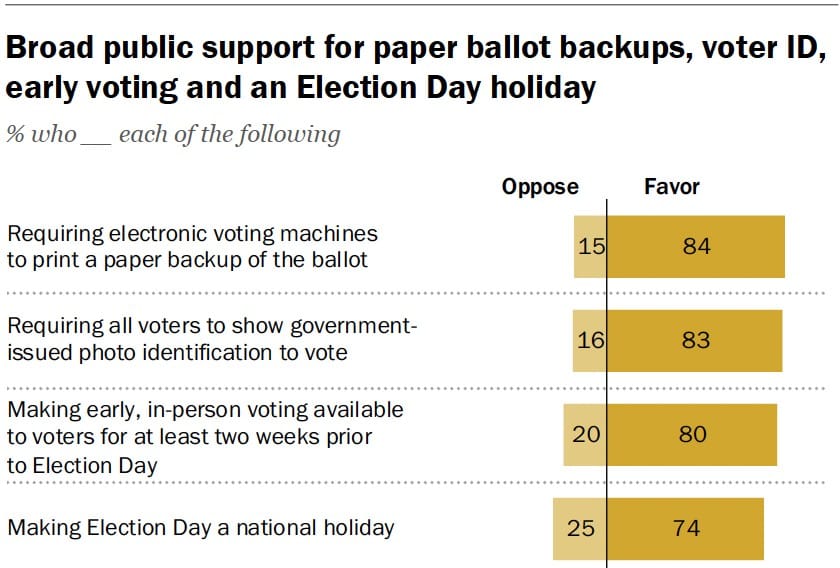
According to Pew Research, more than nine-in-ten Republicans (95%) and about seven-in-ten Democrats (71%) favor requiring all voters to show government-issued photo identification to vote.
So why is voter ID one of the most fought-over issues in American politics?
Because the fight was never really about voter ID.
It is about two things both parties want: turnout among their own voters, and a political issue that motivates their base. Republicans use voter ID to signal they are protecting elections from fraud. Democrats use opposition to voter ID to signal they are protecting minority voters from suppression. Both sides have been doing this for years, and neither side is giving you the complete picture.
If 83% Support Voter ID, Why Is It So Hard to Pass?
This is the question most voters never hear answered honestly.
On the surface, voter ID looks like one of the easiest issues in American politics. Huge majorities support it, including most Democrats. A clean, standalone photo ID requirement with a free ID guarantee, like the one proposed in California, would likely win comfortably in most states.
But voter ID legislation almost never stays clean. And that is by design.
An Independent Voter Project poll of likely California voters, cited by The New York Times, illustrates what happens when you move beyond the simple “do you support voter ID” question and start asking voters about the real-world versions of these laws. Full cross-tabulations are published on IVN.
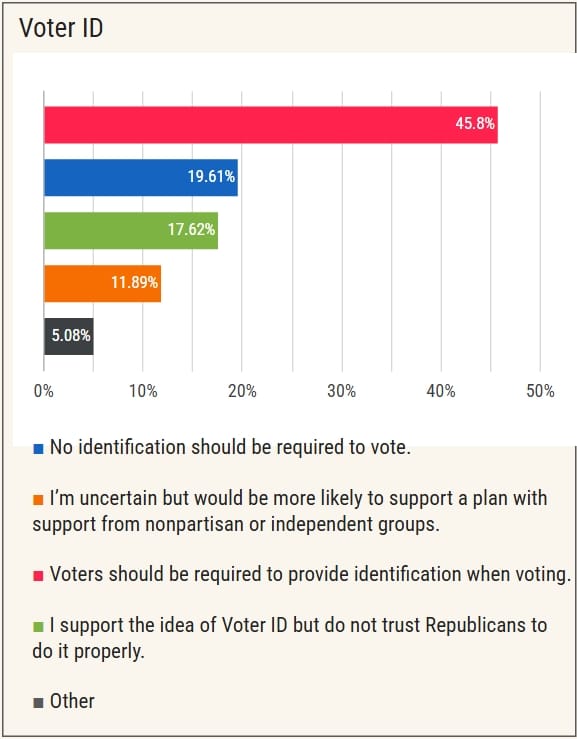
Among all respondents, a plurality (45.8%) said voters should be required to provide identification when voting. Just under 20% said no identification should be required. The remaining voters split into two categories that reveal the real fault lines: nearly 18% said they were uncertain but would be more likely to support a plan backed by nonpartisan or independent groups, and approximately 12% said they support voter ID in concept but do not trust Republicans to do it properly.
That last number is the one both parties want you to ignore.
When you break the results down by party, the picture gets sharper.
Among Republican respondents, 92% said identification should be required. There is almost no internal disagreement. Republican voters are unified on this, and their elected officials know it. Their party trust numbers reflect the same lockstep: 86% of Republican voters trust the Republican Party.
Among Democratic respondents, the picture is completely different, and much more complicated than either party admits. The largest group, about 32%, said no identification should be required to vote. But that means more than two-thirds of Democrats did not land in the flat-opposition camp.
Another 27% said they were uncertain but would support a nonpartisan plan. 17% said identification should be required. And nearly 16% said they support voter ID in concept but do not trust Republicans to implement it.
Read that again: among Democrats, about 60% either support voter ID outright, are open to it with nonpartisan backing, or support it in principle but have trust concerns about who implements it. The flat opposition is 32%. Yet the Democratic Party’s public posture treats voter ID as if its entire base is against it.
The party trust data helps explain why. Among Democrats, 80% trust the Democratic Party. That tight bond between these voters and their party means Democratic elected officials have enormous influence over how their base interprets the issue.
When party leaders frame voter ID as a Republican attack on voting rights, the 27% who are uncertain and the ones who have trust concerns are easy to move into the opposition column, even though their starting position was open to the policy.
Among No Party Preference voters, about 44% said identification should be required. Another 18% support voter ID in concept but do not trust Republicans to implement it. Only 18% said no ID should be required.
The party trust data among these independent voters is telling: About 40% don't trust either party, 28% lean toward the Democratic Party, and nearly 26% lean toward the Republican Party.
Why Popular Does Not Mean Passable
Three forces prevent voter ID from becoming law through normal bipartisan channels.
First: the trust gap. The IVP poll makes it clear that a meaningful share of voters, across party lines, support voter ID in principle but do not trust Republicans to implement it. That is not an abstract concern. The recent history of voter ID legislation shows why.
Laws in North Carolina, Texas, and Georgia were designed with provisions that courts found targeted specific groups of voters.
Prior to the state's existing voter ID law, legislation from 2013 was struck down by a federal appeals court that found the legislature had specifically requested data on which voting methods Black voters used most, then restricted those methods.
When Democrats or independent voters see a new voter ID proposal, they are not just evaluating the policy. They are evaluating who wrote it, what else is attached to it, and whether it will be implemented in good faith.
Second: the Christmas tree problem. Voter ID bills rarely stay limited to voter ID. The federal SAVE Act is the clearest example. What could have been a straightforward photo ID requirement was loaded with proof-of-citizenship mandates, criminal penalties for election officials, restrictions on mail voting, and no federal funding for implementation.
Senator John Fetterman, a Democrat who publicly supports photo ID to vote, voted against the SAVE Act and explained his reasoning in a statement:
“83% of Americans agree on voter ID. 71% of Democrats agree on voter ID. Keep it basic: PHOTO ID to vote. Stop turning this into a Christmas list and attacking vote-by-mail. If the GOP wants real reform over a show vote, put out a clean, standalone bill and I’m AYE.”
Fetterman’s position is probably closer to the median American voter than either party’s official stance. But it does not have a political home because the incentive structure rewards fights, not solutions.
Third: the base problem. About 32% of Democratic voters flatly oppose any voter ID requirement. That is not a majority of Democrats, but it does not have to be. That 32% is concentrated among the most active, most vocal segment of the Democratic base.
These are the voters who show up in primaries, fund campaigns, and punish elected officials who step out of line.
Even though roughly 60% of Democrats are open to some version of voter ID, Democratic elected officials know that embracing it risks a primary challenge from the left. It is similar to the dynamic around immigration enforcement, where Democratic voters broadly support border security but a vocal segment of the base treats any enforcement measure as disqualifying.
In both cases, the internal political math pushes Democratic leaders away from positions their own voters actually hold.
This creates a perverse cycle. Republican leaders introduce voter ID bills loaded with provisions designed to fail in order to keep the issue alive as a campaign weapon. Democratic leaders oppose all voter ID proposals, even reasonable ones, because their base punishes them for engaging.
And the 83% of voters who support voter ID in some form never get a clean vote on the question.
What The Two Major Parties Both Get Wrong
What the right gets wrong: Voter fraud is not rampant. It exists, but it is rare.
The Heritage Foundation, a conservative organization that strongly supports voter ID, maintains the most comprehensive database of proven election fraud cases in the country. As of its most recent update, it contains over 1,500 proven cases of all types of election fraud over a span of decades, which Heritage itself describes as “a sampling,” not a complete count.
Researchers at the Brookings Institution reviewed the same Heritage database. They found that, in Pennsylvania, Heritage had to go back 30 years, across more than 100 million votes cast, to find 39 fraud cases.
In Arizona over 25 years, the fraudulent vote rate was 0.0000845%, and no election outcome was changed.
In Florida in 2025, the state’s Office of Election Crimes and Security found 198 likely noncitizens who had illegally registered to vote or voted, out of more than 13 million registered voters. That is a rate of 0.0015%.
Most documented fraud, nationally, involves absentee ballots, not in-person voting, which is what a photo ID requirement at the polls would actually address.
What the left gets wrong: Fraud is not zero. The Heritage cases are real. And most voters, including most Democratic voters, think showing ID to vote is a reasonable thing to ask. Calling every voter ID proposal “voter suppression” has not been persuasive to the 83% of Americans who support some form of ID requirement, and it has allowed Republicans to own the issue for years.
Research out of Harvard Business School and the National Bureau of Economic Research have found voter ID has little to no impact on elections, one way or the other. It doesn't make elections more secure, but it also doesn't affect turnout.
What “Voter ID” Actually Means
Here is something neither side tells you: “voter ID” is not one law.
There are hundreds of laws, varying by state, and they work very differently from one another depending on which political party is in power.
The Voting Rights Lab tracks election law across all 50 states and the District of Columbia in near-real time. Here is how the current landscape breaks down.
Step 1: Does your state even ask for ID at the polls on Election Day?
Thirteen states, and DC, do not require voters to show any ID at the polls. You walk in, give your name and address, they check it against the registration record, and you vote.
States that do not require ID at the polls: California, Hawaii, Illinois, Maine, Maryland, Massachusetts, Minnesota, Nevada, New Jersey, New Mexico, New York, Oregon, Pennsylvania, and Vermont, plus Washington, DC.
First-time voters in most of these states may be required to show ID, and voters who registered by mail without providing identifying information may also face ID requirements under the federal Help America Vote Act.
The other 37 states ask for some form of ID. But asking and requiring are different things.
Step 2: What kind of ID?
Of the 37 states that ask for ID, 23 accept only photo ID: a driver’s license, passport, state ID card, and similar documents. Eleven states also accept non-photo documents, such as a utility bill, bank statement, or government mail showing your name and address.
Three states allow non-photo ID only in limited circumstances.
Even within photo ID states, what qualifies varies a lot. Some states accept a concealed carry permit but not a student ID. Some accept tribal IDs; others do not. Some accept a digital ID on your phone.
Step 3: What if you don’t have the right ID?
In 10 states, if you show up without qualifying ID, you can sign a sworn statement confirming your identity and cast a regular ballot that counts, with no follow-up required.
In 9 states, you can cast what is called a provisional ballot without ID, but whether it counts depends on what you do afterward.
In 12 states, you can cast a provisional ballot without ID, but you have to come back after Election Day with qualifying ID for it to count. If you do not make that second trip, your vote does not count.
In 6 states, alternatives exist only in limited situations.
New Hampshire goes the furthest. A law enacted in September 2024 eliminated the sworn statement and provisional ballot options entirely. If you show up without a qualifying photo ID, you cannot vote. Period.
N.H. Rev. Stat. § 659:13
In New Hampshire, voters must present a valid photo ID with an expiration date that has not passed by more than 5 years. The expiration-date requirement does not apply to voters over 65 unless they use a student ID.
The following forms of identification bearing a photograph of the voter satisfy the ID requirement:
- Driver’s license issued by any state or the federal government
- Identification card issued by New Hampshire or a non-driver’s identification card issued by the motor vehicles division, department, agency, or office of any other state
- U.S. armed services identification card
- U.S. passport or passport card
- Student ID card issued by: a college, university, or career school in New Hampshire that is approved to operate or licensed to operate in New Hampshire; a public high school in New Hampshire; a nonpublic high school in New Hampshire, accredited by a private school accrediting agency that is recognized by the Department of Education; Dartmouth College; or a college or university operated by the university system of New Hampshire or the community college system of New Hampshire
Voters unable to present ID may be able to vote a regular ballot if their identity can otherwise be confirmed by the supervisor of the checklist.
All Voter ID Laws Are Not The Same
When a politician says they support “voter ID,” that could mean anything from “we’d like you to show a utility bill, but you can still vote if you don’t have one” to “no photo ID, no ballot, no exceptions.”
When a politician says they oppose “voter ID,” they are often really opposing the strictest version of the law. The talking points of both political parties deliberately blur all of this together and use the information to scare voters and turn out their respective bases.
What Does the Supreme Court Say About Voter ID?
The Supreme Court has weighed in, and the short version is this: voter ID can be legal, but it depends on how the law is designed and who it affects.
In Crawford v. Marion County Election Board (2008), the Court upheld Indiana’s strict photo ID law. The justices said Indiana’s interest in preventing fraud and protecting confidence in elections was enough to justify requiring ID. But the Court also left the door open to challenges if a specific law could be shown to put an unconstitutional burden on a particular group of voters.
In Shelby County v. Holder (2013), the Court struck down a key part of the Voting Rights Act that required certain states with a history of racial discrimination to get federal approval before changing their election laws. Once that guardrail was removed, several states moved quickly to pass stricter voter ID laws.
In League of Women Voters of North Carolina v. North Carolina (4th Cir. 2016), a federal appeals court struck down North Carolina’s voter ID law in full. The court found that before passing the law, the legislature had requested racial data on which voting methods Black voters used most, and then restricted exactly those methods.
The court said the law targeted Black voters “with almost surgical precision.” It also noted the state could not identify a single person who had ever been charged with in-person voter fraud in North Carolina. The Supreme Court declined to take the case, leaving that ruling in place.
The legal lesson is this: voter ID is not automatically unconstitutional. But laws designed to restrict specific groups of voters, or that are so burdensome that they effectively prevent eligible citizens from voting, have been struck down.
Do That Many People Really Not Have Valid IDs?
A 2023 national survey, the first of its kind in nearly 20 years, was conducted by VoteRiders, the University of Maryland, the Brennan Center for Justice, and Public Wise. It found that as of 2020, approximately 29 million eligible voters lacked a current driver’s license, and over 7 million lacked any current government-issued photo ID.
A fall 2023 University of Maryland survey estimated that around 50 million American adult citizens (about 20% of the total) did not have a valid driver’s license with their current name and address on it. That group included 23 million Democrats, 15.7 million Republicans, and 10.5 million independents.
When it comes to documentary proof of citizenship specifically, things like birth certificates, passports, and naturalization certificates, a June 2024 Brennan Center estimate found that 21.3 million eligible citizens do not have easy access to those documents, and 3.8 million have no such documents at all.
The people most likely to lack ID are lower-income voters, elderly voters, voters of color, younger voters, people in rural areas, naturalized citizens, and women who have changed their name after marriage.
These gaps are the reality regardless of how you feel about voter ID as a policy.
Supporters of voter ID laws note that in Florida, for example, more than 90% of voters already hold REAL ID-compliant driver’s licenses, so most people would not be affected by a standard photo ID requirement.
Does Voter ID Actually Suppress Turnout?
Research on this can produce mixed results depending on how the study was conducted.
For example, there are studies from Harvard Business School and the National Bureau of Economic Research that show little to no impact on voter turnout.
A December 2025 peer-reviewed study analyzed state turnout data from 1984 to 2020 and found no significant effect of strict voter ID laws on overall turnout. But it also found that states that passed strict laws after 2008 saw a 2.7-percentage-point drop in presidential election turnout.
States that had passed voter ID laws earlier saw no significant effect.
- A March 2025 study of Wisconsin found that voter ID was associated with slightly higher turnout on average and no statistically significant effect on non-white voter turnout.
- A 2017 study in the Journal of Politics found that Latino voter turnout was 10.3 points lower in states with photo ID requirements, and multi-racial voter turnout was 12.8 points lower.
- A later peer-reviewed replication of that study found that when data errors were corrected, the results were statistically unstable. The effect could appear positive, negative, or zero depending on the methodology used.
- A 2014 Government Accountability Office review found that of five peer-reviewed studies, three showed voter ID reduced minority turnout, and two found no significant effect.
- A randomized field experiment in Tennessee and Virginia found that simply notifying voters about ID requirements and helping them understand what they needed did not reduce turnout. Certain kinds of outreach actually increased turnout among infrequent voters by up to 1.5 points.
The latter experiment is particularly interesting because it shows that framing voter ID as a flashpoint benefits both major political parties, not just Republicans, as many would assume.
What’s The Latest Fight About?
A new category of requirement: proof of citizenship
Most of the current wave of legislation goes way beyond photo ID at the polls. It requires voters to prove they are U.S. citizens when they register, using documents like a birth certificate or a passport, not just a driver’s license.
This is a bigger ask than it sounds.
Under long-standing Supreme Court precedent, voters can register to vote in federal elections by simply swearing under penalty of perjury that they are citizens. They do not have to prove it with a document.
States that want to require this new documentary proof of citizenship, therefore, have to offer two separate registration tracks: one for people who have provided documentation, and one for people who have not, with the second group limited to federal races only.
Currently, Arizona is the only state that actually operates this kind of two-track system in practice, and it has been in nearly continuous litigation since 2004.
New Hampshire and Wyoming: already in effect
New Hampshire enacted its proof-of-citizenship registration requirement in September 2024. It also eliminated all alternatives to photo ID at the polls.
Wyoming enacted its proof-of-citizenship requirement in March 2025. To register, voters must show one of a specific list of documents: a Wyoming driver’s license or state ID not indicating non-citizenship, a REAL ID from another state, a U.S. passport, a birth certificate with an official seal, a consular report of birth abroad, a federally recognized tribal ID, a certificate of citizenship or naturalization, or a military draft record or selective service card.
Wyoming also added a new rule: you must have lived in Wyoming for 30 days before you can vote.
The 2026 primaries will be the first major elections to run under both of these laws. That will produce real data, for the first time, on what these requirements actually do to voter registration and participation.
South Dakota and Utah: signed in March 2026
South Dakota’s law applies only to new registrants, not current voters.
Utah’s law also applies primarily to new registrants and requires a citizenship review of existing registered voters. Both create the federal-only voter track described above.
Florida’s SAVE Act: signed April 1, 2026
Florida’s law, HB 991, is broader than the South Dakota and Utah versions.
It applies to both new registrants and currently registered voters, meaning people already on the rolls could be removed if they cannot produce citizenship documentation when contacted by the state.
It takes effect January 1, 2027, after the midterms.
The Florida law would make it more difficult for married women who have changed their names to vote. The law states that if a voter registration applicant’s legal name is different from the name that appears on their citizenship document, official legal documentation proving the name change is also required.
Multiple federal lawsuits were filed minutes after Governor Ron DeSantis signed the bill into law.
A similar proof-of-citizenship law in Kansas was blocked by a federal court in 2018 after it prevented more than 35,000 people from registering to vote.
The federal SAVE Act: stalled in Congress
H.R. 7296, introduced January 30, 2026, would require proof of citizenship to register to vote in all federal elections nationwide. It would take effect immediately upon signing, with no federal funding provided to states to implement it, no phase-in period, and criminal penalties for election officials, including for honest mistakes.
The bill cannot pass the Senate without 60 votes, and it does not currently have them.
Even Senate Republican leaders have signaled the bill is designed to fail. Fetterman’s statement, and the broader reception in the Senate, illustrate how loading voter ID legislation with unrelated provisions turns a consensus issue into a partisan weapon.
A clean, standalone photo ID bill could attract bipartisan support. The SAVE Act, by design, cannot.
Two executive orders: mostly blocked or unworkable
President Trump signed his first executive order on elections in March 2025, which attempted to require proof of citizenship on the federal voter registration form. Federal courts blocked its major provisions. One court permanently ruled that the president lacks the constitutional authority to change election procedures unilaterally, because that power belongs to Congress and the states.
President Trump signed a second executive order on March 31, 2026, directing the creation of a federal voter citizenship list and new tracking requirements for mail ballots. Election law experts said it could not realistically be implemented before the November 2026 elections, regardless of legal challenges, and that courts would block it if the administration tried to implement it.
Legal challenges were pledged immediately by multiple state attorneys general and advocacy organizations.
California: What a Clean Voter ID Law Looks Like
A proposed California ballot initiative offers a useful contrast to the SAVE Act approach. It would move California, which currently requires no ID at all, to requiring a government-issued ID for in-person voting and the last four digits of an ID number for mail ballots. California currently verifies mail ballots only by comparing signatures. (Cal. Elec. Code §§ 3011, 3019, 4100)
The initiative would guarantee a free voter ID card to any eligible voter who asks for one. It would not require proof of citizenship to register. It would not penalize election officials. It would require annual public audits of compliance.
 Cara Brown McCormick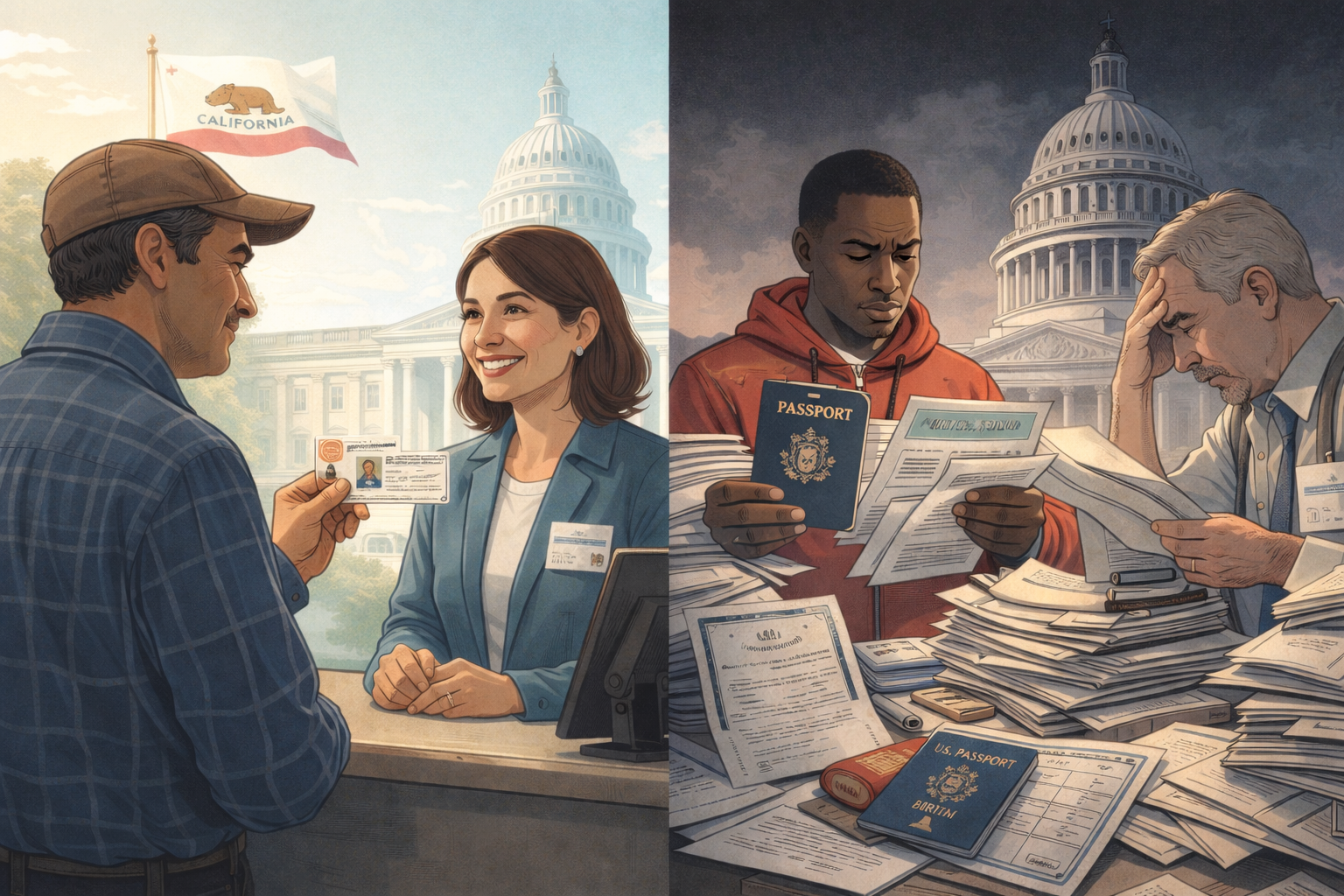
This is voter ID that matches what 83% of Americans actually say they want: a simple, verifiable way to confirm a voter’s identity, with a guarantee that no eligible voter is turned away because they cannot afford an ID.
The campaign against it, however, is unlikely to engage on the merits. As the IVP poll shows, the opposition strategy does not need to argue that voter ID is bad policy. It just needs to brand it as a Republican project.
The easiest path for opponents is not to debate the California initiative’s actual provisions but to lump it together with the SAVE Act, Florida’s HB 991, and Trump’s executive orders and tell voters it is all the same thing.
This is exactly what happened when California Proposition 50 went before voters. The initiative had nothing in common with the federal SAVE Act in substance. But opponents ran a campaign that treated them as interchangeable, and that framing was enough.
Both Parties Like to Fight About Voter ID
Here is what is actually happening beneath the surface of all this legislation.
The federal SAVE Act cannot pass Congress. Courts may block Trump’s executive orders. So, the Republican Party’s strategy has shifted to pushing conservative states to pass their own versions of these requirements, creating facts on the ground, generating legal fights that could eventually reach the Supreme Court, and keeping the issue alive as a political motivator heading into 2026.
Since early 2025, the Voting Rights Lab has tracked 10 enacted bills restricting voter ID or election administration across 9 states: Florida, Utah (2 bills), West Virginia, Georgia, Alabama, Montana, Tennessee, Indiana, and Kentucky.
Eight of those states narrowed the forms of ID accepted at the polls. As of April 2026, 12 states have enacted some form of proof-of-citizenship requirement for voter registration.
Most of these laws are designed to solve a problem whose scale, based on the evidence from states’ own election security offices, is very small.
- Florida found 198 likely noncitizens on its rolls out of 13 million voters.
- Utah found one.
- South Dakota’s 273 cases were caused by a government data entry error, not by people trying to cheat.
That does not mean the laws are illegitimate. Reasonable people disagree about whether even a small number of ineligible votes justifies new requirements. But the political energy behind these laws is not proportional to the documented problem they are addressing, on either side.
Democrats, meanwhile, have their own version of the problem. By opposing all voter ID proposals, including the simplest and least restrictive ones, they concede the issue entirely to Republicans.
The IVP poll data shows this creates an opening: among independent voters, a plurality already supports voter ID, and several more would support it with nonpartisan backing.
Democratic opposition to voter ID does not reflect independent voters’ views. It reflects the party’s fear of its own base.
What Will Be Your Experience?
Your experience as a voter depends on which state you live in.
If you live in one of the 14 states and DC that do not require ID, including California, you do not currently need any ID to vote in person.
If you live in a state that asks for ID but lets you sign a sworn statement instead, you can vote without a qualifying ID document.
If you live in a state where a provisional ballot without ID requires a follow-up trip, not having ID means your vote may not count unless you come back.
If you live in New Hampshire, you need a qualifying photo ID. There is no alternative.
If you live in one of the twelve states with a proof-of-citizenship requirement for registration, you will now need specific documents to register or even stay registered, as in Florida.
As with so much else, what comes next depends largely on the courts.
The Florida law and the SAVE Act are both already the subjects of litigation.
The 2026 primaries in New Hampshire and Wyoming will generate the first real evidence of how proof-of-citizenship requirements affect actual voters in practice.
Voter ID is less a policy debate than a political signal, and both major political parties seem to have decided the signal is worth more to them than the solution.
Until the political value of fighting about voter ID drops below the political cost of actually solving it, expect more laws, more lawsuits, and more noise, and less clarity for the voters caught in the middle of the partisan war.
Related IVN coverage:
- California’s Voter ID Initiative is Way More Chill Than Trump’s SAVE Act
- Trump EO Pushes Citizenship Verification and Mail Ballot Tracking Further Than SAVE Act Debate
- Trump is Building a FEDERAL Voter List: Should YOU Be Scared?
- The Federal Voter ID Bill Is Designed to Fail. Here’s Why
- John Fetterman Blasts Hypocrisy on Both Sides of the SAVE Act Fight