

In the growing age of technology, voters are increasingly turning to the Internet to research, connect, and share political news as the 2012 election progresses. Noticing this trend, Google has introduced Four Screens To Victory, "a framework for political campaigns that outlines how Google can help make the web work for candidates and issues groups up and down the ballot." By providing candidates the tools, trends, and technology necessary for them to share their political views, Google is enabling candidates to connect with voters from their area. The goal? Get out the vote.
By providing voters with specialized news, information, and channels of communication, voters get the information they need to make informed decisions about voting. Looking beyond just the presidential election, Google is analyzing trends in technology and the internet to better connect voters with candidates in all state and local elections.
So where does the name "Four Screens To Victory" come from? The four screens Google narrows down as being essential to any campaign are: television, computers, tablets, and mobile phones. According to Google Politics,
"Access to political information no longer comes from one place - or one screen. In just the four years since the last presidential election, the continued growth of the web and the proliferation of mobile devices has radically transformed when, where, and how voters access political information."
"Research shows that using four screen ad campaigns are 48% more effective in driving campaign awareness and 77% more effective in driving campaign engagement."
Based on this research, Google launched their "Four Screens" toolkit in March. Since then, Google has analyzed the data and released this infographic earlier today:
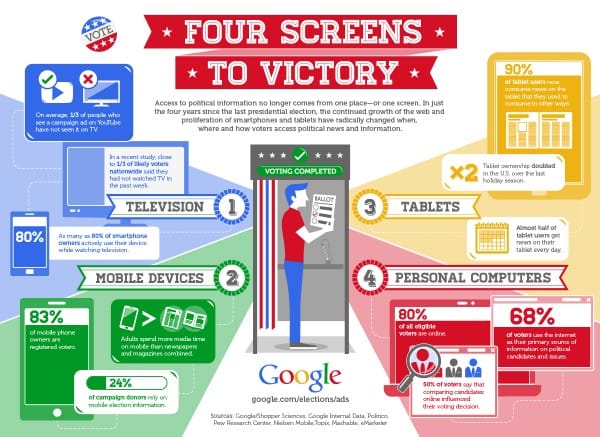
Some key statistics:
- More than 80% of eligible voters are online
- Similarly, 83% of mobile phone owners are registered voters
- 1 out of every 3 likely voters in November say that they didn’t watch tv in the past week
- Voters are spending more media time on their mobile devices than newspapers & magazines combined
For more information, visit Google Politics & Elections Team.