Do Independent Voters Need More Independent Candidates?

Do Independent Voters Need More Independent Candidates?
Published: 30 Aug, 2013
1 min read
ivnvoters

Demand, meet Supply

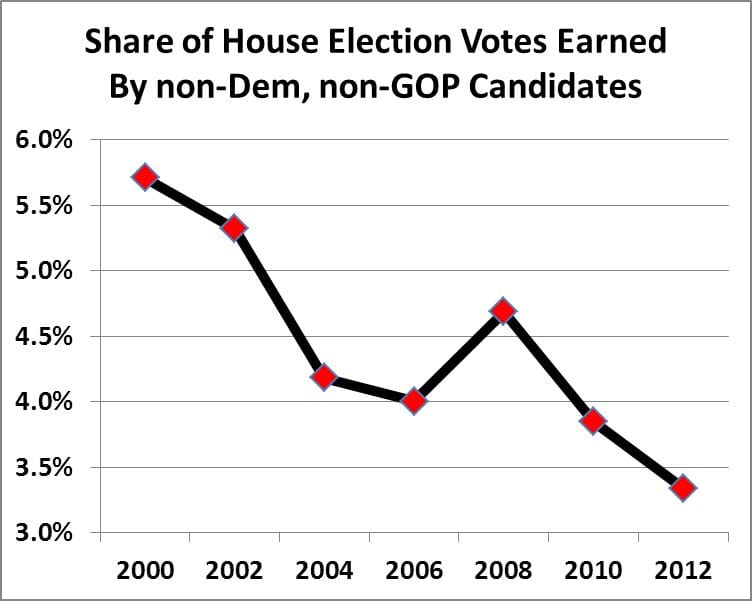
Amidst some disenchantment with both major political parties, the chart above shows, when looking across the 50 states, the share of votes earned by candidates that were not either Democratic or Republican has fallen significantly for U.S. House of Representative elections since 2000.

Super No Funding Time_ad

The State Data Lab resource (Votes Cast for House Election – Other), developed by Truth in Accounting, shows that states with relatively high shares of non-major party votes in 2000 also had some of the greatest declines.  The average share of non-major-party votes in the 5 states with the highest non-Dem and non-GOP shares in 2000 (Alaska, Massachusetts, New York, Rhode Island and Vermont) fell from 28% to 7% over that time frame.  In those states, the shift was clearly associated with rising fortunes for Democratic candidates.

Roughly one-fifth of the states showed a rising trend in non-major-party candidate share of total vote, however.   These states were Arizona, Arkansas, Connecticut, Florida, Illinois, Maryland, Michigan, Missouri, Montana, New Hampshire, Tennessee, and Wyoming.

Truth in Accounting would appreciate feedback on new ideas for data and other resources independent voters would like to see on State Data Lab.

You Might Also Like

New IVP 2026 California Governor Poll: What the Toplines Don’t Tell You
Using verified California voter file data, IVP surveyed high-propensity voters from February 13 through 20. The poll tested first-choice ballot preferences alongside issue intensity on affordability and the cost of living, immigration enforcement, more choice reform, and more....
23 Feb, 2026
-
10 min read
81% of Americans Say Money Controls Politics – Can a Constitutional Amendment Fix It?
Polls consistently show that nearly all Americans across the political spectrum agree that there is too much money in politics – whether from foreign sources, corporations, or so-called “dark money” groups. ...
23 Feb, 2026
-
13 min read
10 Reasons Why the Congressional Stock Trading Ban Will Never Pass
The overlap between committee assignments and stock ownership is not automatically illegal. Because the current legal framework permits this proximity as long as disclosure rules are followed, lawmakers are not operating under a system that forces change....
20 Feb, 2026
-
4 min read