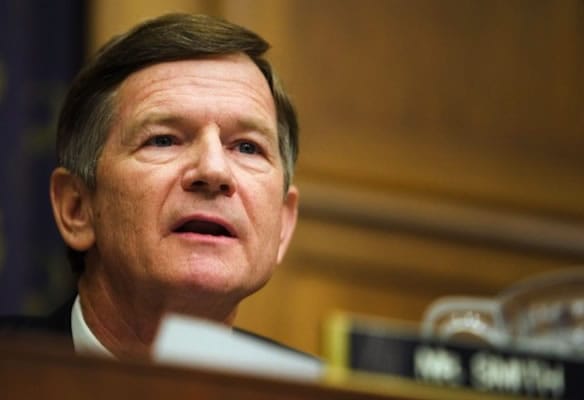
Rep. Lamar Smith, Republican sponsor of the new IPAA bill. Credit: deathandtaxesmag.com
This year, supporters of digital rights and internet freedom have achieved a number of significant political victories against the proponents of draconian regulation and censorship of digital content in both government and industry. In January, advocates of an open internet succeeded in blocking further development of the so-called “Stop Online Piracy Act” (SOPA) in the US House.
Sponsored by Republican Lamar Smith, and with significant bi-partisan support, the bill would have posed a significant threat to the freedom of speech online and digital innovation had it become law. Supporters of the bill claimed it was necessary to protect copyright holders and step up the enforcement of copyright law world wide. Smith announced on January 20th that he would postpone the bill, but continue to seek out avenues for forwarding its goals.
The following month, protests were held in hundreds of European cities on February 11th in opposition to the so-called Anti-Counterfeiting Trade Agreement (ACTA), a multinational treaty that would create a governing body to enforce a newly created global intellectual property regime. Opponents argue that the treaty – which was negotiated in secret and, like SOPA, is strongly supported by industry groups – would infringe on the freedom of expression and threaten individual data privacy. The swell in opposition led to the defeat of the agreement in the European Parliament earlier this month, on July 4th, when it was voted down 478 to 39.
Activists who support the freedom of expression, an open internet and data privacy against intrusions by the powerful coalition of government and industry have remained on alert following these important victories, given the likelihood that supporters of SOPA and ACTA will seek to introduce such measures into legislatures around the globe in a piecemeal fashion. Such vigilance appears eminently justified given recent bills proposed, once again, by Lamar Smith in the US House.
Smith's newest bipartisan endeavor in this realm is the so-called Intellectual Property Attache Act (IPAA). The IPAA essentially reproduces and expands a specific proposal from the final section of SOPA (see SOPA sec. 205). The legislation would create a new executive position, an intellectual property czar, in the person of the Assistant Secretary of Commerce for Intellectual Property. The IP czar would oversee the Intellectual Property Attache Program, a corps of diplomats stationed at embassies around the globe the sole function of which would be to advance the IP regime favored by industry and government.
In a gloss on the bill, the Electronic Frontier Foundation stated that it would do nothing more than “give the entertainment industry more permanent, government-funded spokespeople.”
“The major issue with this bill—and all similar bills—is that the commissioning of people in the executive branch who are solely dedicated to "intellectual property enforcement" caters to Big Content...From our perspective, this bill is nothing more than the government giving Hollywood traveling foot soldiers,” wrote Adi Kadmar.
The political strategy behind such a plan is fairly obvious. The diplomatic IP lobbying program would seek to enact and expand an aggressive enforcement regime abroad, which could then be used to support similar measures at home. As Cory Doctorow noted last week, “as we've seen with other trade deals, one way to get unpopular measures into US law is to impose them on other countries, then agree to "harmonize" at home.”
In our current political climate – and as measures such as SOPA, ACTA and IPAA show – in Washington D.C. perhaps the only thing worse than partisan gridlock is bipartisan agreement.
To review a copy of the proposed IPAA legislation, see the International Digital Times.