Following the controversies surrounding the presidential election of 2000, in which George W. Bush lost the popular vote but won the presidency, there was renewed interest in reforming the Electoral College system. That interest has held steady over the course of the last decade. In a Gallup survey from late last year, 62% of those polled said they would prefer that the president be elected by a direct popular vote rather than via the indirect system characteristic of the Electoral College. The poll found broad agreement across the political spectrum in favor of such a change. Those who said they support the direct election of the president included 71% of Democrats, 61% of Independents and 53% of Republicans.
One potential avenue of reform would be to abolish the Electoral College altogether by means of a constitutional amendment establishing the direct popular election of the nation's highest executive officer. Such a strategy would not be entirely unprecedented. In 1913, the states ratified the seventeenth amendment to the Constitution, which provided for the direct election of US Senators by the people of the several states, taking that power out of the hands of state legislatures.
However, given the difficulty of amending the federal constitution, in recent years reformers have opted to take a different tack. The National Popular Vote Compact seeks to establish the direct election of the president not by abolishing the Electoral College but rather by changing the way in which states award their electoral votes. The Constitution empowers the legislature of each state to determine how it chooses its electors and apportions its electoral votes. Currently, all but two states award all of their electoral votes to the presidential candidate who wins the state's popular vote. The remaining two, Nebraska and Maine, utilize a mixed allocation system that takes into account proportional differences in the popular vote between Congressional districts.
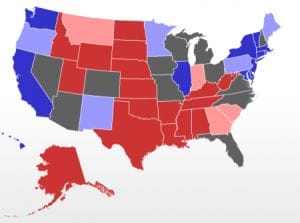
Under the National Popular Vote Compact, states would agree to award their electoral college votes to the winner of the national popular election. Eight states and the District of Columbia have already signed on to the program: Vermont, Maryland, Washington, Illinois, New Jersey, Massachusetts, California and Hawaii. Together, these states control 139 electoral votes, just under half of the 270 necessary to elect the president. According to the agreement, the National Popular Vote Compact will not come into effect until at least 270 electoral votes have been pledged to the process.
Supporters of the compact argue that establishing a popular vote rule is simply common sense and point out that the current system alienates large swaths of the nation from the presidential election process because it privileges a small number of so-called swing states. Opponents worry about the possibility of protracted court cases and the potential unintended consequences that may result of enough states sign on.
Over the weekend, the New York Times hosted a debate on the proposal in its Opinion Pages. Steven J. Brams, a professor of politics at NYU, started off the discussion by making the case in favor of the Compact. Brams noted that in this year's presidential election voters in the nation's three largest states “will largely be ignored in the 2012 campaign,” and argued that the Compact will prevent divergences between the national popular vote and the Electoral College outcome. “The 2012 presidential election will probably be decided by 8 to 12 battleground states . . . The cleanest way to prevent divided verdicts is to abolish the Electoral College and substitute direct popular vote for the president. . . . An ingenious alternative solution is the national popular vote plan.”
In response, readers questioned the legal issues a state compact would raise, and brought up problems that might result from the proposed process.
Martin G. Evans, a professor in the School of Management at the University of Toronto, pointed out that the nature of interstate compacts has not yet been worked out by the courts: “whether interstate compacts have to be approved by Congress is an issue that has not been settled by the courts. When the political power of a state that does not sign the compact is encroached on, the courts may rule that Congressional approval of the compact is required.”
Jay Reinlein worried that the national compact would marginalize smaller states: “Mr. Brams’s solution to the problem of battleground states is no solution at all since it marginalizes smaller states and smaller media markets in favor of larger states and larger media markets.” Mr. Reinlein proposed instead that states should award their electoral votes on a proportional basis.