Skip to content
Sign up free
News

Google Politics: Four Screens To Victory

By Jane Susskind

1-minute read

In the growing age of technology, voters are increasingly turning to the Internet to research, connect, and share political news as the 2012 election progresses. Noticing this trend, Google has introduced Four Screens To Victory, "a framework for political campaigns that outlines how Google can help make the web work for candidates and issues groups up and down the ballot." By providing candidates the tools, trends, and technology necessary for them to share their political views, Google is enabling candidates to connect with voters from their area. The goal? Get out the vote.

By providing voters with specialized news, information, and channels of communication, voters get the information they need to make informed decisions about voting. Looking beyond just the presidential election, Google is analyzing trends in technology and the internet to better connect voters with candidates in all state and local elections.

So where does the name "Four Screens To Victory" come from? The four screens Google narrows down as being essential to any campaign are: television, computers, tablets, and mobile phones. According to Google Politics,

"Access to political information no longer comes from one place - or one screen. In just the four years since the last presidential election, the continued growth of the web and the proliferation of mobile devices has radically transformed when, where, and how voters access political information."

Furthermore,

"Research shows that using four screen ad campaigns are 48% more effective in driving campaign awareness and 77% more effective in driving campaign engagement."

Based on this research, Google launched their "Four Screens" toolkit in March. Since then, Google has analyzed the data and released this infographic earlier today:
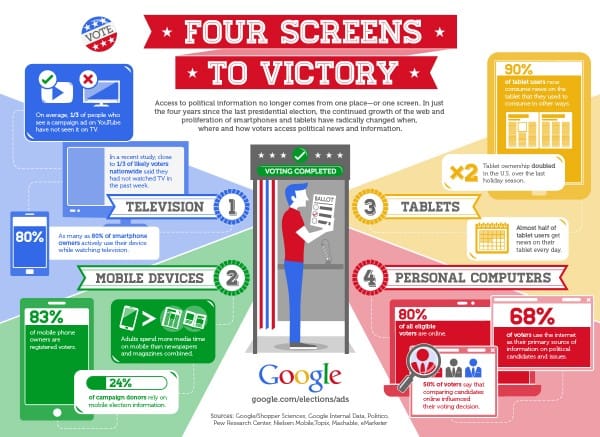
Some key statistics:

  • More than 80% of eligible voters are online
  • Similarly, 83% of mobile phone owners are registered voters
  • 1 out of every 3 likely voters in November say that they didn’t watch tv in the past week
  • Voters are spending more media time on their mobile devices than newspapers & magazines combined

For more information, visit Google Politics & Elections Team.

Tags: News

Adhere to the IVN etiquette

By posting a comment, you agree to adhere to our etiquette rules: No partisan attacks, no personal attacks, substantiate your sources, no self-promotion.

Get IVN’s Free Weekly Newsletter:Get IVN’s Free Newsletter

Get IVN’s Free Weekly Newsletter:Get IVN’s Free Newsletter

Nonpartisan Issues. Diverse Perspectives.

Check your inbox and click the link to confirm.

Republish this article

Republishing guidelines

Republish IVN articles for free. Independent Voter News articles may be republished online or in print under a Creative Commons BY-NC-ND 4.0 license, on these terms:

  1. Credit the author and IVN. Keep the byline ("By Author Name, Independent Voter News") and the attribution note at the end, which links to the original.
  2. Keep the meaning. You may update time and place references and apply your house style. You may trim for length, as long as the cuts don't change the meaning or misrepresent the author. Keep the headline. Mark any additions as your own (for example "Additional reporting by ...").
  3. Translations are welcome. Translate faithfully, add "Translated from English by [your outlet]", and tell us at editor@ivn.us.
  4. Keep the links, including the link to the original article.
  5. Keep the tracking image. The HTML includes a 1-pixel image that counts readers on your page. It collects no personal information.
  6. Photos and illustrations. Images credited to IVN may be used with this article only. Images credited to others (AP, Getty, Unsplash, Wikimedia and so on) stay under their owners' terms. Secure the rights or switch "Include images" off.
  7. Don't sell it. You can't sell our articles or sell ads specifically against them. Your normal site advertising is fine.
  8. No implied endorsement. Don't suggest that IVN or the author endorses you, your candidates or your causes, or that donations to you support IVN.
  9. Keep labels. Opinion or analysis pieces keep that label.
  10. Point search engines to the original. Set the canonical URL of your copy to the original IVN article (the HTML we give you includes the tag).
  11. No bulk or automated republishing, and don't submit our articles to aggregators (Apple News, Google News, MSN) as your own.
  12. Corrections and removals. Update your copy when we correct it, and remove it promptly if we ask. We'll contact you at the email you give us.
  13. Questions or print republication: editor@ivn.us.

IVN staff: fill in who you're inviting above, then create the invite.

Preparing the article

Google Politics: Four Screens To Victory

Choose a format
  • HTML
  • Email HTML
  • Markdown
  • Formatted (.docx)
  • Plain text
  • WordPress blocks
  • PDF
Choose a platform

Photos credited to others need their owners' permission.

To for

Republishing somewhere else? Questions? editor@ivn.us