
 Chad Peace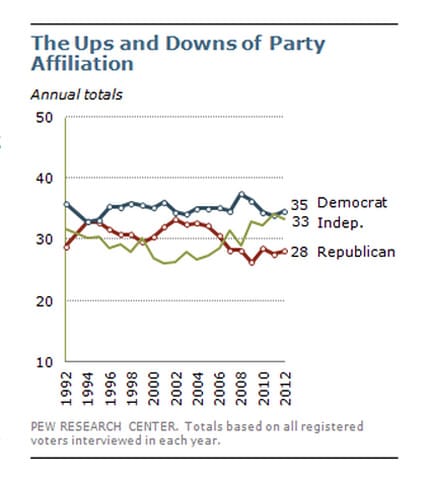
Pew released the results of a survey on the Presidential race showing President Obama having a 10% lead on his challenger Mitt Romney. Many bloggers pointed to the "inaccuracy" of the poll because more Democrats were questioned than Republicans. Pew was quick to point out that recalculated the numbers using a weighted figure would not lead to a more accurate figure. This is because while Democratic voter registration has been rising, Republican voter registration has been falling:
"The latest Pew Research Center survey conducted July 16-26 among 1,956 registered voters nationwide found 51% supporting Barack Obama and 41% Mitt Romney. This is unquestionably a good poll for Obama – one of his widest leads of the year according to our surveys, though largely unchanged from earlier in July and consistent with polling over the course of this year.
And the survey did interview more Democrats than Republicans; 38% of registered voters said they think of themselves as Democrats, 25% as Republicans, and 33% as independents (to clarify, some reporters and bloggers incorrectly posted their own calculations of party identification based on unweighted figures). That’s slightly more Democrats than average over the past year, and slightly fewer Republicans. Recent Pew Research Center surveys have found anywhere from a one-point to a ten-point Democratic identification advantage, with an average of about seven points."
The Pew study goes on to explain that the polls are taken not with party voter registration in mind, but that the studies are conducted to also measure party registration. They point out that there was a spike in Republican registration following 9/11, yet, the trend has shifted the opposite direction in recent years.
What's the explanation for this?