In past elections, seven-term U.S. Rep. Mike Honda (D) would not have to worry about a serious challenge to his incumbency. Honda represents California’s 17th Congressional District in Silicon Valley, where Democrats have won elections without any competition for over two decades.
Honda, who was elected to his first term in Congressional District 15 in 2000, has won every re-election campaign with over 65 percent of the vote. In fact, he garnered over 70 percent in 4 general elections since taking office.In 2010, a majority of California voters approved Proposition 14, an initiative that transformed the primary system in the state to a nonpartisan, top-two open primary.
Under “Top-Two,” all candidates and voters, regardless of political affiliation, participate on a single ballot. The top two vote-getters, regardless of party affiliation, then move on to the general election.
It should be no surprise then that in an area that strongly favors Democratic candidates, Honda advanced to the general election along with another Democrat, Ro Khanna. For the first time in his congressional career, Honda cannot rely solely on Democratic voters to win re-election.
Democrats, who as of May 2014 make up nearly 44 percent of the electorate in District 17, will not decide the winner in the 2014 general election. The winner will be decided by non-party voters, most notably independent voters who make up approximately 32 percent of the electorate. There are more registered independents than registered Republicans (19% of voters).
Honda has the continued support of President Barack Obama and California's Democratic establishment, as well as such groups as the local AFL-CIO, Sierra Club, and Planned Parenthood's Action Fund. He walked away from June’s primary with 48.5 percent of the vote.
Khanna, a former deputy assistant secretary at the U.S. Department of Commerce under President Obama, entered the race as a fresh, young Yale graduate with a business-savvy background. He has overwhelming support from the district’s top tech industry leaders, including Yahoo CEO Marissa Mayer, Google Chairman Eric Schmidt, Facebook COO Sheryl Sandberg, PayPal Co-Founder Peter Thiel, and Napster Co-Founder Sean Parker.
Khanna garnered 27.8 percent of the primary vote.
Ethan Rarick, director of the Robert T. Matsui Center for Politics and Public Service at Berkeley, explained that Honda’s 20-point lead was not a surprise.
“The power of incumbency is substantial,” he said.Taking out an incumbent member of Congress, especially one who has built strong support with the Democratic establishment in California and the federal government, is a difficult task.
Intra-party competition doesn’t necessarily mean Honda will lose his seat to the tech-friendly challenger. What it does mean, however, is that he will have to appeal to a broader base of voters in order to keep it.
"A lot of the valley has been kind of torn -- they think Mike Honda is a nice guy and has represented the district for a long time, but nonetheless think Ro Khanna might be a better fit," said Jim Cottrill, a Santa Clara University professor and an expert on Congress. "I think it's been a slow building of momentum for Ro Khanna's campaign.”
Both candidates realize this and have spent a lot of money to broaden their appeal.
As of May 14, Honda had $1,042,293 on hand after spending about $1.1 million on the primary race. Khanna had $1,016,202 on hand, having spent just under $2.6 million on the primary. In an area with the second-highest wealth concentration in the United States, this same-party race will likely be an expensive reminder that representation matters.
While intra-party competition can be costly, “it’s much better to have everyone involved in the electoral process and make those decisions on who gets elected,” Allan Zaremberg, president and CEO of the California Chamber of Commerce, explains.
Photo Credit: Talk Radio News Service / Flickr
Race Profile
Primary Results:
1) (i) Mike Honda (Dem) 41,094 48.5%
2) Ro Khanna (Dem) 23,549 27.8%
3) Vanila Singh (GOP) 14,351 16.9%
4) Joel Vanlandingham (GOP) 5,782 6.8%
The 17th District is located in the South San Francisco Bay Area — the heart of Silicon Valley. This includes the cities of Cupertino, Fremont, Milpitas, Newark, Santa Clara, Sunnyvale, and one third of San Jose. The district is also home to Santa Clara University, Apple Inc., Intel Corp., Yahoo, and eBay.
The diverse, unique, and enterprise-focused region draws residents from all around the globe. Because of its draw, ethnic make-up of the region is diverse and noticeable. Languages other than English are spoken in almost half of the households in the district. It is also the only district in the United States with an Asian-American majority.


Imaged results provided through Around The Capitol.
Mike Honda (Democrat): Seven-Term United States Representative (since 2001)
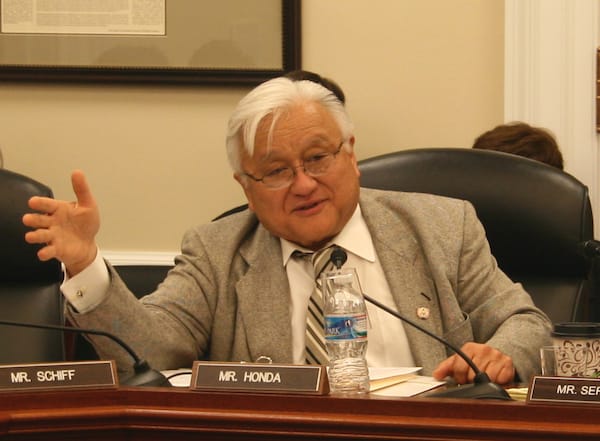
Mike Honda has had a face in local politics for quite some time. Honda's political career started with his election to the San Jose Unified School Board in 1981. From there, he went on to the Santa Clara County Board of Supervisors in 1990, and then to the California State Assembly in 1996. After 5 years representing Assembly District 23, he left the legislature and became a congressman in 2001 for California's 15th Congressional District.
Honda is currently serving his seventh constitutive term in Congress.
He has also been politically successful beyond his elected positions. In November 2003, then-chairman of the Democratic National Committee, Terry McAuliffe, appointed Honda as deputy chair of the DNC. After serving as deputy chair, it wasn't long until Honda was elected vice chair of the DNC in 2005. He served in this position until 2013.
During his time in office, Honda’s legislative efforts have focused on many areas, including, but not limited to, education, civil rights, the environment, LGBT rights, national service, foreign policy, immigration, transportation, and technology.
"It's about getting results, bringing home what people need, and making sure that people understand what I do," Honda says.
Education: San Jose State University -- Bachelor's degree in biological sciences and Spanish, Master's degree in education.
Experience:
- San Jose Unified School Board (1981-1990)
- Santa Clara County supervisor (1990-1996)
- Assemblyman for Assembly District 23 (1996-2000)
- Congressman (2001- )
- 2001-2013 - California’s 15th District
- 2013-2015 - California’s 17th district
Key Issues:
- Job creation
- Raising the minimum wage,
- Protecting women's health and reproductive rights
Committees, Commissions, & Caucuses Assignments:
- United States House Committee on Appropriations (2007)
- Ranking member of the Energy Subcommittee (2005-2007)
- Honda served on the United States House Committee on Science, Space, and Technology (2001 to 2007)
- United States House Committee on Transportation and Infrastructure (2001 to 2007)
- United States House Appropriations Subcommittee on Commerce, Justice, Science, and Related Agencies (2011-2013)
- United States House Appropriations Subcommittee on Labor, Health and Human Services, Education, and Related Agencies
- House Budget Committee (2001-2003, 2011-2013)
- Congressional Asian Pacific American Caucus (Chair Emeritus from 2004-2010)
- Congressional Anti-Bullying Caucus (Founder and Chair)
- LGBT Equality Caucus (Vice Chair and Founding Member)
- Congressional Hepatitis Caucus (Co-Chair)
- Congressional Progressive Caucus (Vice Chair for New Members)
- Democratic Caucus New Media Working Group (Co-Chair)
- Congressional Ethiopia Caucus (Founder and Chair)
- Congressional-Executive Commission on China (Appointed Commissioner since 2005)
Committee Membership:
- House Committee on Appropriations: Subcommittee on Commerce, Justice, Science, and Related Agencies
- Member: Subcommittee on Labor, Health and Human Services, Education, and Related Agencies
Ideology Score: Honda is a far-left Democrat, according to GovTrack's own analysis of bill sponsorship. Honda’s bills have had a total of 379 cosponsors in the 113th Congress.

Photo Credit: U.S. Rep. Mike Honda's congressional webpage
Ro Khanna (Democrat): Teacher, Lawyer, and Politician
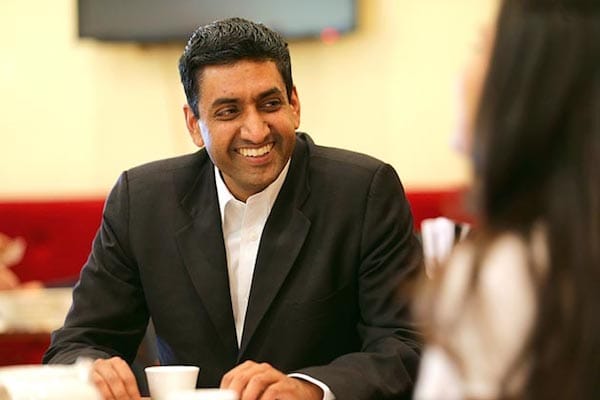
Democrat Ro Khanna, a former Commerce Department official under President Barack Obama, hopes to use his experience to make it to the congressional seat.
Though he has never held office, he has gained a substantive amount of political experience since the last time he ran for Congress in 2003. He challenged Tom Lantos in the Democratic primary in California's 12th Congressional District. After losing, Khanna continued on as an intellectual property lawyer.
Khanna entered the race in District 17 more than a year ago and has gained national attention with his list of robust Silicon endorsements, as well as his his role in the United States Department of Commerce.
Though he has raised over $1 million and reported having $1.7 million cash on hand from tech industry's biggest names, Khanna says he’s not basing his campaign on the tech industry’s narrow interests, but instead advocating a broader, Silicon Valley ethos. His big-name support includes Yahoo CEO Marissa Mayer, Facebook executive Sheryl Sandberg, Google Chairman Eric Schmidt, Napster Co-Founder Sean Parker, investor Marc Andreessen, and venture capitalist Steve Westly.
Education:
- Bachelor's degree in economics, University of Chicago
- J.D., Yale Law School
Experience:
- 12th Congressional District Democratic primary candidate (2004)
- Attorney at O'Melveny & Myers (2004-2009)
- Deputy assistant secretary at U.S. Department of Commerce (2009-2011)
- Attorney at Wilson Sonsini Goodrich and Rosati (2011- )
Key Issues:
- Job creation, especially in manufacturing and technology, and STEM education.
Campaign Themes:
- The Economy: "Promoting economic competitiveness and opportunity in the 21st century must be America’s top priority. A strong economy produces good paying jobs, grows the middle class, and allows people who worked hard their entire lives to retire with dignity."
- Education: "I owe my success today to the fact that I was able to attend fantastic schools – both public and private. But I’m still paying off my student debt, and I know firsthand that affordable higher education is essential to giving hardworking students the opportunity at a fulfilling career with economic security."
- The Environment: "The South Bay is one of the most beautiful regions of the country, with incredible forests, hiking trails, and parks. These natural attributes attract people to live and work in Silicon Valley. Unfortunately, preserving the environment is no longer an abstract debate. The science is indisputable – climate change is happening at an alarming rate, threatening crops and coastlines and causing severe weather patterns that could fundamentally alter our way of life."
- Women in the Workplace: "I am committed to ensuring that women are treated fairly and have an equal opportunity to build a strong economic future for themselves and their families. Having successful women in every sector of the economy moves America forward – bolstering our position as a social and economic leader in the 21st century."
- Working Families: "A strong middle class has always been the cornerstone of our nation’s success. Unfortunately, middle class families are struggling today due to stagnating or decreasing incomes coupled with growing costs of housing, education, and health care – problems exacerbated by misguided government policies."
Photo Source: The New York Times via Redux