On November 8th 2016, Maine became the first state to adopt Ranked Choice Voting as their process to elect state representatives. Now, the citizens’ initiative that passed with over 400,000 “yes” votes, the 2nd highest in Maine’s history, is being challenged by legislators.For those not familiar with Ranked Choice Voting, also known as instant-runoff voting, it is a process where voters rank the candidates in order of preference. If no candidate receives a majority of the votes, the candidate with the least number of votes is eliminated and the voter's second choice becomes their first. This goes on and on until one candidate gets the majority of the votes.
The passed referendum became a law in January 7th, and is set to be implemented in 2018. But voters might not have the last word, since Maine’s Senate voted (with a 24 – 10 vote) in favor of asking for an advisory opinion from Maine’s Supreme Court.
Kyle Bailey, Campaign Manager of the Committee for Ranked Choice Voting, spoke with the George Hale Rick Tayler show about the attempt to delay implementation of Ranked Choice Voting:
“If the Maine’s legislators have wanted to ask for an advisory opinion, they would have done that last year when there was a bill before them. This citizens’ initiative came before the legislators and the legislators voted it out to the people and didn’t ask for an advisory opinion… Now it is a law of the State of Maine, you don’t ask for advisory opinion on an existing law,” said Kyle regarding the senate vote.
Bailey believes the ultimate goal of politicians is to delay implementation of RCV, by undermining the constitutional rights of the people and ultimately dragging the fight out long enough so the initiative loses support and the legislature can repeal it.
“The reality is you change the system, you change the way politicians get elected, you raise some alarms for some powerful politicians and special interest in Augusta who don’t want the system to be changed,” says Bailey. “They never thought we’d ever win this campaign.”
Senate President Mike Thibodeau (R) is leading the legislators who are opposing implementation of Ranked Choice Voting, arguing this will create “chaos” in the next State’s election.
But Maine’s attack on RCV is bigger than we think. Politicians are not only going after the newly established voting process; they’re now taking on the idea of democracy itself. Besides targeting RCV, Maine’s direct democracy is now under fire.
Here’s why.
RCV was adopted under Amendment 31, which gives the people both the power to enact or repeal laws, thus, making any initiative that succeeds under it lawfully constitutional. Because RCV was adopted through a constitutional process, Maine’s legislators will have a hard time trying to invalidate it, so their other option is challenging the initiative process itself!Some mostly conservative legislators are taking the merits of direct democracy head on. Senate Leader Garret Mason
argues, “People can come in here and buy our elections. I hate to say that, but it’s happened way too many times recently,” Mason says.
Republican Governor Paul LePage was even more direct (forgive the pun) saying, “we need to reform the referendum process and we need to return to a representative government,” during the State of the Address on Tuesday night. He argued that direct democracy is not good for the people of Maine, in part, because he believes direct democracy is making the legislators less relevant because the initiative process circumvents their ability of representatives to do the governing.
Senator Thibodeau echoed some of LePage’s consternation with citizen initiatives, saying that the five questions on the 2016 ballot were too much for the people to consider.
On the other hand, Bailey argues that citizens are turning to the initiative process because the legislature is handcuffed by partisanship. The state senate is currently split between 17 Democratic senators and 18 Republican senators, and the state House of Representatives is similarly divided.
Since Ranked Choice Voting was approved by Mainers, 5 separate bills have been introduced into the legislature that would undermine Maine’s direct democracy.
The proposed bills, some of them backed by the Governor, are attacking the citizens’ initiates on many fronts. Bill L.D. 53 would prohibit people from being paid to gather signatures, while bills L.D. 31 and L.D. 212 would require that signatures be collected equally by district, limiting the ability of gatherers to focus on densely populated areas.
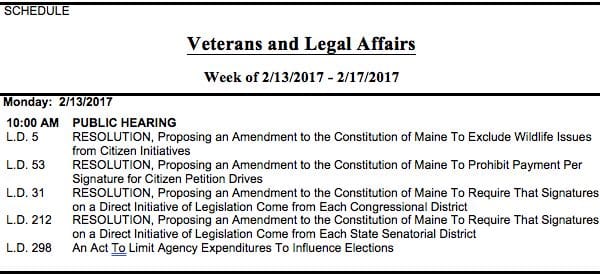
Bailey says that these bill are really just politics as usual, meant to prevent nonpartisan reformers from challenging the highly partisan legislature. He reinforced their commitment to protect democracy in Maine:
“We are going to do everything in our power to defend the law, as well as the constitutional right of Mainers to have direct democracy.”
The Committee for Ranked Choice Voting is encouraging people to speak out, contact their legislator and demand the will of the people to be heard.
To learn more about Maine’s Ranked Choice Voting initiative, visit: http://www.rcvmaine.com/
Image source: Flickr / David Wilson