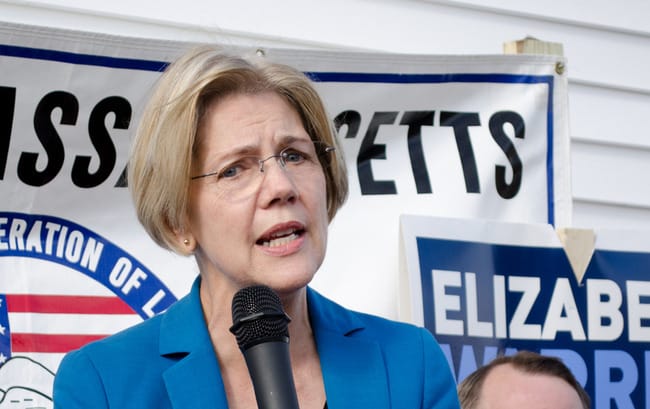
"Every single day, this country invests in big banks by lending them money at near-zero rates. We should make the same kind of investment lending money to students, who are trying to get an education."--Elizabeth Warren
Elizabeth Warren electrified the left last week with her first bill, which stipulates that the federal government should charge the same interest rates for student loans as the Federal Reserve Board charges large banks for overnight loans—a rate currently set at 0.75%. In making this intriguing proposal, Warren makes it very clear that her ultimate purpose is to prevent student loan interest rates from doubling on July 1st from 3.4 to 6.8%-
Critics have been quick to point out that the proposal does not make a lot of economic sense because students default on school loans far more often than major banks default on overnight loans. This proposal, they say, amounts to nothing less than a taxpayer subsidy of the cost of higher education. Warren, who is actually an extremely intelligent person, knows this very well. Her point, I suspect, is that the taxpayers should subsidize higher education. It is a reasonable point.
The Warren bill is the most recent entry in a very long debate about higher education. Most people agree that a college education is a good thing, but Americans have often been divided about what kind of good thing it is. Is higher education a private good—like a new car or a laptop computer—that should be paid for by the consumer? Or is it a public good—like an airport or a park—that benefits everybody and should therefore be supported from public funds.
Education, of course, is both. Studies clearly show that a college education adds a million dollars or more to a person’s salary over the course of a lifetime, making money spent on college a personal investment with a remarkably high rate of return.
But everybody living in a society with a high percentage of college graduates benefits considerably from higher education—even those who never attend or complete college. An educated population produces more growth, creates more wealth, and retains jobs better than an uneducated one. As Anthony Carnevale and Stephen Rose document in their 2011 study “The Undereducated American,” the current graduation rate of 24% is not producing enough college graduates to meet the long-term demand of American industries.
This is very bad news for all Americans. Other countries—especially China and India—are rapidly closing the education gap with the United States and Western Europe. In order to remain competitive over the next 20 years, Carnevale and Rose conclude, America needs to add about 20 million more college graduates to the labor force than we will if the current trends continue.
And this is why, ultimately, Elizabeth Warren’s proposal makes a lot more sense than the current plan to double student loan interest rates to 6.8%--a rate about two points higher than most people pay for a new car. Every increase to the student loan interest rate means that fewer students will complete college, and that those who do will start their careers with greater burdens.
By loaning students money for education, (instead of simply making all college free) we acknowledge that higher education is, to some extent, a private good that benefits those who receive it. But by loaning this money well beneath the commercial interest rate, we acknowledge that education is also a public good that benefits us all.