
Credit: militaryphotos.net
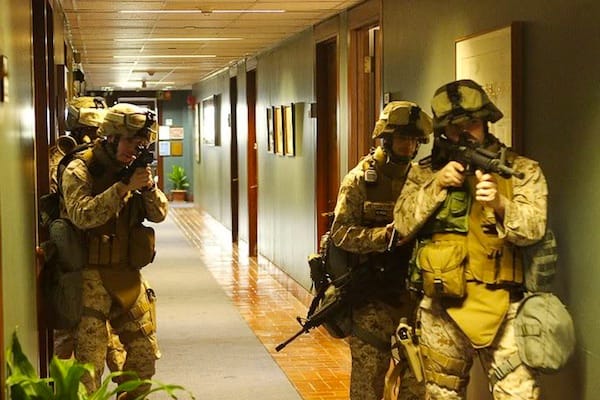
In light of the attack on the U.S. consulate in Benghazi, Libya, Congress has requested an additional 1,000 Marine security guards be added to the Marine Corps Embassy Security Group in order to beef up security at America's overseas diplomatic interests, but fulfilling this request could be easier said than done, and it may not be enough to thwart another attack.
The Marine Corps Embassy Security Group
There are currently about 1,200 Marines serving with the Embassy Security Group in 130 of the 180 countries in which the State Department has diplomatic interests. The congressional mandate would nearly double the size of the Embassy Security Group by the beginning of the 2014 fiscal year, which is when the authorization for the additional personnel begins. It would last for three years.
A Marine Corps spokesman at the Pentagon, Capt. Gregory Wolf, said in an interview with the Marine Corps Times that it shouldn’t be a problem to meet the new staffing requirements, but others aren't so sure.
In the same article, Andrew Bufalo, the author of a book about the Embassy Security Group, "Ambassadors in Blue," points to a number of challenges that the State Department and Marine Corps are going to have to overcome in order to meet the mandate. Bufalo previously served as a detachment commander with the group at embassies in the Republic of Congo and Australia.
According to Bufalo, the Marine Corps has always had challenges meeting staffing demands of the Embassy Security Group because the standards are so high. The Embassy Security Group requires higher quality Marines and, for this reason, many commanders are reluctant to let their best Marines go.
In addition, of those Marines selected to attend the group's training, about 25 percent wash out of the program because they can't meet the requirements.
This has led to Fleet Antiterrorism Security Teams (FAST) being used to fill in gaps in security needs, but as Bufalo points out, the standards for this group are not as high as they are for Embassy Security Group, making it easier for more Marines to become part of these teams. He cautions against lowering standards simply to fill available positions, saying that operations could suffer.
The training for Embassy Security Group takes seven weeks and there are five classes per year. Each class starts with 200 students, but 150 or less will graduate. At that rate, it would take more than a year to fulfill the congressional mandate for 1,000 new guards, well past the beginning of the 2014 fiscal year.
In addition, Marines are limited to the amount of time they spend with the Embassy Security Group, which means that more Marines are leaving as the new guards arrive. Training 1,000 new Marines for embassy security could force the Corps to add more classes, but this presents another problem.
Training more Marines would facilitate the need for more instructors or larger classes with each Marine receiving less attention and scrutiny. Instructor positions are always hard to fill because they require experience and training, above and beyond the students they are teaching. Again, this means that operations could suffer.
The Bureau of Diplomatic Security
The Marine Corps Embassy Security Group is responsible for the security of the State Department's physical locations, though their duties often overlap with the Bureau of Diplomatic Security, the civilian force responsible for the security of information and the people working for the State Department. The Bureau of Diplomatic Security has final authority.
The shortage of Marine security guards is not the only problem the State Department faces when it comes to the security of its interests.
In fact, the Government Accountability Office issued a report back in 2009 detailing multiple security shortcomings at the department's various sites and recommended that the department conduct a review of the Bureau of Diplomatic Security. As of November 2012, that review had not been done as recommended.
According to the GAO's November 2012 report:
"Diplomatic Security faces several policy and operational challenges. First, State is maintaining missions in increasingly dangerous locations, necessitating the use of more security resources and making it more difficult to provide security in these locations. Second, although Diplomatic Security has grown considerably in staff, staffing shortages, as well as other operational challenges, further tax Diplomatic Security's ability to implement its mission. Finally, State has expanded Diplomatic Security without the benefit of adequate strategic planning."
While the Bureau of Diplomatic Security tried to take steps on its own to improve, they fell woefully short.
"We appreciate the steps that the Bureau has taken on its own initiative," the GAO report said, "however we continue to believe that the Department, and not the Bureau, needs to take action in order to strategically assess the competing demands on Diplomatic Security and the resulting mission implications."
Had the State Department done as the GAO recommended, it's possible that adequate security would have been available in Benghazi and that the four Americans lost would still be alive.
While it's admirable that Congress wants to increase security assets now, as well they should, it's a little like closing the barn door after the horse is already out. The rush to solve continued security challenges at U.S. embassies and consulates could end up causing more harm than good if the right people aren't adequately trained and equipped to do the job, and it isn't part of an overall revamping of embassy security.