Photo credit: novus2.com
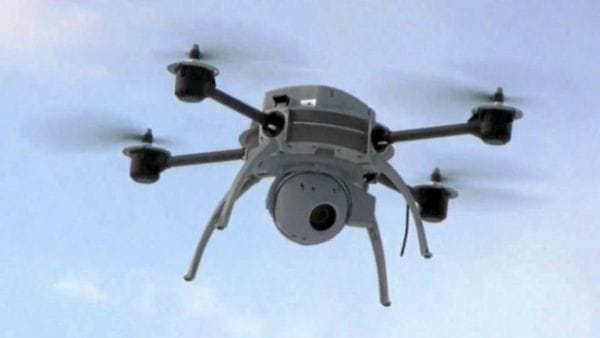
The recent spike in domestic surveillance could represent an increase of police force "militarization" to some, an argument which is primarily defended through public safety measures. In San Diego, CA, the County Sheriff Department's interest in a Scout unmanned aerial vehicle (UAV) has remained shrouded from public knowledge.
Similar to other police forces throughout the US, Freedom of Information Act (FOIA) requests regarding the use of unmanned aerial vehicles have remained painstakingly unfruitful.
This was the case until MuckRock and the Electric Frontier Foundation's (EEF) Drone Census report began examining the issue nationally. The San Diego County Sheriff's Department received the FOIA request and, to no surprise, initially responded that it had no documents to release dealing with the issue of drones.
MuckRock finally received correspondence from the Seattle Police Department regarding "clear evidence of drone interest in San Diego."
San Diego's interest in the Scout UAV, manufactured by Datron World Communications, a Seattle-based information systems corporation, is evidenced in a MuckRock article that includes over 250 pages of e-mails, internal memos, contracts, and sales quotes.
Datron released the following in an e-mail as part of the FOIA request, which read:
"Attached is the quotation recently provided to the SD Sheriff's CID team. They visited Datron's facility and experienced the system with all three cameras, and left with a flash drive full of personal footage and a new found purpose for submitting their wish-list early. Use this quote as a reference point for configuring your system. With this we should be able to tailor an ideal system for your needs, and gain market support for 'special pricing' specifically for Seattle PD."
The Datron sales representative sent this to Seattle PD to use San Diego County as a "reference point" in designing a system of their own. Datron quoted San Diego an estimate totaling nearly $131,087 for one Scout UAV, including thermal imaging packaging and operator training at the Datron facility in Vista, CA.
The San Diego County Sheriff's Department was not on the EEF's list of public agencies that had gone through FAA authorization to fly drones in domestic airspace, however.
Responding to MuckRock regarding the issue, a legal representative for the sheriff's department sent out this response: Photo credit: muckrock.com
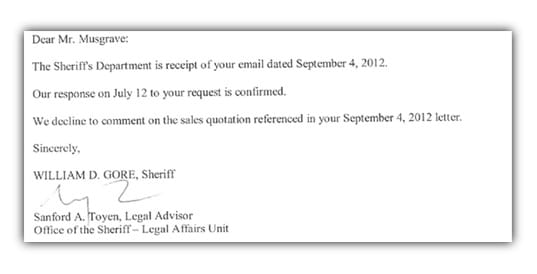
California law stipulates that all documents related to equipment purchases are subject to public record. This holds that the sheriff's department has the ability to justify the denial of public request, but not to "deny comment," as a representative had initially responded in the e-mail.
As a result of this exchange, the San Diego County Sheriff later admitted that the department did not buy a Scout UAV, nor were they looking to buy drones for the county.
Drone Use in Police Departments Nationwide
Though San Diego County never saw the purchase of a drone, several counties throughout the country went forward with UAV surveillance programs.
Seattle PD recently apologized publicly for green-lighting their own drone program without going through the city council first. In Alameda County, CA, citizens were up in arms; protesting their outrage when the county's plans for a drone program were made public. As this process is seemingly facilitated behind closed doors, public outcry for information on this issue is palpable.
According to a Washington Times article, in August of 2011 a U.S. Government-owned UAV was deployed in Lakota, ND in response to a farmer who refused to return twelve cows that wandered onto his pasture.
The event escalated when the farmer became engaged in a standoff between Grand Forks police SWAT and the county sheriff's department. This was the first known time a drone has been used domestically.
These drones, initially used by the Department of Homeland Security (DHS) and Border Patrol units, have been used to assist local law enforcement.
A December 2011 report issued by the ACLU, titled "Protecting Privacy from Aerial Surveillance," offered recommendations regarding the use of drones by local law enforcement. This was in response to the FAA's proposed rules, which would simplify drone use by local law enforcement.
"The report recommends that drones should not be deployed unless there are grounds to believe that they will collect evidence on a specific crime. If a drone will intrude on reasonable privacy expectations, a warrant should be required. The report also calls for restrictions on retaining images of identifiable people, as well as an open process for developing policies on how drones will be used."
These recommendations included stipulations for unmanned aerial vehicles, which included usage restrictions, image retention restrictions, public notice of surveillance programs, democratic control, as well as auditing and tracking effectiveness of the programs.
The propagation of domestic surveillance is worrisome to most, as the fear of becoming a "surveillance society" is in stark contrast with the constitutional rights championed by Americans. Though a beneficial tool in law in order, it can be argued that the use of drones is overstepping federal and state, governmental, and local jurisdictions.