
 Independent Voter Podcast
Tune in for our independent breakdown of Trump’s record-length 2026 State of the Union: voter ID + proof of citizenship, immigration rhetoric, affordability vs “winning” messaging, a rare bipartisan beat on banning stock trading, and the moment the chamber unified around a Coast Guard rescue.
Episode Highlights
In this episode of the Independent Voter Podcast, the team breaks down the political firestorm surrounding the latest State of the Union address, voter ID laws, and the growing national debate over proof of citizenship requirements under the SAVE Act.
Drawing on our new polling data, we highlight a crucial nuance in today’s election reform conversation: while a majority of voters – including independents and many Democrats – support voter ID, there is deep mistrust over which party controls the narrative and implementation.
The discussion connects this trust gap to broader concerns about election integrity, voter suppression narratives, closed primaries, and partisan messaging, underscoring how political rhetoric often undermines widely supported reforms.
We then widen the discussion to talk about the structural drivers of polarization, including gerrymandering, noncompetitive House races, and closed primary systems that incentivize extreme candidates over consensus builders. With less than 5% of congressional races considered competitive, we argue that systemic reform — including independent redistricting commissions, open primaries, and ranked-choice voting (RCV) — is essential to reducing hyper-partisanship.
We then spotlight Wisconsin Governor Tony Evers’ push to ban partisan gerrymandering, legal challenges to primary exclusion in states like New Jersey and Florida, and ongoing reform battles in Maine, where ranked choice voting continues to face constitutional hurdles.
Finally, the episode tackles the escalating influence of money in politics, Super PAC spending, a defunct Federal Election Commission (FEC), and constitutional amendment efforts like the For Our Freedom Amendment backed by American Promise.
 Shawn Griffiths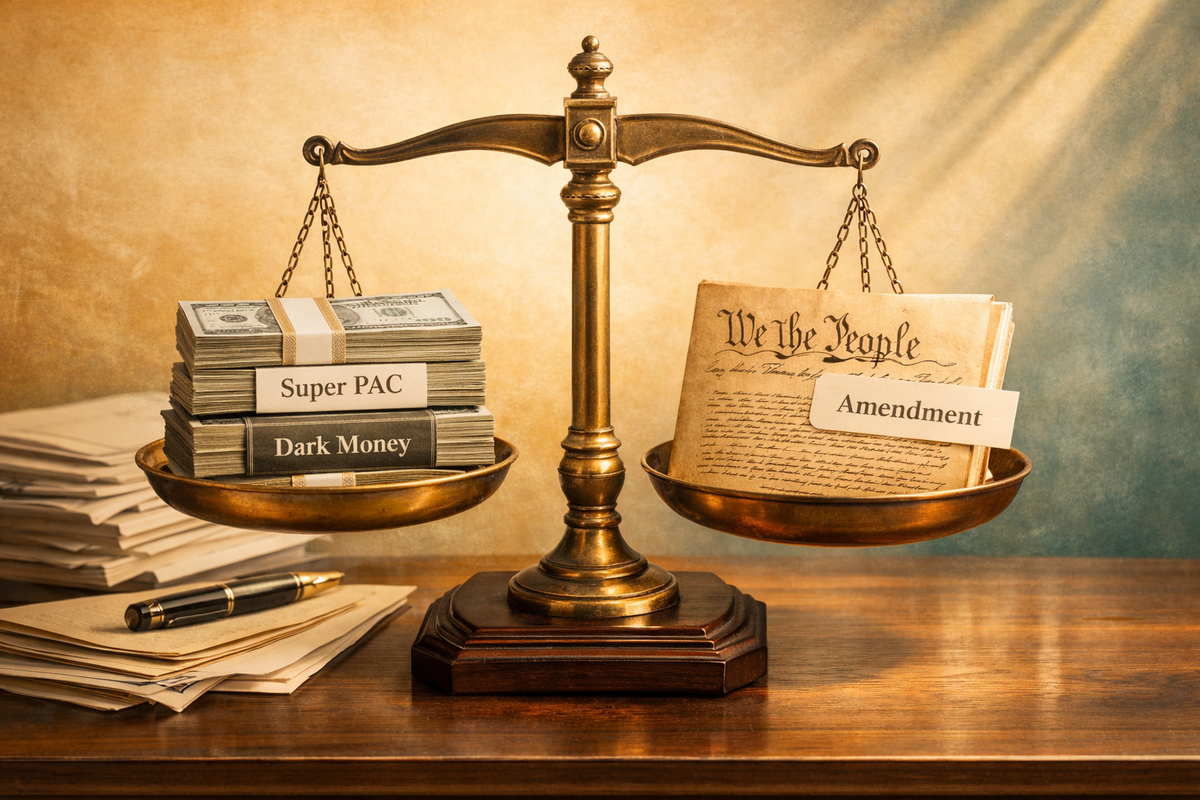
With campaign finance reform polling as an “80/20 issue,” we warn that the 2026 election cycle could resemble the “Wild West” amid regulatory paralysis.
Yet despite deep political division, we end on a hopeful note – pointing to bipartisan moments during the State of the Union, growing collaboration between election reform movements, and rising engagement from independent voters seeking to reshape America’s democratic system.
 Susan von Seggern