
Bipartisan Policy Panel: Independents Should Vote in Our Primaries
 Jane Susskind
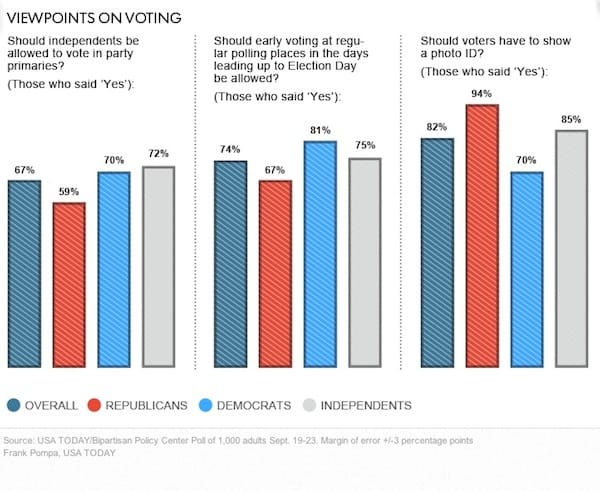
According to a recent USA TODAY/Bipartisan Policy Center poll, Americans are increasingly supportive of electoral reforms aimed towards easing the hyper-partisanship that has plagued the 113th Congress. When asked about redistricting, 35 percent of those surveyed said that legislative district lines should be drawn by a bipartisan commission of selected state officials, 28 percent say the state legislature and governor, and 22 percent say the state supreme court, BPC reports. When asked if independents should be allowed to vote in primary elections, Americans overwhelmingly said yes, by a 67 to 24 percent margin. Independents responded with an even larger margin, with 72 percent supporting the inclusion of independent voters in the primary election. When asked if citizens should be allowed early voting at regular polling places in the days leading up to Election Day, 74 percent of Americans said yes. When it comes to Voter ID laws, 84 percent support requiring people to show a government-issued photo ID.
To discuss the findings and electoral reform in more detail, the Bipartisan Policy Center (BPC) held its third National Conversation on American Unity, an interactive town hall meeting, inviting panelists, students, politicians, and citizens to join panel discussions at Ohio State University or online. Speaking about the partisan divide and the role of independent voters were former Democratic and Republican Ohio Governors Ted Strickland and Bob Taft, former cabinet members Ann M. Veneman and Dan Glickman, former congressman Henry Bonilla, former Ohio Speaker of the House Jo Ann Davidson, and Victoria Kennedy.
Issues ranged from multi-member districts, the primary process, voter education, redistricting committees, voter fraud, to online voting, and while panelists disagreed about specific electoral reforms, they seemed to agree that the root of the problem is in the polarization of our elected officials.
"We are encouraged in so many parts of our lives to radicalize our approaches, it's true in school, it's true in sports, and it's true in politics. The problem is that it's dangerous in politics," Glickman said.
Some panelists suggested that partisanship has increased because the parties are not strong enough anymore. They argued that parties have been weekend and that stronger parties would better represent people.
But, if the problem is in the polarization, can we really work toward electing less radical candidates by strengthening party control?
By nearly 3-1, Americans believe the solution is to let independents vote in primaries, backed by the argument that "Independents should be allowed to vote in party primaries because it will help produce candidates in both parties who are more moderate and more willing to compromise."
The problem the question ignores, however, one also unanswered by the panelists, is that the Supreme Court has held that “forcing parties” to allow non-members to vote in their primaries violated the parties’ first amendment right of private association. (See, California Democratic Party v. Jones).
What this means is that independents are constitutionally prohibited from participating in partisan primary elections unless the parties, not the state, allow them to. The reason: in 47 states that have partisan primaries, the main purpose of the primary elections to elect a leader of a party. In short, these 47 states have granted parties a private right to control their leadership nomination through the state-funded primary process.
There is an alternative to partisan primaries though, an alternative that sidelined in the BPC panel discussion. Nonpartisan primaries are conducted in three states. Rather than having a purpose of electing a party leader, they are conducted to narrow the field of candidates to be on the general election ballot, regardless of party affiliation.

Given the partisan paralysis in Washington, we should go beyond bipartisan solutions and demand nonpartisan solutions.
You Might Also Like


