Bay Delta Conservation Plan Could Tunnel California Funds

 Cheyenne Cary
A slide from BDCP's August 29 public meeting. Credit: BDCP
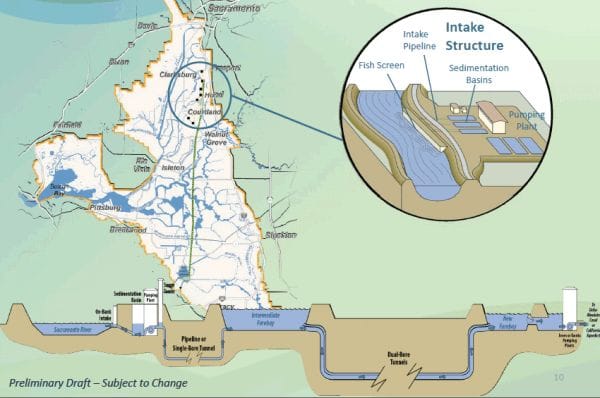
With a price tag in the tens of billions, the proposed Sacramento-San Joaquin water conveyance system is a financial heavyweight of a project. Five years of construction would create an historic new piece of California’s infrastructure that would funnel water from the Sacramento River Delta southward through the city of Tracy and beyond. Ultimately, the project would move water toward the thirsty cities and farmland of southern California.
Cost estimates from the Bay Delta Conservation Plan start at $23 billion and independent analyses spiral upward to $47 billion or more. The conveyance system would provide southern California with greater access to an essential commodity, but how can funding be sourced? How will the project impact ratepayers? Can the expense be justified?
After six years and $150 million in planning, the official answer remains “we don’t know.” Due to some political finagling, the tunnel project escaped a required cost-benefit analysis and funding sources remain largely unidentified. Skeptical lawmakers introduced a bill that would prevent the BDCP from moving forward until such a cost-benefit analysis was completed, but the Assembly Appropriations Committee killed the bill back in May.
The consequences of this is that the whole project can keep flowing smoothly without so much as a vote in the Legislature.
Under the State Water Project, the tunnel plan is off-budget, meaning that all costs are free from Legislative oversight. The nonpartisan Legislative Analyst’s Office reported that “SWP’s off-budget status makes it difficult for the Legislature to evaluate the entire water system [...] and evaluate whether the costs of BDCP planning are reasonable.”
Sources for funding the project are also unclear. Until recently, Governor Jerry Brown planned to finance part of the project through a “water bond” that would appear on the ballot for the 2012 general election. However, the California State Legislature voted to postpone the bond until 2014 ”to improve its odds of success with voters,” according to a statement from Assemblyman Henry T. Perea’s Office.
Early reports from the BDCP assumed that the State Water Project and the Federal Water Project would split the costs 50/50, but the most recent administrative draft states that contractors “have not agreed upon a specified allocation of costs,” and “as actual cost allocations are determined, this assumption may change.”
No matter how things turn out, the SWP would be one of the largest sources of funding for the project. This means that the state project would pass on costs to its contractors in local water districts, who would then pass on the costs to their customers.

An independent analysis of the Los Angeles Department of Water and Power, which imports the vast majority of its water from the SWP, estimates that the tunnel project would increase LADWP water rates by $273 to $546 per acre-foot by 2020, or 24 to 48 percent. The same review recommends conservation, water reuse, and even desalination of groundwater as financially favorable alternatives to importing water from a highly expensive SWP.
The tunnel plan, as it stands now, represents a gigantic expense with limited benefits in both the short and long term.
University of the Pacific’s Business Forecasting Center issued a wide-range analysis that put the tunnel plan’s final ratio of benefits to costs at 0.3 to 0.5. This means that for every dollar spent on the project, taxpayers could expect thirty to fifty cents back. These benefits include the total amount of water moved over the life of the project, increased water security in the event of an earthquake, and the highly-debated boost to the Delta ecosystem.
The continued life of the BDCP depends on finding vastly different alternatives to the current plan, and not just raising the cap on maximum water exports as Brown proposed in a meeting this month. It’s going to take something innovative, something ingenious, and something that’s not exactly the same plan from thirty years ago.
You Might Also Like