
Photo: Chris Clark
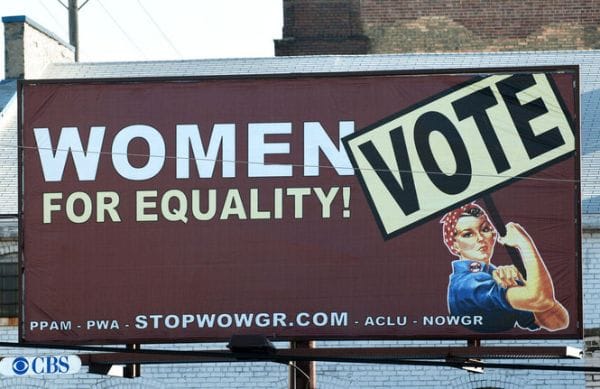
I’m not going to talk about abortion or, to use a Washington representative’s recent phrase, “that rape thing.” I’m not going to talk about percentages or numbers, herding women into corrals of data for candidates to pick at or divvy up. Women matter this election because they fought tirelessly to earn suffrage and, in their attempt to exercise that right, are simplified and objectified.
On October 23, Gallup released a poll examining the gender gap in this year’s election.
“Despite the great attention paid to the importance of the women's vote in the 2012 election, there has been a larger change in men's than in women's preferences compared with 2008.”
Gallup continues:
most important problem facing the nation
While, statistically, men may have changed their party preference since 2008 in larger numbers, the statement misses the mark in that women do, in fact, matter more in this election season.
That’s because women’s issues aren’t just “women’s issues.” The gender-specific concerns of women address a larger-scale attack on fundamental rights to self-determination, access to health care, and economic equality.
Last Thursday morning, CNN removed an article from their website titled “Study looks at hormones and voting.” The article, written by a woman, looked at the supposed correlation between a woman’s hormonal cycle and her voting tendencies. The piece attracted over 300 comments and prompted subsequent posts about its tastelessness on a multitude of sites.
Women are, no doubt, an important demographic to the election. After all, they are business owners, heads of households, white-collar workers, blue-collar workers, liberals, conservatives, students, public servants, doctors, soldiers, and everything in between. Each is one human, one vote, encompassing the societal roles held by all Americans.
With less than a week until November 6, female voters have garnered an increasing barrage of attention from all media outlets. Campaigns have paid particular attention to how they speak to the female demographic in these important last days. Yet, women have faced significant challenges to the ways in which they have been able to contribute to the conversation and how they are spoken about.
A recent New York Times piece delineates the types of women voters that exist, according to different research organizations and polls. At one point in the article, however, the author describes data from Scarborough Research, a market research firm.
The data yields other tidbits that could be useful to campaigns trying to reach independent women. Their taste in television programming, for example, runs to the daytime soaps, their preferred soft drink is Diet Sierra Mist, and their preference in wine is, fittingly, rosé.
Here, the word “fittingly,” inserted by the writer, highlights a conversation in which women are labeled, told, and molded at will. Their “taste in television programming,” including “daytime soaps,” implies that women are at home all day. They do not work. They drink diet soda. They care about physical appearances. There was no description in the article on methodology of the study, nor does it differentiate between demographics within the female population.
Jon Stewart, on The Daily Show, pointed out that the language surrounding woman voters is sexualized and objectifying. Particularly, Stewart cites pundits’ use of the phrase “turn on,” as a means to describe whether or not female voters will vote for either candidate at the polls. Similarly, a recent Wisconsin radio ad stages a conversation between two women in a coffee shop. One identifies the candidate, “He’s the cute one, right?”
The authors of both the CNN piece and the New York Times piece are women (the CNN writer apologized if she caused offense). However this isn’t a war on women by males – it isn’t a male assertion of dominance of authority. The struggle goes beyond traditional feminist fights. Caring about the conversation about the female vote, the characterization of their voices, and the rhetoric employed in attaining their attention is paramount to a democracy that champions individuality, economic worth, and freedom.