The Rise of an Idea: Libertarianism and American Politics

 Conor Murphy
credit: rickety.us
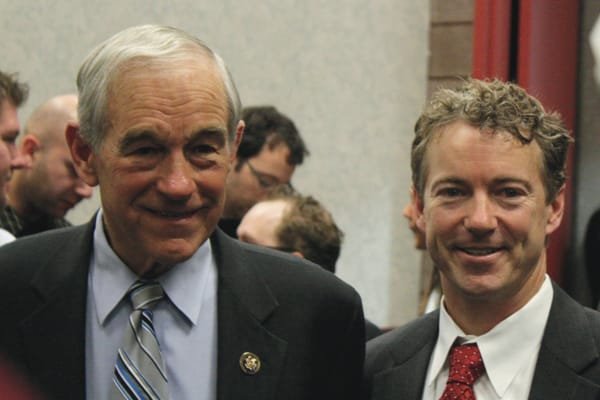
Much has been written about Rand Paul and his rise to prominence after his historic filibuster last month. As big and as important as that story was, more focus should be concentrated on the rise of the libertarian movement itself.
The last time libertarianism has had this much of a voice in a major party was almost fifty years ago when Goldwater was the Republican candidate for president. Since that time, the liberty movement has had little to no voice in the national spotlight.
Libertarianism seemingly had a place in the Republican Party at the beginning of the Reagan administration, but libertarians quickly learned that Reagan would be unable to shrink government at an adequate rate.
Looking back on the eighties, government actually grew as spending increased, so it was very difficult to see Reagan as an economic libertarian even though he expressed support for tax cuts. It was during this time that Ron Paul left the Republican Party due to his feelings that it had abandoned its roots and principles.
Ten years ago, this country had just begun the invasion of Iraq with widespread public support. There was no concern over a declaration of war, presidential powers, or civil liberties. Any Republican (or Democrat for that matter) who questioned the mission, the policy, or its constitutionality was considered unpatriotic.
While Ron Paul was back in Congress as a Republican once again, the party had come a long way from the anti-imperialism favored by “Mr. Republican”, Robert Taft. This was a Republican Party that went from being a staunch defender of limited government to a party that supported preemptive war and was instrumental in passing the Patriot Act.
Even in President Bush's second term, when the war became more unpopular with the left, most conservatives stood with the president in support of the war and the administration's foreign policy in general.
Libertarianism finally got some air time in 2008 when Ron Paul decided to run for president. Unfortunately for Dr. Paul, the Republican Party was still very much the party of Bush, Cheney, and Rumsfeld. When he wasn't being ignored completely he was ridiculed and laughed at by the rest of the party.

Although Congressman Paul was easily defeated for the party nomination, he sparked what his supporters still call the Ron Paul Revolution. These passionate supporters were the core of what was to become a much more influential libertarian wing of the Republican Party.
Throughout the next four years, libertarianism saw victories all over the country. In 2010, Rand Paul and Mike Lee were elected to the Senate, while Justin Amash was elected to the House.
In 2012, Ron Paul retired from Congress, but by then there were even more liberty-minded candidates winning office. Ted Cruz was elected to the Senate, while Thomas Massie and Kerry Bentivolio were elected to the House. Liberty-minded Republicans were becoming more viable as candidates.
Just four years after being defeated in 2008, Ron Paul decided on one last presidential run. This was a much different campaign than Paul's last one. Unlike in 2008, many of Paul's primary opponents, such as Newt Gingrich or Rick Perry, were beginning to agree with his stance on the Federal Reserve.
Jon Huntsman even joined Paul as another Republican to call for immediately bringing troops home from Afghanistan. While unsuccessful in securing the party's nomination once again, Dr. Paul received over two million votes during the primaries, succeeded in his efforts to bring attention to monetary policy, and was able to convince the Republican Party to officially take a stand against the Fed.
In 2013, Ron Paul retired after serving twelve terms in the House. Despite having large shoes to fill, Rand Paul accomplished something that took his father almost thirty years to do; he garnered national recognition for himself and libertarian philosophy in general.
He brought the issue of drones and government authority to the center of the political debate and even more amazingly, had individuals and groups from all ends of the political spectrum stand up and praise his position.
From Alan Colmes and Sean Hannity to Campaign for Liberty, Heritage Foundation and Code Pink, all of them stood on the side of Rand Paul and the constitution against the president. One would be hard pressed to find any person or issue that ever unified a coalition that was this diverse against a sitting president.

It seems as though Rand Paul has begun to prove what libertarians have known all along: liberty brings people from all sides together.
During his “Rally for the Republic” back in 2008, Ron Paul might have said it best when he boldly proclaimed, “An idea whose time has come cannot be stopped by any army or any government."
If Ron Paul is right (and he usually is) then libertarianism might just have a bright future after all. It's not there yet, but after many years it is finally headed in the right direction.
You Might Also Like