Fix Congress Now Caucus Brings Compromise to Washington

 Heather Rogers
Credit: NewsDay
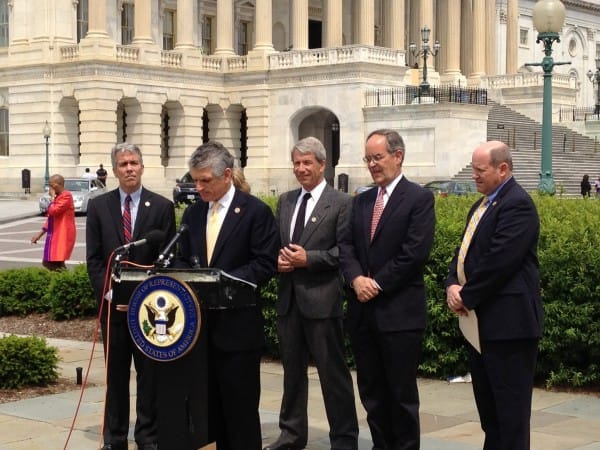
A unique example of bipartisan teamwork, the Fix Congress Now Caucus has been founded in the House to attempt to pass legislation through compromise. The caucus was initiated by Rep. Scott Rigell (R-VA), and co-founded by Rep. Reid Ribble (R-WI), Rep. Kurt Schrader (D-OR), and Rep. Jim Cooper (D-TN), making it an even group of two Democrats and two Republicans.
They have developed a mission statement defining the purpose of the caucus which is to,
Identify, agree upon, and move forward legislation and rule changes that will fix this institution to such a degree that we are able to fully meet our deep obligation to our fellow Americans -- and to our children and grandchildren. And we will be bold in our efforts to truly make a difference.
In May, the caucus announced its support of HR3643, the No Budget, No Pay Act, which halts the pay of all members of Congress if both houses have failed to approve a budget and all the regular approbations bills for a fiscal year before October 1st of that year. The act has been co-sponsored by more than 40 members of Congress since its inception in December 2011. It's also a major piece of No Labels' advocacy program.
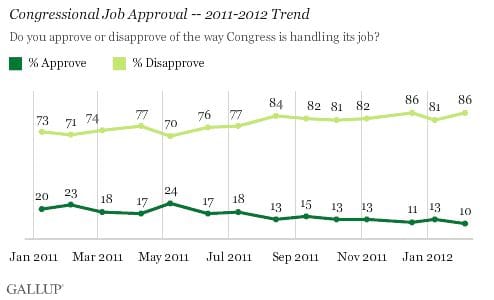
According to No Labels, Congress has successfully passed a federal budget on time only four times in the past 60 years. This continual failure has led to the bleak approval rating of Congress, currently holding steady at around 16%, near its lowest approval rating in history.
Congress is dominated by the parties who largely refuse to compromise. The Fix Congress Now Caucus is optimistic that acts like the No Budget, No Pay Act will force party members to work together in order to modify the dismal fiscal climate. Credit: Gallup Politics
Thomas Mann, of the Brookings Institution, said recently in an interview with the Associated Press that Republicans and Democrats alike treat Congress as “a strategic game in which the legislative process is used to advance one’s party prospect in the next election.”
The caucus hopes to reform this stagnant climate, so Congress will be able to accomplish its goals without such fervent opposition from parties which are in direct opposition with one another.
“The American people need to ask their Congressmen to vote for their country and their conscience, not for their political party,” says caucus member Rep. Jim Cooper (D-TN).

If this is what the American people want, compromise that fuels results which reflect their needs, then they must demand as much from their elected representatives.
The Fix Congress Now Caucus is currently comprised of 12 members, 4 Democrats and 8 Republicans. They are endeavoring to grow as they seek more members from both sides of the political aisle. As their numbers increase and congressional constituents become more vocal about their disapproval of Congress, the climate in Washington will eventually be forced into change.
You Might Also Like