The Climate Change Discussions Fail Once More

 Lucas Eaves
Photo: UNFCCC
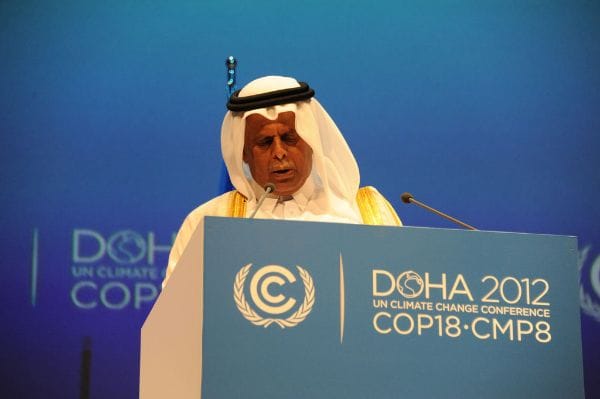
Discussions about climate change in the United Nations have been going on for 20 years, without much success. The fact that negotiators failed to deliver even the minimum requirements of the Doha summit this year is another example of the incapacity of the world nations to address an issue of which the consequences are more and more tangible.
The Doha Summit was set to close Friday, but discussions drew out into Saturday and resulted in the adoption of a hurried series of texts, the scope of which remains highly disappointing. Indeed, the only agreement that came out of the two weeks of negotiations was an extension of the Kyoto protocol until 2020 for the European Union, Australia and 10 other developed nations, countries only representing 15% of global carbon emissions.
Despite pressure from civil society and scientists to reach an agreement on a variety of other issues, the negotiations remained at a stalemate on Friday night. Even the emotional speech made by the official delegate of the Philippines, which was hit by a typhoon on Tuesday resulting in more than 500 deaths, did not convince the major players to make the necessary concessions.
"The outcome of our work is not about what our political masters want. It is about what is demanded of us by 7 billion people. I appeal to all, please, no more delays, no more excuses. Please, let Doha be remembered as the place where we found the political will to turn things around. Please, let 2012 be remembered as the year the world found the courage to find the will to take responsibility for the future we want. I ask of all of us here, if not us, then who? If not now, then when? If not here, then where?"
Going over the allocated time has become a tradition in the climate change negotiations (the conference in South Africa last year lasted 36 hours longer). By Friday, delegates increased their efforts to reach agreements before morning, particularly as food and water ran low.
https://twitter.com/pwatkinson/status/277122672062758913
However, even with one more day of negotiation, two main areas of contention remained unsolved by the time the conference closed.
Tension ran high between developed countries and least developed countries about a funding agreement for emissions reductions. At the Copenhagen summit in 2009, rich nations pledged to give $100 billion annually to developing nations by 2020.The developing countries argued they need $60 billions from 2013 to 2015 in order to deal with "climate change-induced rise in droughts, floods, rising sea levels and storms." With the US and the EU still struggling economically, they did not agree on any concrete figures, a major fallout of the Doha summit.
Another important topic was the future of "hot air," the 13 gigatone of unused trade-able carbon emission permits that were given to Eastern European nations when they entered the Kyoto protocol. The nations of the Pacific, as well as less developed countries, consider the elemination of this surplus an essential condition for an agreement in Doha. Eastern countries, on the other hand, especially Poland, do not want to give up such a benefit.

The final text does not cancel these permits but the EU, Australia, Japan, Noway and Switzerland committed themselves to not buy any of these permits in order to reach their goals under Kyoto II. This means that in reality these permits will not be exchangeable until 2020.
The disappointing outcome of the negotiation has been criticized by developing countries, the Philippines and NGOs have been particularly vocal about their discontent.
https://twitter.com/ecoflo/status/277465056348876800
https://twitter.com/WWF/status/277478997665918977
You Might Also Like