Republicans and Democrats Both Losing Battleground States

 Jane Susskind
Abysmal congressional approval ratings have become the norm in our hyper-partisan political environment and government dysfunction is now cited as the most pressing issue facing our nation. Problem solving and compromise have been replaced by party politics and congressional gridlock, bringing our government to a halt in 2013.

But it would be a mistake to say that Republicans and Democrats don't compromise on anything. Over the last 200 years, they have worked together to create districts that work in each party's favor to eliminate competition and thereby strip voters of a meaningful vote. In state after state, they have joined forces to restrict voters who choose not to affiliate with their political parties from participating in their “private" primaries.
Their attempt to silence unaffiliated and independent voters, however, has backfired.
Since 2008, independent voter registration has increased 17.4 percent in the 10 states with the most competitive Senate and gubernatorial elections in 2014, according to a new study released by Third Way. In terms of voters, that is an increase of 1,337,765 independent voters.
Meanwhile, Democratic registration has decreased by 658,112 (4.8 percent) while Republicans registration has increased slightly by 359,903 (3.3 percent). Voter registration change in competitive senate elections 2008-2014, Courtesy of Third Way
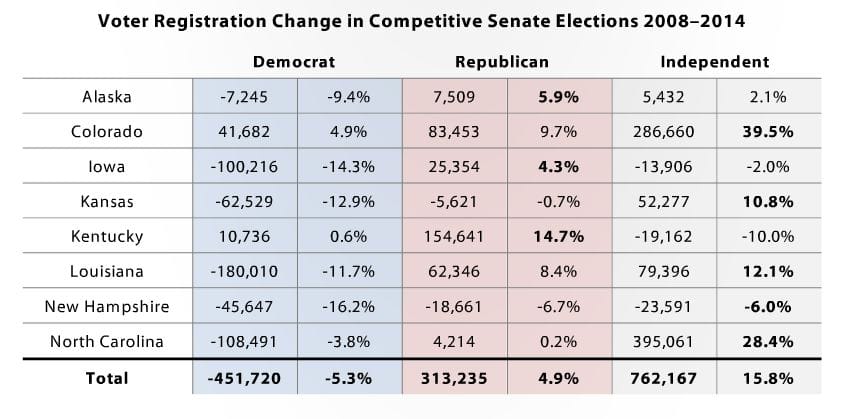
The ten states identified by Third Way as battleground states in 2014 are Alaska, Colorado, Florida, Iowa, Kansas, Kentucky, Louisiana, Maine, New Hampshire, and North Carolina.
Independent voters are not only increasing at a much higher rate than party voters, but in Colorado, Iowa, Maine, and New Hampshire they outnumber Democrats and Republicans.
In Alaska, independent voters are the majority.
What does this mean for the November midterm elections? Candidates in these states will have to look outside their party labels in oder to appeal to independent voters, as these voters will likely decide who controls the Senate in 2014.

Take Kansas, for instance. Independent candidate Greg Orman holds a commanding lead against his opponent, Republican Senator Pat Roberts.
While historically a "red state,” Kansas has seen a drastic shift in voter registration since 2008, with independent voters now outpacing Republicans as the fastest growing proportion of the electorate. In 2008, Roberts only won 50 percent of the independent vote, drawing into question his ability to maintain his seat in an increasingly “purple” state.
Across the nation, we are witnessing a shift in political attitude, with 42 percent of Americans now identifying as political independents and a majority saying that the major parties no longer represent them. Candidates must reassess how they approach campaigning if they expect to win.
You Might Also Like