Meet The 8 Senators Who Voted Against the NDAA

 Thomas A Hawk
We talk about the political divide in Washington and the gridlock that prevents anything from getting done on Capitol Hill. Yet, if there is one thing both parties can agree on, it is the topic of defense, war, and foreign policy.
That was evident this week when the Senate approved the National Defense Authorization Act in a 89-8 vote. The bill authorizes $700 billion in military spending for the next fiscal year.
The US is now on track to have the largest military budget in the decade-plus wars in Iraq and Afghanistan. The bill would require Congress to repeal budget caps on several federal agencies, including the Pentagon, passed in 2011.
Yet there was notable opposition in the Senate on both sides of the aisle to this massive increase in military spending.
US Sens. Bob Corker (R-Tenn.), Kirsten Gillibrand (D-NY), Patrick Leahy (D-VT), Mike Lee (R-Utah), Jeff Merkley (D-Ore.), Rand Paul (R-Ky.), Bernie Sanders (I-Vt.), and Ron Wyden (D-Ore.) bucked the partisan establishment and voted no on the bill.
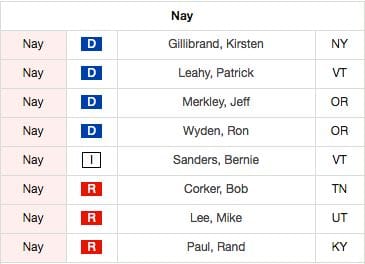
Image Source: GovTrack.us
For those who know these lawmakers, their opposition may not come as too much of a surprise.
US Sen. Rand Paul, for instance, has long taken a stance of sobering the nation's foreign policy and approach to war and military operations.
Paul introduced an amendment to the 2018 NDAA that would have repealed the 2001 and 2002 resolutions authorizing the use of military force (AUMF) for the wars in Afghanistan and Iraq.

Paul's amendment was defeated, but he noted on the Senate floor, "For the first time in 15 years, we are debating the congressional role in the declaration of war."
US Sen. Bernie Sanders also has a fairly consistent voting record on defense spending. He has voted no on nearly every NDAA in the past 10 years.
"Foreign policy is about U.S. government budget priorities," said Sanders during a foreign policy speech at Westminster College in Fulton, MO.
Sanders often priorities domestic issues -- like health care and anti-poverty programs -- over defense when it comes to the federal budget.
The NDAA has long had bipartisan support. It doesn't seem to matter how much is spent or where the money goes, the NDAA has an impressive 55-year track record of passing in Congress.
There may be good things about the 2018 NDAA. There may be bad things. Very few people know because the issue gets very little discussion in Congress and in the media.
With such a huge increase in spending, we should have a discussion about why this increase is needed and where the money is going.
You Might Also Like