Government Provided Healthcare Unfavorable Among Many Americans

 Zachery Abramson
Credit: Human Events

According to a recent Gallup poll American opposition to government provided healthcare has continued to rise steadily since 2007. Compared to a 2000 number of 64% in favor of making healthcare a responsibility of the federal government, the recent poll results of 44% in favor represent a distinct shift in the mentality of the American public.
Healthcare reform has been pushed into the limelight in the past two election cycles, particularly given the recent controversy surrounding the Affordable Care Act, popularly known as "Obamacare." According to Gallup, support for such a measure reached its apex in 2006, with 69 percent of American support. Favorability for government provided healthcare has declined steadily each year since then.

The ACA has been met with heavy criticism from political opponents, as well as ample attention from the Supreme Court, and public opinion seems to reflect this partisan distrust. A Reuters-Ipsos poll from June of this year outlines this divide; while 56% of Americans opposed the bill after the Supreme Court upheld its constitutionality, the majority of opposition came from Republicans and independents. 81% of Republicans opposed the act, as well as 62% of the independents. A staggering 75% of Democrats supported the reform.
These poll results are complicated by an overall support, across party lines, for most provisions of the bill. Even while the bill itself is unpopular amongst Republicans and independents, an overwhelming majority of this demographic favored the creation of an insurance pool in which customers have access to an insurance exchange. This is particularly useful for small businesses, where they can take advantage of group pricing benefits.
The government's sliding scale of subsidies provided to those in need of, but cannot afford, health insurance and the ban on denying coverage for preexisting conditions and coverage for young adults under 26, given their parent's insurance status, was also popular across the political spectrum. The main provision that remains controversial is one which requires the expansion of Medicaid benefits to families with incomes under $30,000.
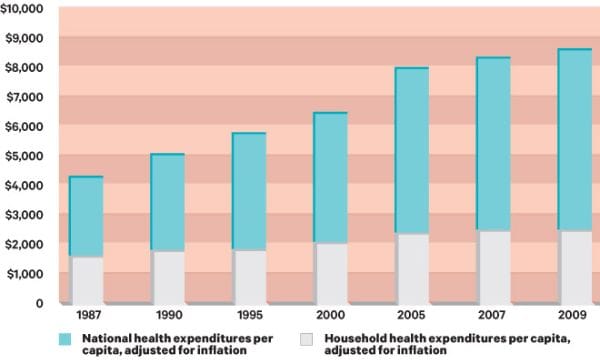
In 2006, while support for government-run healthcare reached its peak, Americans agreed that the healthcare industry was in a state of crisis. Although American healthcare spending per capita is more than any other country in the world, even 51% higher than Norway, the next largest per capita spender, health care costs are unreconcilable for a large number of Americans. Graph by Wired.com, Data from CDC
The passage of the ACA hasn't produced a major transformation in Americans' sentiment on healthcare. Americans remain unsatisfied with their healthcare coverage and costs, although the majority have remained positive about the quality of their care. However, over the next couple years the healthcare system will still be going through changes as more provisions of the Affordable Care Act go into effect. It's not yet clear how this will affect the attitude towards government provided healthcare, particularly amongst the 77% the Gallup poll reported were unsatisfied with the cost of healthcare.
You Might Also Like