Four Foreign Policy Issues Voters Should Be Aware Of

 Landon Shroder
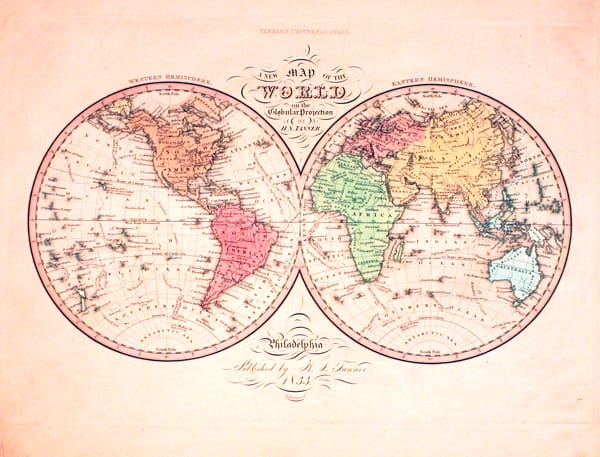
Historic Map Collections of the Sheridan Libraries
Debate on foreign policy issues has been virtually non-existent during this election cycle, which is understandable, but dangerous. While economic issues will continue to remain center stage, voters must have the tools to be able to assess foreign policy, as the two subjects are uniquely interdependent. Economic recovery at home is hinged on sustainable foreign policy objectives abroad. Here are four foreign policy issues that the conscientious voter should be aware of as the November election gets closer.
- Be wary of rhetoric as policy. Foreign policy and strategic security is a game of calculations, the great game, to be more descriptive. One inimical decision can have a cascading effect that impacts on global security, economy, and stability. Be skeptical of candidates who claim that, “America never leads from behind”. This is a slogan, a reflective quandary, not a plan of action. Voters should apply the same kind of scrutiny to a candidate’s foreign policy, that they would, when they buy a car. What kind of mileage is America going to get out of this policy? What kind of warranties are available with a specific course of action? And more importantly what kind of road side assistance is available along the way.
- Candidates must have the ability to articulate foreign policy and strategic security objectives in aggregate. Obstacles to foreign policy and strategic security rarely exist in isolation. Most failure in international relations comes from a robust lack of consideration for indicators that drive conflict. These indicators are usually, political, cultural, and religious. Voters should expect their candidate to understand these indicators, as well as, sectarianism, religious fanaticism, and how American policies could inadvertently provide the conditions for their amplification. Most critically, a candidate must communicate planning, not only on how global threats can be mitigated, but also on how rapprochement can be promoted. Utilization of force, which lacks a political formula is not likely to succeed. A candidate should be able to describe the integration of the two. Foreign policy, as a mechanism for strategic security is a long game. Voters should use this as a baseline when assessing a candidate’s foreign policy objectives.
- Voters should be critical of candidates who are beating the proverbial ‘war drum’. American military dominance is as fearsome as it is marvelous; however, political solutions should currently be the default setting. Foreign policy is inherently complex. It is easier to enunciate strategic security initiatives through a prism of military intervention, but after a decade of war (on two fronts) this policy lacks depth and foresight. Voters must also apply the cascade metric, i.e., what is the cascading effect of military intervention? America could launch a military intervention to temporarily stop Iran’s nuclear program, but what effect will that have on neighboring Iraq? America sustained almost 5,000 casualties and invested close to a trillion dollars in Iraq. Iraq also holds 11% of all global oil reserves. Is a short-term tactical gain in Iran worth America’s entire strategic policy in Iraq? Is it worth the inevitable rise in gas prices at home? Voters should expect their candidate to be able to balance this equation.
- The world is changing and America needs allies. The rise to prominence of countries like Turkey and Brazil, along with the continued growth of China and India will alter the global power dynamic. Coupled against the stagnation of Europe, due to recession, in addition, to the re-emergence of Russia, and America finds itself in a precarious position. The days of foreign policy, based on unilateral indifference is over. Voters should expect their candidate to advance policies that will harness the influence of countries like Turkey, Brazil, India, Egypt, Iraq, and Indonesia to achieve foreign policy objectives, not isolate them. This cannot be accomplished by threats of military force, bullying, or kowtowing to countries like Israel, at the expense of wider regional or global interests. A candidate should be able to highlight how he will work to retain current allies and bring emerging powers into the sphere of American influence.
As these four foreign policy issues show, foreign policy is a complex ritual, one which must be constantly adjusted to adapt to dynamic circumstances. Intractable positions on foreign policy run contrary to building consensus internationally, which is needed to advance the goals and objectives of America abroad. While foreign policy might not be the mainstay of this election, it should be viewed with equal importance. Bad foreign policy decisions will not only isolate American interests abroad, but make the chances for sustainable recovery at home that much more difficult.
You Might Also Like