Economic Impact of Immigration in California Could Result in $8B Gain

 Tom Blanton
Albert Lozano / Shutterstock.com
One of the key factors California may consider in the latest immigration reform is its potential for economic gain. This potential was analyzed in a report out of the University of Southern California (USC).
According to this report, the Center for the Study of Immigrant Integration (CSII) and the Center for American Progress (CAP) have both released studies suggesting authorization and citizenship for undocumented immigrants would lead to improvements in the state’s economy.
CSII released a more conservative estimate in the potential economic boost from authorization and citizenship. Still, even this more conservative estimate suggests an annual average of almost $4.6 billion would be pumped back into California’s economy. The higher estimate from CAP proposes a potential annual boost of almost $8 billion.
These estimates are similar in effect to a study conducted by the US Department of Labor that saw a 15% increase in wages for newly authorized immigrants within five years after the enactment of the Immigration Reform and Control Act of 1986.
Estimates from CSII and CAP may seem minuscule in relation to California’s 2010 gross state product (GSP) of almost $2 trillion, but there are other beneficial factors to consider.
Undocumented workers tend to be lower-income. The report suggests that because of this, undocumented workers will be more likely to spend their paychecks than to save them. What follows then is a “strong multiplier effect on the state’s economy.”
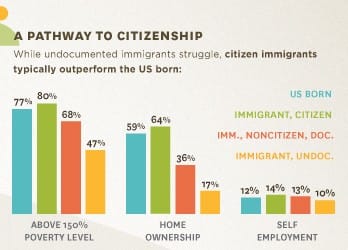
Credit: UCS, CSII (click to enlarge)
While the roughly $4.5 billion potential boost to California’s economy through authorization and citizenship could be seen simply as immediate and short term economic benefit, there’s also the state’s future to consider.

According to the report out of USC, “children of undocumented parents face greater barriers to accessing social services and programs and tend to have more negative social, economic and health outcomes.”
About 1.5 million children in California live with at least one undocumented parent, which is about 16% of children in the state.
In order to possibly curb the negative social, economic, and health outcomes these children tend to face, the report from USC believes the state should begin by legally incorporating their parents. The studies conducted by CSII and CAP suggest the only feasible way to beneficially bestow authorization and citizenship to these undocumented immigrants would come in the form of an immigration reform that grants them greater economic opportunities.
The question for California residents to consider now is whether the mandates incorporated in the 2013 Immigration Bill, S. 744, would present authorization and citizenship to undocumented immigrants in an economically beneficial manner.
Is the 13+ year waiting period for citizenship required of undocumented immigrants a realistic expectation of the reform? Many of the children of undocumented immigrants will no longer be children by the end of that waiting period. Will the negative social, economic, and health outcomes suggested by the report have already taken their toll on the next generation?
The goal of the newest immigration reform could arguably be to economically benefit both the undocumented immigrants and the state’s they call home. That being said, reports like the recent one out of USC strongly suggest any modern reform address these issues at the heart of their philosophy.
You Might Also Like