48 Percent of Independents Support Taxpayer-Funded Federal Campaigns

 Shawn M Griffiths
 Patricia Hofmeester / Shutterstock.com
Less than half (48%) of independent voters in the United States would vote in favor of a law that would replace the current campaign finance system with a system that allows federal campaigns to be publicly financed, according to a recent survey by Gallup. This number falls between the national average of adults who support government-funded federal campaigns (50%) and those in opposition of such a system (44%).
The question:
Would you vote for or against a law that would establish a new campaign finance system where federal campaigns are funded by the government and all contributions from individuals and private organizations are banned?
The results of the nationwide telephone survey suggests Democrats are more likely to support such a system as 60 percent of respondents who affiliate with the Democratic Party said they would vote in favor of the law. Republicans are least likely to support the measure as 54 percent said they would vote against it.
Credit: Gallup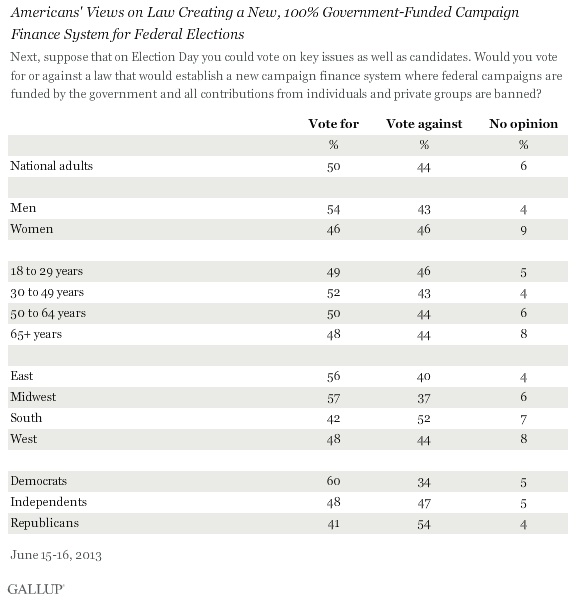
Regardless of political affiliation, however, nearly 8 out of 10 respondents support limiting campaign contributions and the amount candidates for the U.S. House and U.S. Senate can spend on an election. Again, Democrats are statistically more likely to support such a measure, but independents and Republicans are not far behind -- both only four percentage points lower.
Credit: Gallup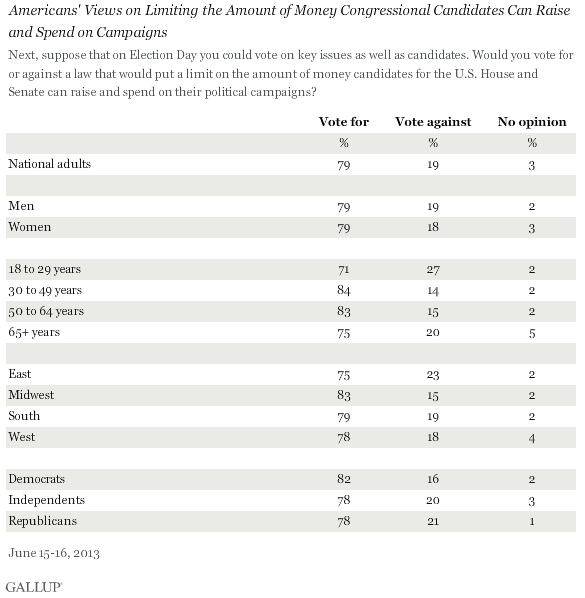
Even without considering the margin of error (+/- 3%), the general consensus is that campaign finance reform is needed and restrictions need to be put in place on how much can be raised and spent by a campaign. Americans are just divided on whether regulations on campaign finance should include relying on taxpayer dollars to help reign in the amount of money involved in each election.
American sentiment is at odds with the legal precedent set by Citizens United v. FEC. A limit on how much can be raised and spent would likely mean there would need to be limits on how much can be donated. According to the Supreme Court, campaign contributions are a form of free speech. However, many Americans don't seem to agree with this idea.

Compared to any kind of speech or expression (vocal, print, visual, protests, marches, even a vote as sad as that sounds), money has a significantly greater impact on a campaign and therefore has greater political influence. To say money equals free speech while supporting unlimited political contributions is to say some people are entitled to more political influence than others.
Most forms of expression or speech listed above carry the same amount of weight, except the form of expression that should matter the most to a campaign is a person's vote. That should be considered the ultimate act of free speech. It's not a stretch -- especially considering the polling data provided by Gallup -- to say most Americans, including independent voters, agree.
You Might Also Like