
Credit: The Albany Times
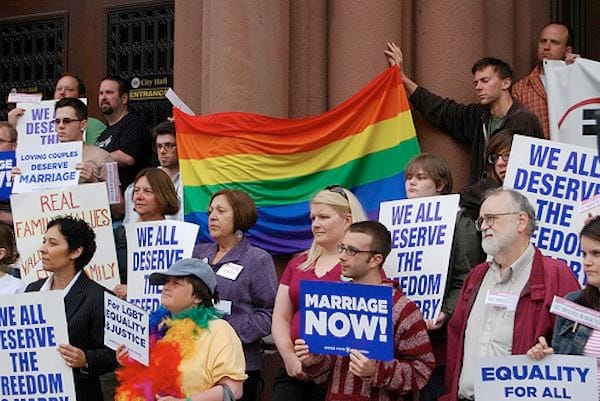
November 6, 2012 is now considered to be a key date in the history of gay rights activism. Same-sex marriage was legalized in Maine, Maryland, and Washington through ballot referendums approved by popular vote. These landmark victories for gay rights on election night brought the total number of states that recognize same-sex marriage to nine.
There were other important milestones for gay rights activism in 2012, including the election of the first openly gay Senator, Tammy Baldwin, the defeat of the constitutional amendment to ban same-sex marriage in Minnesota, and the retention of a pro-gay marriage Supreme Court judge in Iowa. All of this happened on the night Barack Obama, the first president to come out in support of same-sex marriage, was re-elected to a second term.
For the first time in US history, nationwide polls find that a majority of Americans support making same-sex marriage legal and the results of the 2012 elections seem to signal a change in American society. Gay rights activists and organizations have the capacity to advance their positions efficiently, which includes increasing fundraising efforts as these groups outspent political opposition 3-1 in the ballot states.
However, the battle over marriage equality is far from over. The Supreme Court will likely decide to hear one or more cases related to gay rights across the country on November 30. The high court has 5 appeals submitted to it to consider.
Three cases will address the constitutionality of the Defense of Marriage Act (DOMA), a federal law that says only marriages between one man and one woman are valid. DOMA prevents gay couples legally married under state law from receiving a wide range of benefits. These cases are under high scrutiny because of conflicting US circuit court decisions and the declaration by the Obama administration that this specific part of the law is unconstitutional. The Supreme Court will have to settle the differences between the courts as well as between the Executive and Legislative branches.
The Supreme Court could also weigh in on the legal battle surrounding California's Proposition 8, which banned gay marriage in the state in 2008. The 9th Circuit Court of Appeals ruled in February that the ban was unconstitutional as it discriminates against the GLBT community, thus violating the equal protection close in the Fourteenth Amendment.
Finally, the Supreme Court will have the opportunity to hear the arguments on the Arizona law which would prevent gay couples from receiving domestic partnership benefits. The court decision that put an injunction on the law was confirmed in late 2011 by the 9th Circuit Court of Appeals.
The high court will likely make a ruling on one or more of these cases by the middle of 2013, making it another very important year for gay rights activism. Movements are also preparing to expand their efforts to other states. Activists have identified 7 states that could potentially legalize same-sex marriage as soon as 2014: Oregon, Rhode Island, Delaware, Minnesota, Colorado, Hawaii, and New Jersey.