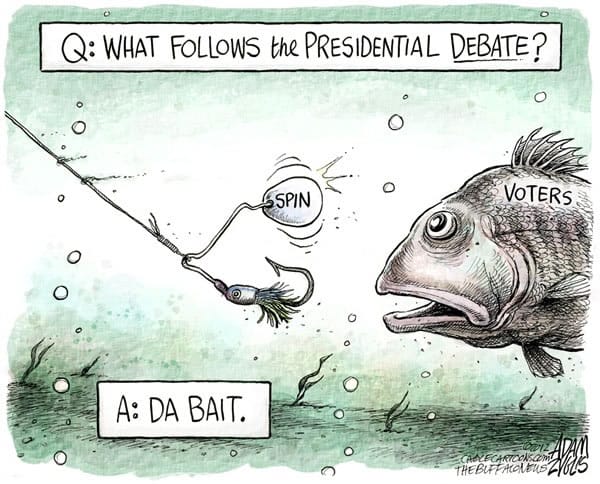
Credit: Cagle Post
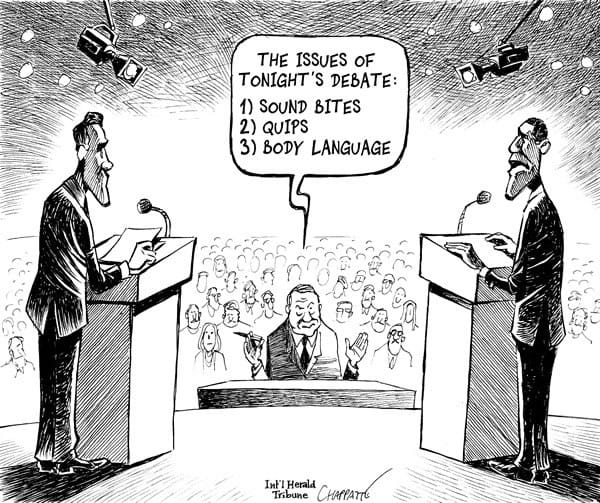
In the wake of Wednesday night's spectacle, a surge of presidential debate political cartoons have flooded the internet that reflect an American public disillusioned with the debate and its format. The presidential debate and the political cartoons that became of it highlight the lack of substance in our political discussion. Many news outlets have characterized Romney's presence as aggressive and commanding, labeling him the "winner" over Obama in their first spar. From his body language, to his attacks on Obama, to the way he treated the moderator, Jim Lehrer, most commentators have given Romney high marks. Most of the criticism of Obama was over what he did, not what he said.
The media has criticized Obama's own performance as defensive and unprepared. And while the media focused on the candidates' moves and words, many of these cartoons focus on the current debate format's ineffectiveness at providing an informed and accurate depiction of the candidates and their policies. Neither depicted the candidates' stances on national issues.
Lately, there has been increasing criticism over the "non-partisan" CPD for perpetuating the two-party monopoly over our political discussion. Some argue that it is this bipartisan discourse that is largely responsible for the gridlock that has left many Americans disillusioned with our government. In many ways, Wednesday's moderator Jim Lehrer reinforced this throughout the debate by repeatedly asking Romney and Obama how they differed on specific issues. In many cases, Obama and Romney's policies are almost identical. Again, neither the media nor cartoonists focused on these important points.
Credit: Cagle Post
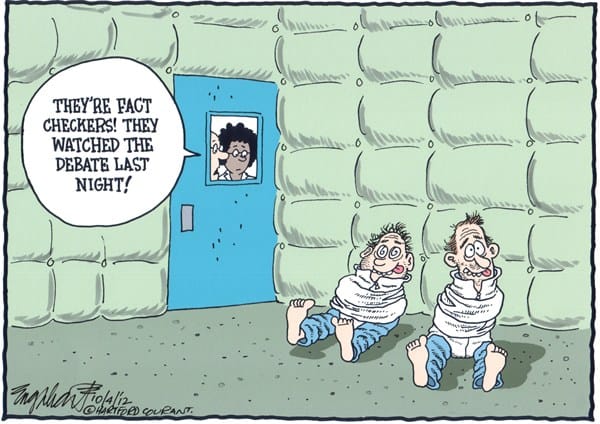
During the debate both candidates took liberty with exaggeration and truth. In many cases, the two candidates simply talked over the moderator or "pivoted" on his question. Cartoonists were quick to critique, and the reality in the press is that confidence and style has become more important than substance. Wednesday's debate generally followed a single pattern: a few talking points for each candidate, followed by personal attacks and a quick quip. With broad media exposure and quick access to information, any actual discussion of the issues was lost in the commentary on literal performance.
In the last twenty-four hours alone, hundreds of memes have poked fun at things that have little to do with real policy discussion. Like the media storm created by Romney's "47 percent" controversy, popular culture surrounding the presidential election is what holds the public's short-term interest. In the meantime, many voters are still waiting for a real discussion of the country's long-term health. Caption: Cagle Post