Image by Jim Young / Reuters
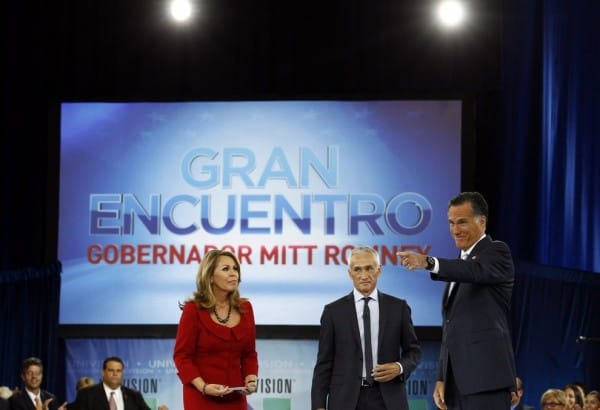
When Univision realized that the Commission on Presidential Debates had announced an all white line up of moderators, they took matters into their own hands, believing that the Latino American community needed its voice heard in a nonpartisan environment. The idea behind the forum was for there to be a space in which candidates could discuss Latino-American issues that were likely to be overlooked in the other debates. The programming included Romney and Obama exclusively. Univision did not invite any third party candidates to the forum.
Both Mitt Romney and Barack Obama agreed to the forum even though the Commission on Presidential Debates denied Univision's request. Jorge Ramos, who moderated the Univision presidential forums, said, "It's so interesting, because the Commission on Presidential Debates seems to believe that it is OK to have an African-American president, but it is not OK to have a moderator from a minority group."
Univision had originally agreed to a student-only forum, which was to take place at the University of Miami. However, according to an interview between Univision anchor Maria Elena Salinas and BuzzFeed, after the Romney campaign realized that student body support for him was less than they expected, they told Univision they would have to “reschedule” unless the student-only rule was lifted.
Univision complied and an enthusiastic audience appeared at the forum with Romney. A majority of the audience was selected by the Campaign, a fact that Univision acknowledged on their Facebook. The Obama campaign requested that a majority of its tickets be given out through a lottery, with a small portion to be given to Democratic students on campus. The University of Miami said in a statement that "Because of rules imposed by the campaigns, the University had to give preference to politically affiliated student organizations and student leaders. The University got roughly half of the tickets for each event."
Univision is known for its attempts to remain impartial in the political arena, but the neutrality of the forum was undermined by the presidential campaigns' heavy involvement in the terms and conditions of the events. Salinas was disappointed by the fact. She said of the Romney forum, "We were a little bit thrown because it was supposed to be a TV show, it wasn't a rally. It was a little bit of disrespect for us."
The Univision forums had the potential to provide an independent, low-pressure environment for the candidates to discuss issues generally overlooked on the mainstream news networks. Yet, it seems that the acute competitiveness of campaigning was able to erode the possibility of truly open discourse on the issues at hand. Should candidates seek to sway independent voters to their camp, as well as motivate them to make it to the polls this November, they will need to minimize the blatant exhibition of partisan conceit.