Skip to content
Subscribe

Poverty, Incarceration and Violent Crime in the United States

Published:

Credit: oklahomawatch.org
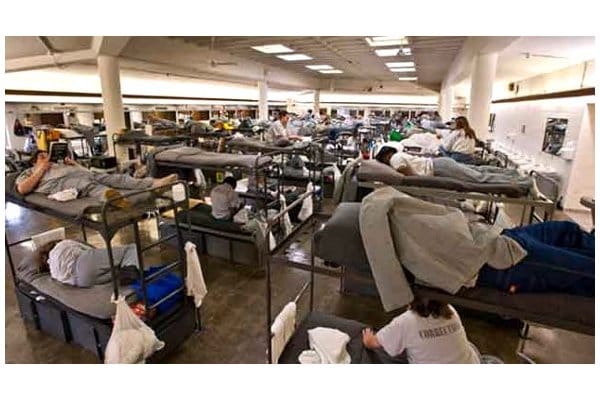
Conspicuously absent from our current national dialogue has seemingly been any notable discussion on issues of poverty, mass incarceration and violent crime in America.

The cycle of poverty, violence and incarceration was well documented in this harrowing investigative documentary on the city of Baltimore done by Al Jazeera. Statistics show that the issues raised in the short documentary remain significant, if often ignored, problems in the United States.

According to a study done by the United States Census Bureau the official poverty rate in America increased to 15.1 percent in 2010, up nearly a full percent from 2009. Poverty increased for the fourth straight year, and over 46 million Americans are now below the poverty threshold.

Meanwhile, incarceration rates have continued to rise along with poverty rates. According to Fareed Zakaria of Time Magazine, the prison population in the United States has quadrupled since 1980 from 150 per 150,000 adults to 760 per 150,000, giving American the highest incarceration rate in the world.

The costs of incarceration are staggering. In California, $4 billion more was spent on prisons than the University of California and state college systems during 2011. A college student costs California less than $10,000 per year to educate, while a prisoner costs over $45,000 per year to incarcerate. Nationwide, the United States is now spending around $70 billion per year on corrections according to the NAACP.

Incarceration rates have risen, but violence remains a significant problem within the United States, though violent crime rates have fallen. According to The Daily, as of June 15, 228 people had been murderedd in Chicago alone this year compared to the 144 Americans who had been killed in Afghanistan during the same time frame. Since the war in Afghanistan began in 2001, 2,000 American troops have been killed there, while 5,000 residents of Chicago have been murdered during the same time frame.

According to the Washington Post, 6,551 Americans have been killed in the Iraq and Afghanistan wars thus far. Comparatively, according to The Disaster Center, between 14,000 and 17,000 Americans have been murdered each year since 2001.

Incarceration and poverty rates are on the rise in the United States, and while violent crime has been reduced nationwide over the past two decades, it remains a devastating and too common cause of death in many American communities.

Adhere to the IVN etiquette

By posting a comment, you agree to adhere to our etiquette rules: No partisan attacks, no personal attacks, substantiate your sources, no self-promotion.

Contact IVN

Questions about this article or our coverage? Send us a message. A free IVN member account is required.

Message sent

Thanks, we’ll review it and get back to you if needed.

Message not sent

Sorry, something went wrong. Please try again.

Sign in to send a message

Messages are tied to your IVN member account. Signing in is free and takes a few seconds.

Republish this article

Republishing guidelines

Republish IVN articles for free. Independent Voter News articles may be republished online or in print under a Creative Commons BY-NC-ND 4.0 license, on these terms:

  1. Credit the author and IVN. Keep the byline ("By Author Name, Independent Voter News") and the attribution note at the end, which links to the original.
  2. Keep the meaning. You may update time and place references and apply your house style. You may trim for length, as long as the cuts don't change the meaning or misrepresent the author. Keep the headline. Mark any additions as your own (for example "Additional reporting by ...").
  3. Translations are welcome. Translate faithfully, add "Translated from English by [your outlet]", and tell us at editor@ivn.us.
  4. Keep the links, including the link to the original article.
  5. Keep the tracking image. The HTML includes a 1-pixel image that counts readers on your page. It collects no personal information.
  6. Photos and illustrations. Images credited to IVN may be used with this article only. Images credited to others (AP, Getty, Unsplash, Wikimedia and so on) stay under their owners' terms. Secure the rights or switch "Include images" off.
  7. Don't sell it. You can't sell our articles or sell ads specifically against them. Your normal site advertising is fine.
  8. No implied endorsement. Don't suggest that IVN or the author endorses you, your candidates or your causes, or that donations to you support IVN.
  9. Keep labels. Opinion or analysis pieces keep that label.
  10. Point search engines to the original. Where your CMS allows, set the canonical URL to the original IVN article.
  11. No bulk or automated republishing, and don't submit our articles to aggregators (Apple News, Google News, MSN) as your own.
  12. Corrections and removals. Update your copy when we correct it, and remove it promptly if we ask. We'll contact you at the email you give us.
  13. Questions or print republication: editor@ivn.us.

IVN staff: fill in who you're inviting above, then create the invite.

Preparing the article

Poverty, Incarceration and Violent Crime in the United States

Choose a format
  • HTML
  • Email HTML
  • Markdown
  • Formatted (.docx)
  • Plain text
  • WordPress blocks
  • PDF
Choose a platform

Photos credited to others need their owners' permission.

To for

Republishing somewhere else? Questions? editor@ivn.us