Skip to content
Subscribe

Horse Meat in the US: Is Too Much Love Bad For Horses?

Published:

Credit: http://pauldorpat.com/seattle-now-and-then/seattle-now-then-horse-meat-anytime/
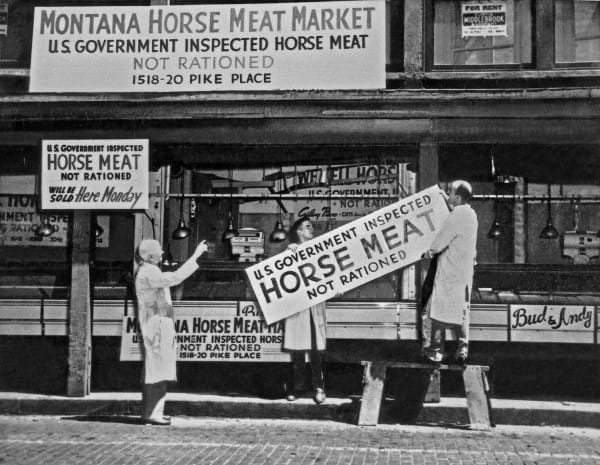
Horse meat in the US

It has not been in the front news, but two weeks ago Governor Chris Christie signed a law that would prohibit the sale of horse meat in the US state of New Jersey as well as the slaughter of horses for human consumption. This is the last example of a phenomenon of sacralization of horses, which in the end might be detrimental to horses.

It might surprise many people that until 2006, the United States used to produce 20% of the world's horse meat. In 2007, under the pressure of animal activists, Congress passed a law that cut funding to USDA inspection of horse meat, resulting in the closing of the last three slaughter houses in the US. In late 2011, Obama signed a law lifting the ban, leaving authority to regulate this issue in the hands of the state, but no slaughter house has been opened since.

The taboo over eating horse meat has changed over the years. In Medieval Europe, under the impulse of Pope Gregory III, Christians were encouraged to stop the pagan practice of eating horse meat. But in times of scarcity, eating horse was sometimes the only option. Such a situation applied to Napoleon's soldiers, whose only means of survival was to eat their own horses in the beginning of the 19th century. French doctors then decided that there were no medical reasons for not eating horse meat and the practice spread to other European countries. In Great Britain, however, horses' nobility prevented them from being reduced to another simple food.

The United States inherited this anglo-saxon attitude towards horses, to which we add a special bond created over the extensive use of horses to conquer its immense territory. Even in times of shortage, horse meat never really found its place into the diet of Americans, with the moderate exception of WWII and its aftermath. But disgust for horse meat has not been enough to eliminate America's capitalistic instincts, and since the end of the 19th century, the U.S. has been consistently providing horse meat to the European market. U.S. contributions reached 20% of the world market in 2006.

Animal protection groups finally convinced members of the Congress to stop these "massacres" in 2007.  However, has this prohibition really served its purpose? Since the ban, the production of horse meat in Mexico and Canada rose approximately by the same amount as the 2007 U.S. production. The production was not stopped, rather it was displaced. This requires more transportation than before and the conditions for these animals do not necessarily meet American standards. In addition, people selling their horses are now making less money than before or are simply abandoning horses because they cannot afford to take care of them.

One of the reasons behind the protection of horses in New Jersey is that they are "magnificent animals" appreciated "for their grace and beauty." One might ask, do beauty and grace justify not allowing horses to be killed under the same standards as cows and pigs, but rather shipping them abroad or abandoning them?

Adhere to the IVN etiquette

By posting a comment, you agree to adhere to our etiquette rules: No partisan attacks, no personal attacks, substantiate your sources, no self-promotion.

Contact IVN

Questions about this article or our coverage? Send us a message. A free IVN member account is required.

Message sent

Thanks, we’ll review it and get back to you if needed.

Message not sent

Sorry, something went wrong. Please try again.

Sign in to send a message

Messages are tied to your IVN member account. Signing in is free and takes a few seconds.

Republish this article

Republishing guidelines

Republish IVN articles for free. Independent Voter News articles may be republished online or in print under a Creative Commons BY-NC-ND 4.0 license, on these terms:

  1. Credit the author and IVN. Keep the byline ("By Author Name, Independent Voter News") and the attribution note at the end, which links to the original.
  2. Keep the meaning. You may update time and place references and apply your house style. You may trim for length, as long as the cuts don't change the meaning or misrepresent the author. Keep the headline. Mark any additions as your own (for example "Additional reporting by ...").
  3. Translations are welcome. Translate faithfully, add "Translated from English by [your outlet]", and tell us at editor@ivn.us.
  4. Keep the links, including the link to the original article.
  5. Keep the tracking image. The HTML includes a 1-pixel image that counts readers on your page. It collects no personal information.
  6. Photos and illustrations. Images credited to IVN may be used with this article only. Images credited to others (AP, Getty, Unsplash, Wikimedia and so on) stay under their owners' terms. Secure the rights or switch "Include images" off.
  7. Don't sell it. You can't sell our articles or sell ads specifically against them. Your normal site advertising is fine.
  8. No implied endorsement. Don't suggest that IVN or the author endorses you, your candidates or your causes, or that donations to you support IVN.
  9. Keep labels. Opinion or analysis pieces keep that label.
  10. Point search engines to the original. Where your CMS allows, set the canonical URL to the original IVN article.
  11. No bulk or automated republishing, and don't submit our articles to aggregators (Apple News, Google News, MSN) as your own.
  12. Corrections and removals. Update your copy when we correct it, and remove it promptly if we ask. We'll contact you at the email you give us.
  13. Questions or print republication: editor@ivn.us.

IVN staff: fill in who you're inviting above, then create the invite.

Preparing the article

Horse Meat in the US: Is Too Much Love Bad For Horses?

Choose a format
  • HTML
  • Email HTML
  • Markdown
  • Formatted (.docx)
  • Plain text
  • WordPress blocks
  • PDF
Choose a platform

Photos credited to others need their owners' permission.

To for

Republishing somewhere else? Questions? editor@ivn.us