Skip to content
Subscribe

Social Media Strengthens The Democractic Process

Published:

One of the core pillars of our political process is the belief that democracy works best when the most people participate. Yet with the election just one week away, we are confronted with a number of challenges to ensuring that our democracy functions to the best of its abilities. With the acceleration of technology and increased access to information, however, it has been found that social media sparks democracy.

Tools made available by social media have encouraged alternative voices to enter the political arena, voices that in previous years have been muted. As a result of technology, participation in the political process is accessible and direct engagement is feasible.

Through social sharing, social media users have the opportunity to broadcast political messages. By sharing a campaign or candidates' message, users are becoming advocates of that message. Passing political messages along to friends can have revolutionary effects in enhancing the democratic process.

On the local level, candidates and politicians are able to engage with residents of their city or town. By using Facebook and Twitter, elected officials have a direct experience with their government, and can represent the many voices in his or her community.

Adam Sharp, head of Government and Politics on Twitter, spoke to the importance of social media in expanding democratic reach at the Republican National Convention earlier this year:

"In a broader sense, what you're seeing is a democratization of access. That you don't need the same establishment infrastructure to get the same message out that you used to. We think back to the 1980 Republican Primary and that moment when Ronald Reagan took the microphone and said 'I paid for that microphone.' Anyone can have a microphone now and that microphone is free."

Without the topdown infrastructure of a major political party, he continues, social media paved the way for the Tea Party Movement to organize across state lines in 2010 and to find like-minded individuals who would not have connected in previous election.

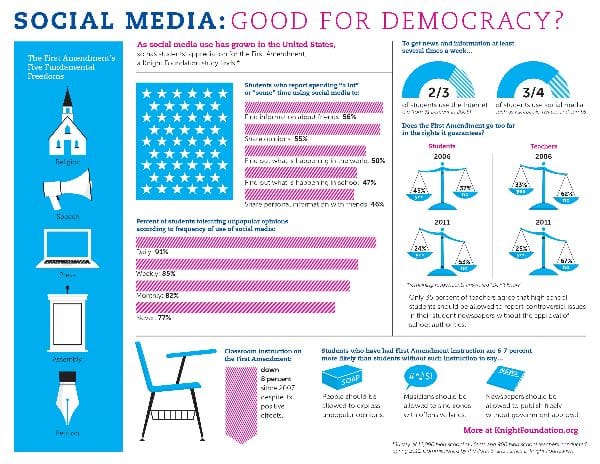
Social media has also been linked to increasing student appreciation for the First Amendment rights inherent in the democratic process. One of the key findings of a study conducted by Knight Foundation was that students who use social media have a higher appreciation of the First Amendment. Ninety-one percent of students actively on social networking sites agreed that "people should be allowed to express unpopular opinions," while students who had never used social media only agreed with that statement 71% of the time. Media Bistro visualized these findings into the below infographic:
Do you think social media sparks democracy? If so, in what ways?

Adhere to the IVN etiquette

By posting a comment, you agree to adhere to our etiquette rules: No partisan attacks, no personal attacks, substantiate your sources, no self-promotion.

Contact IVN

Questions about this article or our coverage? Send us a message. A free IVN member account is required.

Message sent

Thanks, we’ll review it and get back to you if needed.

Message not sent

Sorry, something went wrong. Please try again.

Sign in to send a message

Messages are tied to your IVN member account. Signing in is free and takes a few seconds.

Republish this article

Republishing guidelines

Republish IVN articles for free. Independent Voter News articles may be republished online or in print under a Creative Commons BY-NC-ND 4.0 license, on these terms:

  1. Credit the author and IVN. Keep the byline ("By Author Name, Independent Voter News") and the attribution note at the end, which links to the original.
  2. Keep the meaning. You may update time and place references and apply your house style. You may trim for length, as long as the cuts don't change the meaning or misrepresent the author. Keep the headline. Mark any additions as your own (for example "Additional reporting by ...").
  3. Translations are welcome. Translate faithfully, add "Translated from English by [your outlet]", and tell us at editor@ivn.us.
  4. Keep the links, including the link to the original article.
  5. Keep the tracking image. The HTML includes a 1-pixel image that counts readers on your page. It collects no personal information.
  6. Photos and illustrations. Images credited to IVN may be used with this article only. Images credited to others (AP, Getty, Unsplash, Wikimedia and so on) stay under their owners' terms. Secure the rights or switch "Include images" off.
  7. Don't sell it. You can't sell our articles or sell ads specifically against them. Your normal site advertising is fine.
  8. No implied endorsement. Don't suggest that IVN or the author endorses you, your candidates or your causes, or that donations to you support IVN.
  9. Keep labels. Opinion or analysis pieces keep that label.
  10. Point search engines to the original. Where your CMS allows, set the canonical URL to the original IVN article.
  11. No bulk or automated republishing, and don't submit our articles to aggregators (Apple News, Google News, MSN) as your own.
  12. Corrections and removals. Update your copy when we correct it, and remove it promptly if we ask. We'll contact you at the email you give us.
  13. Questions or print republication: editor@ivn.us.

IVN staff: fill in who you're inviting above, then create the invite.

Preparing the article

Social Media Strengthens The Democractic Process

Choose a format
  • HTML
  • Email HTML
  • Markdown
  • Formatted (.docx)
  • Plain text
  • WordPress blocks
  • PDF
Choose a platform

Photos credited to others need their owners' permission.

To for

Republishing somewhere else? Questions? editor@ivn.us