Credit: wikimedia.com
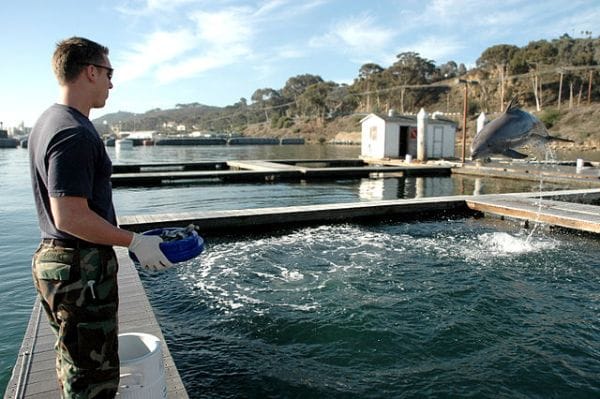
It is a commonly known fact that dolphins are some of the most intelligent animals on earth. Their athletic, agile design, high mental capacity, heightened senses, and use of sonar allow them to stay operational under water for extended periods of time. All of these positive traits make for a marine mammal that is extremely receptive to training. At the SPAWAR defense facility in Point Loma, the NAVY selectively breeds and trains dolphins (which can take up to seven years) to locate and detect mines or unmanned underwater drones. The Navy's Marine Mammal Systems (MMS) is a program under the Science Applications International Corporation (SAIC), and has a value of over $49 million if all four one-year options are exercised.
Local media has been focusing on the fact that of the eighty dolphins currently "employed" in the program, twenty-four of which will be replaced by underwater unmanned vehicles (UUVs). The switch is set to begin in the spring of 2017, but it seems that dolphins are under no threat of losing their jobs. Despite the progression and advancement of technology, dolphins remain the superior intelligent beings.
To provide some first-hand experience, IVN San Diego reached out to mammal handler Lee Pattinson, who spent years working in the program.
From where are the dolphins acquired? Were they predominantly strays like the seals, or are they selectively bred? If so, where?
The dolphins are now bred in captivity, some at the Point Loma facility.
What is the overall risk posed to these animals? The positions have been referred to as "jobs" by the media, but of course, an animal cannot be paid. What are some of the benefits for the mammals?
I would say the overall risk the animals would only be human complacency - for instance, during the transportation of an animal. Since the program's biggest concern is animal care and safety, any time an animal is moved it is with the utmost caution and care. Benefits to the animal would most certainly be the health care. They are checked every day, for any signs of sickness, and have regular blood tests, fecal samples, gastric samples, and ultra sounds to ensure the animal is always healthy. The animals only receive sushi grade fish, which is probably better than what we buy in the store! The facilities where we prepare them are immaculate, cleaned and inspected every day.Similar programs have been in place since the 50s, but where does the SAIC program differ now? I'm not a mammal program history buff or anything but, in the four years I was there, I saw many aspects of the program streamlined with the use of technology. Computer systems, for instance, that help us navigate better and faster while working in small boats. New designs and ways of transporting the animals that make it safer and more comfortable for them. With anything, it's always progressing, becoming more efficient, and safer for the animals every day.Do you see technology phasing out the use dolphins?I worked very closely with the UUV platoon, and it is amazing what the machines can do. However, I don't believe they will ever surpass the capabilities of the animals. My animal never ceased to amaze me with his detection ranges of underwater objects. Unlike the UUV, the dolphin can think and decipher on its own what is what. The UUV just gives you back data and the human still has to sift through it all and decide if it is a "mine" or any object they may be looking for.How have you seen this program evolve since your involvement? Do you find this program to be very effective?Every day it is evolving; new training techniques, for example, as we develop better and safer ways to transport and care for the animals. I think the program is more than effective. Any assigned task will be completed.
The program, which is run locally, has been part of the city for over two decades, and as such should remain static for the city. SAIC senior vice president and business unit manager Tom Baybrook has said, "SAIC has supported the Navy's Marine Mammal Program since 1986, providing talented and committed staff who deliver the critical training needed to fulfill the MMS's critical mission needs. We look forward to continuing our support of this important customer, and doing our part to help keep those at sea safe from harm."