What to do when something you regularly buy declines in quality? In
Exit, Voice and Loyalty, economist Albert Hirschman posited that disappointed customers have two options – take their business elsewhere (exit) or complain to management (voice). The choice they make depends largely on the degree of loyalty they feel towards the provider of the goods or services.
Voters sensing that the quality of their political party’s candidates has deteriorated may exit by switching parties; those feeling greater party loyalty may choose the voice option, becoming more involved and possibly challenging party leaders. But voters in Arizona and across the U.S. have been defying conventional theories and taking a third path. Proposition 121, the “Top Two” primary initiative, seeks to validate and empower these voters.
Surveys show unprecedented levels of distrust and even disgust with Congress, state legislatures, and politics in general. A chief complaint is partisan gridlock, which suggests stark differences between the two major parties. Yet, many claim there are few real difference between Democrats and Republicans. What they’re rejecting isn’t one party or the other – it’s the current two-party system.
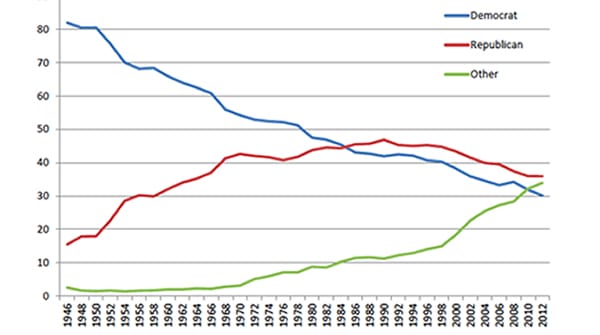
To gauge the level of voter discontent, consider this: joining a party costs nothing, parties energetically recruit new members, and party loyalties traditionally ran through generations. Yet, voters today are declaring their independence by changing their party preference to Independent. Party membership has deteriorated to the point where they can’t give it away for free. Nowhere is this more evident than in Arizona, where the percentage of voters registered as independent has soared in recent years, recently passing registered Democrats and on track to pass Republicans early next year (see graph). This wholesale desertion of the two main parties is occurring despite the lack of any organized effort to increase the ranks of Independents.
Polls show even greater percentages are self-identifying as independent, suggesting that many voters have emotionally exited their parties, even if they have yet to formally change their registration. Ironically, this exodus has left party loyalists to dominate partisan primaries, eschewing moderates for more “ideologically pure” candidates who, when elected, intensify the gridlock. This behavior alienates more voters, and the feedback loop is complete.
Backers of Prop. 121 want to break the cycle of partisan by stripping parties of their special status and privileges and opening primaries to all voters. A system under which candidates must seek the support of all those whom they want to represent doesn’t sound like such a revolutionary idea. But maybe it is.
Trens in Arizona Voter Registration: 1946 through 2012