What Happens if There Is an Electoral Vote Tie
By Shawn M. Griffiths on 10/25/2012 in Barack Obama, congress, Election 2012, electoral college, mitt romney, president with 39 CommentsRead Time: 5 - 8 minutes
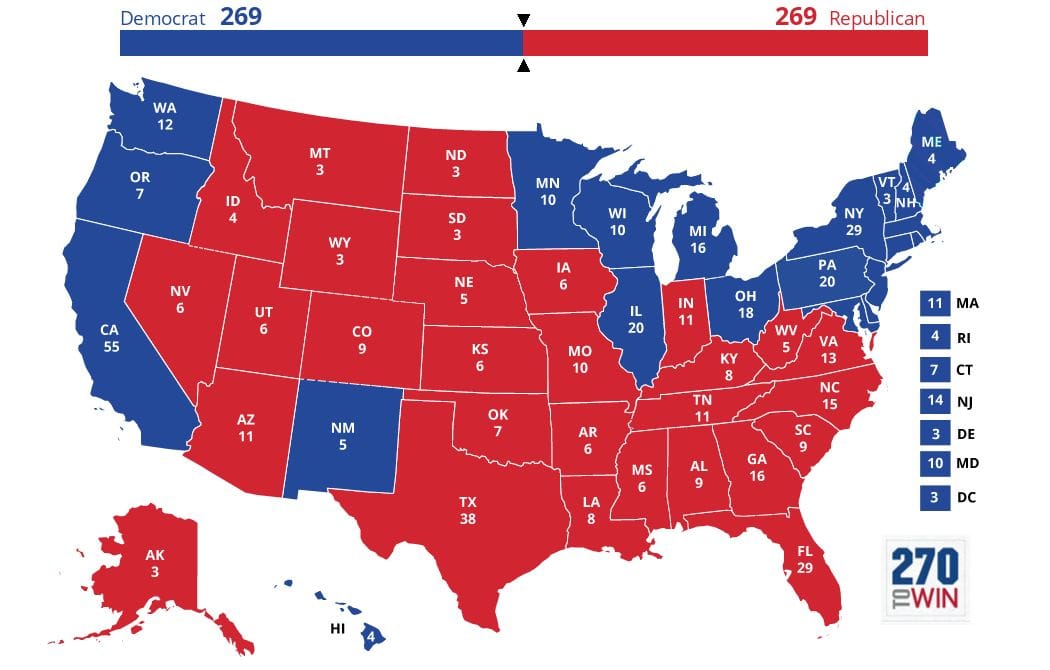
Credit: User generated electoral maps on 270towin.com
It’s the morning of Wednesday, November 7, 2012, and every major news outlet is reporting that for the first time in nearly two centuries, there is a tie in the electoral vote. Both Mitt Romney and Barack Obama have secured 269 votes. Fire begins to rain down from the sky, the ground begins to quake, and Republicans and Democrats lose their minds.
Okay, so maybe the imagery of apocalyptic events is bit extreme, but the reaction people will see in the wake of reports that there is a projected tie in the Electoral College would make it seem like the world is being torn asunder. While this outcome is unlikely, the first question of whether it is possible can be answered with an indisputable “yes.”
So, what happens if there is an electoral vote tie on November 6?
The Constitution of the United States has a contingency measure in place in the event neither presidential candidate can reach the 270 threshold. Article II, Section 1 states:
“The person having the greatest number of votes shall be the President, if such number be a majority of the whole number of electors appointed; and if there be more than one who have such majority, and have an equal number of votes, then the House of Representatives shall immediately choose by ballot one of them for President; and if no person have a majority, then from the five highest on the list the said House shall in like manner choose the President. But in choosing the President, the votes shall be taken by States, the representation from each state having one vote; A quorum for this purpose shall consist of a member or members from two thirds of the states, and a majority of all the states shall be necessary to a choice. In every case, after the choice of the President, the person having the greatest number of votes of the electors shall be the Vice President. But if there should remain two or more who have equal votes, the Senate shall choose from them by ballot the Vice President.”
There are additional stipulations laid out in the Twelfth Amendment and the Twentieth Amendment.
The results people hear on election night or on the Wednesday after Election Day are projected results. They are not official. The Electors will meet on the third Monday of December, which is December 17, 2012. Roughly half the states have laws that require their Electors to vote for the candidate that won the popular vote in their state. In a state that does not have such laws in place, an Elector could decide to change their vote if the popular vote is very close.
In the event of a projected tie in the Electoral College, one Elector could change everything by switching their vote. In this scenario, the vote would then become 270-268, giving the advantage to one campaign over the other. The lack of restrictions on Electors in some states means that not every state is guaranteed “winner take all.” Most experts say this is highly improbable, but there have been instances in the past when an Elector has changed their vote.
The race between Mitt Romney and Barack Obama has not only been one of the closest presidential elections Americans have seen in many years, but it is also one of the ugliest. It is likely that if the tie scenario becomes a reality we could see a repeat of 2000, but on a much more massive scale. There would probably be lawsuits over voting results in more than one state and the relevance of the Electoral College would become a major part of the national dialogue.
Most political analysts speculate that if there is a tie in the Electoral College the election would remain undecided until the new Congress convenes in a joint session on January 6, 2013 to count the electoral votes. This is something that happens after every presidential election and if neither candidate has 270 electoral votes then that is when things get really interesting.
The constitution gives the authority to select the new President of the United States to the US House of Representatives if there is an electoral tie. The House does not select the presidential ticket or the campaign. House members would pick the president only because the constitutional authority to select the Vice President of the United States belongs to the US Senate.
Imagine a situation where Republicans keep the House, but cannot gain control of the Senate or make it a 50-50 split. This is a situation that favors Romney, but does not help his running mate. As polarized as this Congress has been, it is not completely far-fetched to imagine a divided White House if the Democrats have decisive control of the Senate and the Republicans keep their majority in the House.
Under the assumption that there are eleven battleground states (CO, FL, IA, MI, NC, NH, NV, OH, PA, VA, WI), there are thirty-two possible electoral tie combinations for 2012. However, if people considered the most current polling trends, the likely scenario seems to be that Romney would need to break the tie in Virginia, take Colorado, reverse trends in Nevada, and Obama would have to secure Ohio.
How likely is an electoral tie?
Even in a race as tight as the 2012 presidential race between Mitt Romney and Barack Obama, it is still statistically unlikely that there will be an even split in electoral votes. However, this is still going to be a very close race. Americans may not know who their next president is going to be at the end of election night. The two biggest states to watch right now are Ohio and Virginia.


Leave Your Comment →
39 Comments
Cassidy Noblejas Bartolomei
10.25.2012
@cassidynb
It’s interesting that roughly half the states require Electors to vote as the popular vote does. Do you know if this is a stagnant situation or if more/less states are requiring that Electors vote the same as the populous of their state?
Shawn M. Griffiths
10.25.2012
@shawntx
It hasn’t really been an issue in most elections. I don’t think Florida even re-considered it after 2000 because the situation hasn’t come up when an Elector changing the vote has shifted the results of the election and Electors going rogue like that is rare.
Terri Harel
10.25.2012
@tlharel
Can you imagine the news frenzy if this happens? Run off campaigning?
Alex Gauthier
10.25.2012
@alexg
house rules. vice president should be the tie-breaker.
Alex Gauthier
10.25.2012
@alexg
“Fire begins to rain down from the sky, the ground begins to quake, and Republicans and Democrats lose their minds.” that sir, is an understatement
Jane Susskind
10.25.2012
@jsusskind
If this were to happen, the electoral college would the center of the debate. Personally, I think the electoral college needs to be reformed and a popular vote system would be more effective in increasing voter turnout, which would in turn make for a more representative government.
Lucas Eaves
10.25.2012
@lucaseaves
It would be funny to have Romney President and Obama Vice-President. But more interesting is that the House could choose a third party candidate and he would be president, even without any popular support. It will not happen but in theory, it is possible.
Sharon Roberts
10.25.2012
What about the popular vote? Does it count for nothing?
Brandon Fallon
10.25.2012
@bfallon
Florida is also a major battleground state, the largest by far in terms of electoral votes. Romney seems to be ahead in Florida but Obama seems to be ahead in Ohio and Virginia, all within the margin of error.
Shawn M. Griffiths
10.26.2012
@shawntx
Yeah, Florida is a big battleground state, but I don’t think it will be the biggest state to watch this year. Ohio and Virginia are going to be key. If Obama takes Virginia, with trends how they currently are, then the race could be over.
Gabe Iacoboni
10.25.2012
What happens depends on who controls the Senate come 2013.
Wes Alderson
10.25.2012
I “think” I recall from my history classes of 55 years ago, that in case of an electoral tie, the house of representatives decides the winner. If fact this may have happened once – the Tyler Election? Not sure. One thing I AM sure of, is that no change in the electoral collgege system made because of THIS election can have any effect on THIS election. It will be what it will be, based on current law.
Jacqueline King Romo
10.25.2012
Let’s hope it’s an honest one. I find it hard to believe last election’s reject is this ones golden boy. I don’t think the race is as close as they are broadcasting. The ballots that have been mailed show the President in the lead and as a rule that predicts how the votes go. Facebook and Twitter also show the President more popular. Listen to the people, get our voting policies out of the third world and let freedom ring!!!
Jay Saxon
10.25.2012
There won’t be a tie. If the Dems don’t win by an uncheatable margin, Rmoney is in.
Joshua Garber
10.25.2012
It will depend on when the troops get their absentee ballets. With four states forgetting to send them at the regular time it could really mess things up.
John Ortega
10.25.2012
http://www.facebook.com/photo.php?fbid=517257934954183&set=a.514303718582938.131764.513823708630939&type=1&relevant_count=1
Chris Falco
10.25.2012
Congres picks the President and the Senate picks the VP
Eric Roth
10.25.2012
Electoral Colleges either need to reform to stop the all or nothing system and accurately reflect the popular vote or just go away and use just the popular vote. Being a Californian and NOT a Democrat I feel that every election I’m being disenfranchised.
Lee Ames
10.25.2012
That is why we should do away with “Winner takes all” that some states have. If I remember my political science correctly, Texas is one of them… The “winner takes all” discounts the voters who didn’t vote with the majority, so their votes really do not count…
Suzanne Genow
10.25.2012
There won’t be a tie….If your state polls are open… GO VOTE
Suzanne Genow
10.25.2012
With all the early voting being allowed….you don’t have to wait for Nov 6. Check your rules. I have to wait in my state, but many are voting right now.
Lee Ames
10.25.2012
” In the Federalist No. 10, James Madison argued against “an interested and overbearing majority” and the “mischiefs of faction” in an electoral system. He defined a faction as “a number of citizens whether amounting to a majority or minority of the whole, who are united and actuated by some common impulse of passion, or of interest, adverse to the rights of other citizens, or to the permanent and aggregate interests of the community.” Republican government (i.e., federalism, as opposed to direct democracy), with its varied distribution of voter rights and powers, would countervail against factions. Madison further postulated in the Federalist No. 10 that the greater the population and expanse of the Republic, the more difficulty factions would face in organizing due to such issues as sectionalism”
Duane Dichiara
10.25.2012
Good article.
Joe Marshall
10.25.2012
What if something great happened like that big “not Obama and not Romney” voter group gave Ohio and Florida…and maybe some others to someone else…and NO ONE got enough to win
Mike Thomas
10.25.2012
This is a better video explaining it… https://www.youtube.com/watch?v=sHEDXzOfENI
Wizzle Hizzle
10.25.2012
Vote for Gary Johnson and the libertarian ticket!
Richard Griffin
10.25.2012
Then we need to have a do-over with better candidates.
Eric Burks
10.25.2012
Gary Johnson!!!
Carlos Perez
10.25.2012
Have to be a winer…. A big lobby waiting to reward …..!
Roman Makuch
10.25.2012
Lousy article, the author needs to learn some math. There are 545 electoral votes available. Unless there is some new math, the closest will be 272-273. Can’t be a tie, not with a winner take all system. All states should adopt what Maine and Nebraska do. For every Congressional District that you win, you get one vote and who ever get the most total votes in the state, gets the remaining two votes.
Hai
10.25.2012
@hailife
If electors voted proportionally to their respective states’ popular vote, I bet that it would encourage more participation. The US can set a better example as a democracy, if we have well more than just half of eligible voters participating. I hope that states like Maine and Nebraska will set a precedent for others to follow. Voters would feel that their votes do count, when they can contribute more directly to the results of a national election.
Shawn M. Griffiths
10.25.2012
I am curious to know where you got the information that there are 545 electoral votes. There are actually 538 electoral votes, which is why 270 is the magic number. Since it is an even number a tie is possible and I even explain one way a tie in the electoral vote can happen. It is shown in the image attached to the article.
S Chad Peace
10.25.2012
Roman Makuch I think you should stick to making an argument rather than attacking the author. Not really sure why the tone or attack was necessary.
Linda Leach
10.25.2012
we can vote early, but in my state the results are not known until Election Day
Wayne Alexander
10.25.2012
Lets go with the most votes and most states won or cut the country in half.
Julia Hill King
10.25.2012
IF tie, the congress will choose the president, which is controled by the Republicans.
Biill Kaprelian
10.26.2012
consicdering the 2000 election was “bestowed” by the Supreme Court it would not surprise me that 2012 would be a statistical tie decided by congress….what remains a surprise to me is that with all the demographic change in America…..the GOP is on the brink of a win with a all white, all male ticket. I thought diversity was here to stay and flourish…..I guess not.
Emma Goda
11.06.2012
@emmagoda
I would be interested to see a tie.
anonymous
11.06.2012
cause they suck