Depending on what territory you live in, the utility that provides your electricity is either owned or an Investor Owned Utility (IOU).
Contrary to popular belief, IOUs such as SDG&E, PG&E, and Southern California Edison, do not determine the rates charged on your electricity bill. Rather, the California Public Utilities Commission (CPUC) regulates rates.
There are 4 tiers under the CPUC rate structure. The tiers are determined by the amount of electricity a consumer uses relative to the “Baseline,” which represents the amount estimated to be necessary to support a small family.
In 2000, after energy trading companies like Enron caused huge spikes in electricity costs by manipulating market rates, the Legislature responded by “freezing” the amount IOUs can charge for Tier 1 and Tier 2 rates to protect low-income ratepayers.
CURRENT SDG&E ELECTRICITY RATES
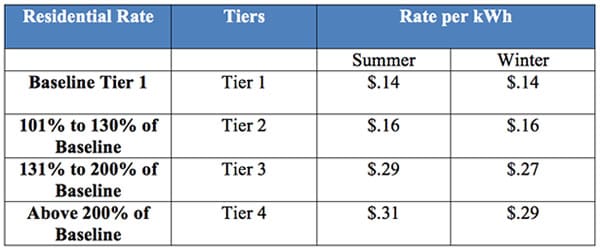
In addition to its low-income protection, the steep Tier 3 and 4 rates were seen as a way to encourage energy conservation. Creating even higher rates in Tier 4 was a way to encourage larger residential consumers to invest in more costly rooftop solar technology.
Aside from a very minor rate adjustment by way of SB 695 in 2009, the bottom tiered rates have remained the same since 2001. SB 695 allowed limited annual increases to the Tier 1 and 2 rates to account for inflation, but did not make up for the inequity created as a result of the rate freeze from 2000-2009.
The burden of paying for increases in the price of electricity over the last decade falls on customers who fall in tiers 3 and 4 of the rate structure. These tiers consist of middle-class and large families who use more energy than the minimum estimate established by the state.
From the Assembly Utilities and Commerce Committee:
According to the PUC testimony provided to the Assembly Rural Caucus, IOU electricity rates have roughly tracked inflation since 2003 and average between $0.14 and $0.16 among SCE, San Diego Gas & Electric (SDG&E), and Pacific Gas and Electric (PG&E). Yet some ratepayers, because they use more than their Tier 1 and 2 allocations, will pay more than double this because of current restrictions on rate design...For example, in Southern California Edison's (SCE’s) service territory, 66 percent of residential sales are in Tiers 1 and 2. As a result, the remaining revenue requirement is borne by the remaining 34 percent of their sales.
The issue isn’t whether low-income protection and alternative energy are positive policy goals, but whether the customers in tiers 3 and 4 can afford to subsidize the lower ratepayers as the inequity grows.As a result of rate divergence, there is a shrinking base of Tier 3 and 4 energy consumers caught in the middle of those protected by rate increase and those who can afford to invest in solar. And every time a Tier 4 ratepayer switches to solar, the pool of large low-income and middle-class ratepayers left to subsidize the bottom two tiers gets smaller.
Rising energy costs are only going to compound this problem. With rates set to rise this summer, middle-class families that comprise most of the Tier 3 and 4 customers are going to feel the pain.
But, don’t blame the utility company. The only thing IOUs can do to cover the increasing energy costs is to raise rates on a relatively small part of their customer base.
Existing law requires "the PUC to allocate a 'baseline' quantity of electricity based on 50% to 60% of average residential electricity consumption for customers served with both gas and electricity or 60% to 70% for all electric residential customers and to take climatic and seasonal variations into account.”
However, a new Assembly bill has been introduced to address the inequity between rate tiers that would:
Require the Public Utilities Commission (PUC), when it approves changes to electric service rates charged to residential customers, to determine that the changes are reasonable, including that the changes are necessary in order to ensure that the rates paid by residential customers are fair, equitable, and reflect the costs to serve those customers.
As the author, Assemblyman Perea, states in his commentary on the bill:
The energy crisis is long over, but laws meant to protect residential rate users are now preventing the CPUC from governing the rate structure and making necessary changes for the thousands of middle to low income families struggling to pay high energy costs … without legislative changes, the CPUC has only very limited ability to fix this unfair residential electric rate structure.
The bill unanimously passed in the Assembly Utilities and Commerce Committee on April 15, 2013 and was re-referred to Assembly Appropriations Committee on April 24.
For a complete summary of AB 327, including a list of supporters, opponents, and arguments in favor and against, go HERE.