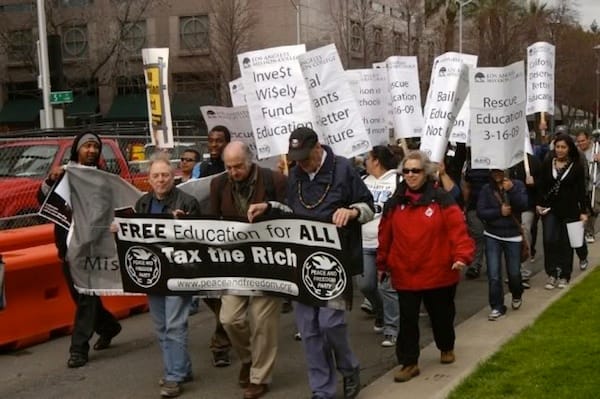
The Peace and Freedom Party Has Three Chances in California
By Benjamin Foster | 10/25/2012 | Ballot Access, California, Elections 2012, Headline, Open Primaries | 25 Comments
Californians will have the chance to cast their ballot for three Peace and Freedom Party (PFP) candidates this November. “California’s Feminist Socialist Political Party,” offer this as their platform:
“We represent the working class, those without capital in a capitalist society. We organize toward a world where cooperation replaces competition, a world where all people are fed, clothed and housed; where all women and men have equal status; where all individuals may freely endeavor to fulfill their own talents and desires; a world of freedom and peace where every community retains its cultural integrity and lives with all others in harmony.”
The PFP of California was founded in 1967. Since it’s inception, the party has averaged approximately two percent of the vote. The PFP has recently received some national attention for its 2012 presidential nominee, Rosanne Barr. Part of Barr’s presidential platform is to overturn California’s Proposition 14, the Top Two Primaries Act. Barr’s pick for vice president, Cindy Sheehan, sent this statement when questioned about the effects of the “Top Two” system:
“I think the Top Two Primary law in California is essentially an anti-democratic law that was written to ensure that only the candidates with the biggest campaign chest (probably will always be the Democratic or Republican) will go on to the general election. The law made it even harder for 3rd or Independents (unaffiliated) to get on the primary ballots, so the poorer campaigns have to spend a lot of limited time and resources on ballot access, then have little for the primary challenge. Also, now, the Peace and Freedom Party is being required to almost double our registration by 43,000 more voters by 2014, or we will lose our ballot status in California. I think its a law that needs to be overturned.”
The PFP fears this may be the last time that Californians are able to vote for a congressional or state representative from their party. Prior to the passage of California’s Proposition 14, a party qualified for the general election as long as they received two percent of the vote. In 2012, however, the November ballot is limited to the two candidates that receive the greatest number of votes in the primary.
PFP representatives Mary McIlroy, Lee Chauser, and Eugene Ruyle finished in the top two as write-in candidates. With the exception of McIlroy, the candidates strategically ran in districts in which the incumbent was unopposed. This allowed them to finish in the top two by default. Though Proposition 14 orders that write-in votes be discarded, a pending appeal has allowed the candidates to remain on the ballot this November.
Mary McIlroy is challenging Democrat Loni Hancock, the 9th State Senate District incumbent. Hancock has been serving since 2008 and prior to that served in the 14th Assembly District for six years. McIlroy hopes to unseat Hancock by appealing to working class voters. Her platform consists of “eliminating fees and tuition from California’s community colleges and universities, keeping state parks accessible, and increased taxes on the rich.” As detailed by California Secretary of State, Debra Bowen, ”124,501 votes were cast in June’s primary election. Of that, McIlroy received 0.6% of the votes and Hancock received 99.3% (Lisa Ringer, a Libertarian candidate, received the remaining 0.1%).”
Lee Chauser is running against Democratic incumbent Ricardo Lara for the 33rd California State Senate District. Chauser received three votes as a write-in candidate. Chauser speaks critically of the two major parties on his campaign website, stating:
Democrats and Republicans have not been able to make a real change. Real change, involves taking the wealth of the rich few and putting to work for the people, instead of, those rich people who don’t really need it.
In addition to taxing the rich, Chauser’s platform consist of “free tuition for all students, a fair salary for teachers and professors, and free health care, housing, and welfare.” Once a running mate of Chauser’s, Eugene Ruyle is heading a race of his own.
Ruyle is representing the PFP in California’s 15th State Assembly District. Ruyle ran for congress in 1982 as a PFP candidate while living in Long Beach, California. He has since run twice: once in California’s 10th Congressional District and once in California’s 6th Congressional District. Bowen’s website details the results of the primary, stating, “Ruyle received 0.2% of the 68,584. Current State Assembly member Nancy Skinner received the remaining 99.8% of the votes.” While speaking to Ruyle about his Assembly District race, he expressed his frustrations with California’s Top-Two open primary system:
Although it seems to widen voter choice in the primary, it actually restricts voter choice in the general election… This means that minor party candidates are essentially excluded from the election. As a result, in 2014, we don’t expect to have any Peace and Freedom Party candidates in statewide elections.
Proponents of the system, however, believe California is already experiencing increased competition and voter choice. This is explained by comparing California’s 2010 congressional elections to the elections of 2012:
“During the 2010 midterm elections just two years ago, before the new Top Two open primary took effect, out of California’s fifty-three congressional districts, exactly zero US House seats changed parties and only two new representatives were elected.”
This November, California has at least five congressional races in which incumbency is threatened. Congressional incumbents Waxman and Stark have been serving since the 1970s and are engaged in their first competitive race in decades. The marginalization of the Peace and Freedom Party remains a possibility, but so too does a less partisan, more competitive congress in California.


Leave Your Comment →
25 Comments
Jane Susskind
10.25.2012
@jsusskind
Change is not immediate. This is the first year we have had the open primary in California, and have already seen positive affects for CA voters. In a few election cycles, I think that the new system will prove to be a very successful reform.
I also have to disagree with the argument that the open primary makes it harder for third parties and independents to get on the ballot — in my opinion, making it easier for these candidates to get on the primary ballot is the first step towards getting them on the general election ballot. The fact that there are 5 Peace and Freedom candidates on the ballot speaks to the success of this reform.
Emma Goda
10.25.2012
@emmagoda
PFP is an interesting group and surprisingly they have averaged 2 percent of the vote.
Matt Metzner
10.25.2012
@mmetzner
Good for PFP for figuring out the system and getting their party on the ballot in districts where they could. This should be good for them and other 3rd parties in the future.
Lucas Eaves
10.25.2012
@lucaseaves
It is impressive to see them continue fighting even after their extremely small score in the primary. Good luck to them.
Benjamin Foster
10.25.2012
@befoster87
I agree, Lucas. Speaking with representatives of the party was inspiring. Depsite their lack of support, they remain enthusiastic about their ideals.
Chad Peace
10.25.2012
@Chad_Peace
Top-Two primary opponents argue that the new system will harm third parties. The ultimate irony is that in most states, like California, a third party or independent has NEVER won a seat. Now, California has multiple independents and Peace and Freedom candidates with a shot at actually winning office. Are the chances that third parties and independent getting to the general election ballot smaller than before? Of course, because its a “top-two” system … the chances are smaller for everyone. BUT, are the chances they actually win exponentially greater. Yes. Because the new system levels the playing field for everyone.
Bob Richard
10.25.2012
The three PFP candidates walked through an open door that will be slammed shut in future elections. Republicans and Democrats now realize that they have to put up candidates every district, even where they will clearly lose in November. This isn’t going to happen again under Top Two.
None of the four PFP write-in candidates were planning to run until PFP activists realized that only one Republican or Democrat had filed and that a write-in candidate might well come in second. Three of the four did come in second; the fourth lost to a major party write-in candidate. They, and other minor party candidates, understand that Top Two makes paying the filing fees and gathering the signatures not worth the effort, just to appear on a ballot that far fewer voters pay attention to than the November ballot. To make this worse, Top Two dramatically increases the signatures required in lieu of filing fees for minor party candidates (although it does reduce signatures required for independent candidates who can afford to pay filing fees).
Incidentally, it’s Cindy Sheehan rather than Cindy Sheen.
Benjamin Foster
10.25.2012
@befoster87
Thank you, Bob. Fixed! You highlight an important point, and that is voter choice in November.
Chad Peace
10.25.2012
@Chad_Peace
Comments like Sheens are part of the problem. She fundamentally doesn’t understand what the nonpartisan open primary did. There is not such thing as “losing ballot status” in California anymore. The rules are the same for everyone. Period. No special favors for Reps, Dems, Peace and Freedom or anyone else.
*Edit for clarification. The “ballot status” still applies as to the candidates ability to select a party for their “party preference. But, this qualification has nothing to do with the top-two system and is just a result of the existing rules that would be in place whether or not there was a new primary system.
Dave Kadlecek
10.25.2012
Actually, “ballot status” still does mean something in California, though much less than before the passage of Proposition 14.
First, election for the offices covered by Proposition 14 is not truly non-partisan, because candidates’ parties are still listed on the ballot. The candidates are no longer their parties’ nominees, but they are still representatives of their parties on the ballot. However, only candidates from ballot-qualified parties have their party listed on the ballot; others appear with “no party preference” next to their names.
(This was initially a court’s interpretation of the less than clear language of Prop 14′s original implementing language (passed at the same time Prop 14 was placed on the ballot, with the same few minutes of consideration in the middle of the night); since then, the legislature changed the Elections Code to make the law more clearly reflect the court’s earlier ruling.)
Second, ballot-qualified parties are still able to nominate candidates for President of the United States. That is still a big deal for third-party and independent presidential candidates. If petitioning as an independent presidential candidate was the only way national third party and independent presidential candidates could get on the ballot in California, as will be the case if the existing third parties lose their ballot status, California voters will almost always be limited to choosing between the Democratic and Republican Parties’ presidential candidates.
Third, ballot-qualified status still allows parties names to be listed on voter registration forms. If a party’s name isn’t listed on the form, then many (even most) less dedicated supporters will make one of the choices they can do on the form by just checking a box rather than checking “other” and writing in the name of the party.
Finally, the one positive thing (for parties) that Proposition 14′s implementing legislation did was to allow parties to list their endorsements for “voter-nominated” offices in sample ballot pamphlets. However, only ballot-qualified parties can do this.
Chad Peace
10.25.2012
@Chad_Peace
you are correct about the “ballot status” … it merely did not change as the law existed prior. The ONLY relevance this has is to the candidates desire to express a party preference on the ballot. The top-two primary has nothing to do with this qualification. These are the barriers set up under the old system that would survive regardless of the new law. This is a result of the OLD law. However, all candidates benefit from the new law that reduced the thresh hold for everyone to get on the ballot.
Thank you for clarifying this.
Alex Gauthier
10.25.2012
@alexg
you’d think a populist party would be more popular
Genevieve Santiago
10.25.2012
@gsantiago87
Nice article, Ben. It is unfortunate that the PFP candidates are not focusing on the good that this opportunity has presented. How they made the ballot is less important. They should focus on their exposure and make voters aware of the alternative ideas they have to offer.
Gary Grayson
10.25.2012
Somethang to Consider!!! Oust the Corrupt Archaic 2 primary party greedy political machines!!!
Var Enyo
10.25.2012
I voted for a independent representative but yeah, he has no chance. The phony conservative big spending republican here gets all the money.
Tim Locke
10.25.2012
while one could assume actually winning sets a clear example of such election structure, but in the end, if you can not get on the ballot, one can not win the election. Thus the ability to be on the ballot far outweighs ever winning one.
Amanda Washburn
10.25.2012
Change takes time. Vote your values and build your parties.
Daunesse Osmond
10.25.2012
Judy Ferro
10.25.2012
Near Seattle’s U of W there are two Democratic women with excellent leadership records running against each other. A hard choice whether you favor them or don’t….
Barry Short
10.25.2012
Ranked preference voting – voting for your 1st, second, third and fourth choices in order in each election – would do far more to increase small party chances. I’s easy to set up with electronic voting.
Duane Dichiara
10.25.2012
I think the real discussion here is actually whether there should be a nomination process, like we used to have, or a ‘non partisan primary’ where the top two move on regardless of party affiliation. I’m ok with the new system. See I can’t have my cake and eat it too. I think political parties are private organizations. They can ‘endorse’ or ‘nominate’ whoever they want. BUT if they are given too many ‘special’ rights the government gets to step in and regulate them. Frankly I don’t think the government should regulate political parties at all for the most part. Let us pick how we run our parties (ie no govt regulation of how we set up our local or state committees), what we spend, and so on.
C. T. Weber
10.25.2012
Parties use to pick their candidates in smoke filled rooms, out of public view or input. The partisan primaries were a progressive idea to shed light on to the process. Top two will send decisions on who the party candidates will be back behind closed doors.
Jeff Mullen
10.25.2012
I agree with ALL FOUR candidates in the third-party Presidential Debate. ALL of them, from the very Conservative Virgil Goode to the very Liberal Jill Stein, pointed out that, when you can put whatever party you want on your name on the ballot line, and only the top two vote-getters make it to the final election, it makes political parties totally meaningless and skews the election towards the candidate(s) who can spend the most on political ads.
In a few words, that would be “no.”
C. T. Weber
10.25.2012
First, let me say that I am not an independent voter. I am a partisan voter, as are nearly 80% of the voters in California. It’s immoral to design an electoral system to try and grow the 20%. I am opposed to top two. Top two reduces voters choices in the much larger, much more important general election. There are problems with our system but they are bad election laws, money, and the corporate media. What we need is a system that will allow the various constituencies to be represented in the state legislature and U.S. House in proportion to the number of votes received in the general election. We need to have districts where several members are elected from each district. That way if a party or independent candidates receives 50% of the vote that party or independent candidates get 50% of the seats, and if a party or independent candidates receives 10% of the vote that party or independent candidates get 10% of the seats. That way the majority is protected and the minorities are given voice and representation. That is a win-win election system.
Benjamin Foster
10.26.2012
@befoster87
Thank you for your contribution, C.T. Proportional representation certainly has its advantages. The disadvantage of course being fragmentation. With the kind of gridlock we saw in congress over the past 4 years makes it hard to argue against any alternative.